Event submissions
Published

This submission belongs to the session B. General: Posters of the event 6th International Electronic Conference on Medicinal Chemistry
Published date
06 Nov, 2020
Citation
Nevena Stevanović, Ivana Matić, Dragana Mitić, Božidar Čobeljić, Katarina Anđelković, Synthesis, characterization and cytotoxicity of Zn(II) complex with N-substituted glycine hydrazone, in Proceedings of 6th International Electronic Conference on Medicinal Chemistry, 1 November–30 November 2020, MDPI: Basel, Switzerland, doi: 10.3390/ECMC2020-07456
Share
Email
Facebook
Twitter
LinkedIn
Synthesis, characterization and cytotoxicity of Zn(II) complex with N-substituted glycine hydrazone
'%3e%3cpath%20d='M12.6647%2010.9104C12.4176%2010.325%2012.0589%209.7933%2011.6088%209.34485C11.16%208.89511%2010.6283%208.53653%2010.0432%208.28891C10.038%208.28629%2010.0327%208.28498%2010.0275%208.28236C10.8437%207.69282%2011.3743%206.73252%2011.3743%205.64907C11.3743%203.85423%209.92005%202.40002%208.12522%202.40002C6.33038%202.40002%204.87618%203.85423%204.87618%205.64907C4.87618%206.73252%205.40677%207.69282%206.22296%208.28367C6.21772%208.28629%206.21248%208.2876%206.20724%208.29022C5.62031%208.53783%205.09365%208.89287%204.64167%209.34616C4.19192%209.79496%203.83334%2010.3266%203.58573%2010.9117C3.34247%2011.4846%203.21128%2012.0987%203.19925%2012.721C3.1989%2012.735%203.20135%2012.7489%203.20646%2012.7619C3.21157%2012.7749%203.21924%2012.7868%203.22901%2012.7968C3.23877%2012.8068%203.25045%2012.8148%203.26334%2012.8202C3.27623%2012.8256%203.29007%2012.8284%203.30406%2012.8284H4.09012C4.14776%2012.8284%204.19362%2012.7825%204.19493%2012.7262C4.22113%2011.7148%204.62726%2010.7676%205.34519%2010.0497C6.08802%209.30686%207.07452%208.89811%208.12522%208.89811C9.17592%208.89811%2010.1624%209.30686%2010.9052%2010.0497C11.6232%2010.7676%2012.0293%2011.7148%2012.0555%2012.7262C12.0568%2012.7839%2012.1027%2012.8284%2012.1603%2012.8284H12.9464C12.9604%2012.8284%2012.9742%2012.8256%2012.9871%2012.8202C13%2012.8148%2013.0117%2012.8068%2013.0214%2012.7968C13.0312%2012.7868%2013.0389%2012.7749%2013.044%2012.7619C13.0491%2012.7489%2013.0515%2012.735%2013.0512%2012.721C13.0381%2012.0947%2012.9084%2011.4856%2012.6647%2010.9104ZM8.12522%207.90243C7.52388%207.90243%206.95792%207.66793%206.53214%207.24215C6.10636%206.81636%205.87185%206.2504%205.87185%205.64907C5.87185%205.04773%206.10636%204.48177%206.53214%204.05599C6.95792%203.63021%207.52388%203.3957%208.12522%203.3957C8.72655%203.3957%209.29252%203.63021%209.7183%204.05599C10.1441%204.48177%2010.3786%205.04773%2010.3786%205.64907C10.3786%206.2504%2010.1441%206.81636%209.7183%207.24215C9.29252%207.66793%208.72655%207.90243%208.12522%207.90243Z'%20fill='%235D1EE1'/%3e%3c/g%3e%3c/svg%3e)
Nevena Stevanović 1
Ivana Matić 2
Dragana Mitić 1
Božidar Čobeljić 3
Katarina Anđelković 3
1. Innovation center of the Faculty of Chemistry, University of Belgrade, Studentski trg 12-16, 11000 Belgrade, Serbia
2. Institute of Oncology and Radiology of Serbia, Pasterova 14, 11000 Belgrade, Serbia
3. Faculty of Chemistry, University of Belgrade, Studentski trg 12-16, 11000 Belgrade, Serbia
Abstract
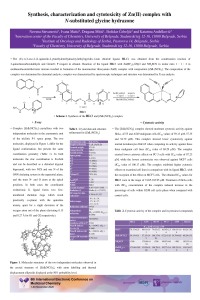
The (E)-1-(2-oxo-2-(2-(quinolin-2-ylmethylene)hydrazinyl)ethyl)pyridin-1-ium chloride ligand, HLCl , was obtained from the condensation reaction of 2-quinolinecarboxaldehyde and Girard’s P reagent in ethanol. Reaction of the ligand HLCl with Zn(BF4)2·6H2O and NH4SCN in molar ratio 1 : 1 : 2 in methanol/acetonitrile/water mixture resulted in formation of the mononuclear thiocyanato Zn(II) complex with composition [ZnL(NCS)2].
The [ZnL(NCS)2] complex has distorted trigonal bipyramidal geometry, according to the X-ray, elemental analysis, NMR and IR spectroscopy. The tridentate hydrazone ligand is coordinated in deprotonated form to the Zn(II) with a NNO set of donor atoms, while the other two coordination sites are occupied by thiocyanate ligands.
The cytotoxic effects of the complex and its precusor ligand were examined against five human malignant cell lines: cervical adenocarcinoma HeLa, melanoma A375, breast adenocarcinoma MCF7, prostate adenocarcinoma PC-3, and lung carcinoma A549, as well as against normal human keratinocyte cell line HaCaT. Zn(II) complex showed moderate cytotoxic activity against HeLa, A375, and A549 malignant cells. This complex showed lower cytotoxicity against normal keratinocytes HaCaT when comparing its activity against these three malignant cell lines. The complex exerted lower cytotoxic effect on PC-3 cells, while the lowest cytotoxicity was observed against MCF7 cells. The complex exhibited higher cytotoxic effects on examined cell lines in comparison with its ligand HLCl, with the exception of the effect on MCF7 cells. Treatment of HeLa cells with 2IC50 concentration of the complex induced increase in the percentage of cells within G2/M cell cycle phase when compared with control cells.
Keywords
characterization
cytotoxicity
Girard's P reagent
hydrazone ligand
X-ray
Zn(II) complex
Poster
Stevanovic_Synthesis_Characterization.pdf
Lead optimization in the search for new antifouling compounds
Novel BODIPYs with dimethylamine substituents and their cationic and iodinated derivatives for anticancer and antibacterial photodynamic therapy