Event submissions
Published

This submission belongs to the session B. General: Posters of the event 6th International Electronic Conference on Medicinal Chemistry
Published date
06 Nov, 2020
Citation
Elizaveta Gladkova, Arina Chepanova, Alexandra Zakharenko, Olga Luzina, New sulfonates and amides derived from berberine as Tdp1 inhibitors, in Proceedings of 6th International Electronic Conference on Medicinal Chemistry, 1 November–30 November 2020, MDPI: Basel, Switzerland, doi: 10.3390/ECMC2020-07464
Share
Email
Facebook
Twitter
LinkedIn
New sulfonates and amides derived from berberine as Tdp1 inhibitors
'%3e%3cpath%20d='M12.6647%2010.9104C12.4176%2010.325%2012.0589%209.7933%2011.6088%209.34485C11.16%208.89511%2010.6283%208.53653%2010.0432%208.28891C10.038%208.28629%2010.0327%208.28498%2010.0275%208.28236C10.8437%207.69282%2011.3743%206.73252%2011.3743%205.64907C11.3743%203.85423%209.92005%202.40002%208.12522%202.40002C6.33038%202.40002%204.87618%203.85423%204.87618%205.64907C4.87618%206.73252%205.40677%207.69282%206.22296%208.28367C6.21772%208.28629%206.21248%208.2876%206.20724%208.29022C5.62031%208.53783%205.09365%208.89287%204.64167%209.34616C4.19192%209.79496%203.83334%2010.3266%203.58573%2010.9117C3.34247%2011.4846%203.21128%2012.0987%203.19925%2012.721C3.1989%2012.735%203.20135%2012.7489%203.20646%2012.7619C3.21157%2012.7749%203.21924%2012.7868%203.22901%2012.7968C3.23877%2012.8068%203.25045%2012.8148%203.26334%2012.8202C3.27623%2012.8256%203.29007%2012.8284%203.30406%2012.8284H4.09012C4.14776%2012.8284%204.19362%2012.7825%204.19493%2012.7262C4.22113%2011.7148%204.62726%2010.7676%205.34519%2010.0497C6.08802%209.30686%207.07452%208.89811%208.12522%208.89811C9.17592%208.89811%2010.1624%209.30686%2010.9052%2010.0497C11.6232%2010.7676%2012.0293%2011.7148%2012.0555%2012.7262C12.0568%2012.7839%2012.1027%2012.8284%2012.1603%2012.8284H12.9464C12.9604%2012.8284%2012.9742%2012.8256%2012.9871%2012.8202C13%2012.8148%2013.0117%2012.8068%2013.0214%2012.7968C13.0312%2012.7868%2013.0389%2012.7749%2013.044%2012.7619C13.0491%2012.7489%2013.0515%2012.735%2013.0512%2012.721C13.0381%2012.0947%2012.9084%2011.4856%2012.6647%2010.9104ZM8.12522%207.90243C7.52388%207.90243%206.95792%207.66793%206.53214%207.24215C6.10636%206.81636%205.87185%206.2504%205.87185%205.64907C5.87185%205.04773%206.10636%204.48177%206.53214%204.05599C6.95792%203.63021%207.52388%203.3957%208.12522%203.3957C8.72655%203.3957%209.29252%203.63021%209.7183%204.05599C10.1441%204.48177%2010.3786%205.04773%2010.3786%205.64907C10.3786%206.2504%2010.1441%206.81636%209.7183%207.24215C9.29252%207.66793%208.72655%207.90243%208.12522%207.90243Z'%20fill='%235D1EE1'/%3e%3c/g%3e%3c/svg%3e)
Elizaveta Gladkova 1,2
Arina Chepanova 3
Alexandra Zakharenko 3
Olga Luzina 1
1. N. N. Vorozhtsov Novosibirsk Institute of Organic Chemistry, Siberian Branch of the Russian Academy of Sciences, 9, Akademika Lavrentieva Ave., Novosibirsk 630090, Russian Federation
2. Novosibirsk State University, Pirogova str. 1, Novosibirsk 630090, Russian Federation
3. Novosibirsk Institute of Chemical Biology and Fundamental Medicine, Siberian Branch of the Russian Academy of Sciences, 8, Akademika Lavrentieva Ave., Novosibirsk 630090, Russian Federation
Abstract
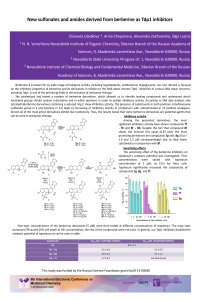
Berberine is known for its wide range of biological activity, including hypolipidemic, antibacterial, hypoglycemic, etc. Our interest is focused on the inhibitory properties of berberine and its derivatives in relation to the DNA reparation enzyme Tdp1. Inhibition of various DNA repair enzymes, including Tdp1, is one of the promising fields in the evolution of antitumor therapy.
We synthesized and tested a number of berberine derivatives, which allowed us to identify leading compounds and understand which functional groups should contain a derivative and in which positions in order to exhibit inhibitory activity. According to SAR data analysis only tetrahydroberberine derivatives containing a reduced ring C show inhibitory activity. The presence of substituents in both positions simultaneously (amide or sulfonate group in 9 and bromine in 12) leads to increasing of inhibitory activity (IC50 = 0.5 – 4 µM) in comparison with unbrominated in 12 position analogues. Almost all of the most active derivatives exhibit low cytotoxicity. Thus, the results reveal that some berberine derivatives are potential agents that can be used in antitumor therapy.
This study was funded by the Russian Science Foundation grantNo19-13-00040
Keywords
alkaloid
berberine
isoquinoline
Tdp1
tetrahydroberberrubine
Poster
Poster_Gladkova.pdf
Prevention of the probe hole clogging up during administration of nano Ag preparations in animal models of gastrointestinal diseases
Evaluation of the neuroprotective potential in MPP+ -induced neurodegeneration of the new heterocyclic compounds based on pyrazolopyridine scaffold