Event submissions
Published

This submission belongs to the session B. General: Posters of the event 6th International Electronic Conference on Medicinal Chemistry
Published date
06 Nov, 2020
Citation
Ana Catarina Sousa, Rafaela Cabral, João Costa, Maria Paula Robalo, Synthesis of 1,4-naphthoquinones derivatives under non-conventional conditions and in silico studies, in Proceedings of 6th International Electronic Conference on Medicinal Chemistry, 1 November–30 November 2020, MDPI: Basel, Switzerland, doi: 10.3390/ECMC2020-07470
Share
Email
Facebook
Twitter
LinkedIn
Synthesis of 1,4-naphthoquinones derivatives under non-conventional conditions and in silico studies

Ana Catarina Sousa 1,2
'%3e%3cpath%20d='M12.6647%2010.9104C12.4176%2010.325%2012.0589%209.7933%2011.6088%209.34485C11.16%208.89511%2010.6283%208.53653%2010.0432%208.28891C10.038%208.28629%2010.0327%208.28498%2010.0275%208.28236C10.8437%207.69282%2011.3743%206.73252%2011.3743%205.64907C11.3743%203.85423%209.92005%202.40002%208.12522%202.40002C6.33038%202.40002%204.87618%203.85423%204.87618%205.64907C4.87618%206.73252%205.40677%207.69282%206.22296%208.28367C6.21772%208.28629%206.21248%208.2876%206.20724%208.29022C5.62031%208.53783%205.09365%208.89287%204.64167%209.34616C4.19192%209.79496%203.83334%2010.3266%203.58573%2010.9117C3.34247%2011.4846%203.21128%2012.0987%203.19925%2012.721C3.1989%2012.735%203.20135%2012.7489%203.20646%2012.7619C3.21157%2012.7749%203.21924%2012.7868%203.22901%2012.7968C3.23877%2012.8068%203.25045%2012.8148%203.26334%2012.8202C3.27623%2012.8256%203.29007%2012.8284%203.30406%2012.8284H4.09012C4.14776%2012.8284%204.19362%2012.7825%204.19493%2012.7262C4.22113%2011.7148%204.62726%2010.7676%205.34519%2010.0497C6.08802%209.30686%207.07452%208.89811%208.12522%208.89811C9.17592%208.89811%2010.1624%209.30686%2010.9052%2010.0497C11.6232%2010.7676%2012.0293%2011.7148%2012.0555%2012.7262C12.0568%2012.7839%2012.1027%2012.8284%2012.1603%2012.8284H12.9464C12.9604%2012.8284%2012.9742%2012.8256%2012.9871%2012.8202C13%2012.8148%2013.0117%2012.8068%2013.0214%2012.7968C13.0312%2012.7868%2013.0389%2012.7749%2013.044%2012.7619C13.0491%2012.7489%2013.0515%2012.735%2013.0512%2012.721C13.0381%2012.0947%2012.9084%2011.4856%2012.6647%2010.9104ZM8.12522%207.90243C7.52388%207.90243%206.95792%207.66793%206.53214%207.24215C6.10636%206.81636%205.87185%206.2504%205.87185%205.64907C5.87185%205.04773%206.10636%204.48177%206.53214%204.05599C6.95792%203.63021%207.52388%203.3957%208.12522%203.3957C8.72655%203.3957%209.29252%203.63021%209.7183%204.05599C10.1441%204.48177%2010.3786%205.04773%2010.3786%205.64907C10.3786%206.2504%2010.1441%206.81636%209.7183%207.24215C9.29252%207.66793%208.72655%207.90243%208.12522%207.90243Z'%20fill='%235D1EE1'/%3e%3c/g%3e%3c/svg%3e)
Rafaela Cabral 3
João Costa 4
Maria Paula Robalo 4,5
1. DEQ, ISEL-IPL, Rua Conselheiro Emídio Navarro 1, 1959-007 Lisboa, Portugal;
2. CQE, IMS, IST-UL, Avenida Rovisco Pais, 1049-001 Lisboa, Portugal.
3. Área Departamental de Engenharia Química, Instituto Superior de Engenharia de Lisboa, Instituto Politécnico de Lisboa, 1959-007 Lisboa, Portugal.
4. Área Departamental de Engenharia Química, Instituto Superior de Engenharia de Lisboa, Instituto Politécnico de Lisboa, 1959-007 Lisboa, Portugal
5. Centro de Química Estrutural, Instituto Superior Técnico, Universidade de Lisboa, 1049-001 Lisboa, Portugal.
Abstract
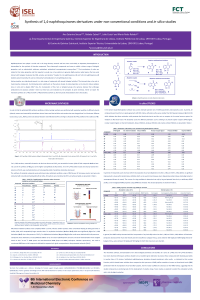
Recent trends and strategies regarding organic synthesis are focused in the development of methodologies under the green chemistry principles and with green technology, which has become a popular area of research. Microwave-assisted synthesis is considered as an important approach toward green chemistry and, nowadays, is broadly used in the pharmaceutical industry for the oriented-synthesis of targeted compounds. The energy supply is based on an oscillating magnetic fields that promotes the rotation of the polar molecules and consequently causes more interactions between molecules which promotes faster, cleaner and higher product yield reactions, when compared to conventional heating methods. Under this context we set our goal in the strategic synthesis of 1,4-naphthoquinones derivatives because of their wide range of biological and pharmaceutical properties such as anti-inflammatory, antibacterial, antitumor and other chemotherapeutic agents. Reactions conditions were optimized based on the starting 1,4-naphthoquinone and the chemical nature of coupler amines. Target compounds were produced in 10 minutes, through Michael addition to quinonoid ring and yields were depending on the chemical character of the coupler, ranging between 57 to 89%. In silico studies were performed using Molinspiration web-based tool to predict bioactivity scores, against several biological targets, and for estimation of important pharmacokinetic parameters. Toxic parameters were generated by OSIRIS data warrior software [5]. Results showed no violation to Lipinski’s rule of five (ROF) and all compounds present good values as potential kinase inhibitors.
Acknowledgements: Authors thank Fundação para a Ciência e Tecnologia for financial support through projects IUD/QUI/00100/2013, PTDC/BBB-BB/0122/2014 and RECI/QEQ-QIN/0189/2012. Authors gratefully acknowledge IST-UTL NMR and MS Networks for facilities and the analysis performed by HPLC in the pHarmaLAB laboratory funded by 9ºW program of Hovione Farmaciência S.A.
Keywords
in silico studies
microwave-assisted synthesis
1,4-naphthoquinones derivatives
Poster
ECMC_Poster_ACSousa.pdf
New procedure for the synthesis of indolo[3,2-b]quinoline derivatives with DNA G-quadruplex stabilization capacity
Functionalization of imidazo[2,1-c][1,2,4]triazine core and their evaluation in H2O2-induced oxidative stress