Event submissions
Published

This submission belongs to the session B. General: Posters of the event 6th International Electronic Conference on Medicinal Chemistry
Published date
06 Nov, 2020
Citation
Joalen Pereira do Monte, Goreti Pereira, Beate Saegesser Santos, Development of composite biomaterials based on calcium polyphosphate, alginate, and magnesium for bone tissue applications, in Proceedings of 6th International Electronic Conference on Medicinal Chemistry, 1 November–30 November 2020, MDPI: Basel, Switzerland, doi: 10.3390/ECMC2020-07474
Share
Email
Facebook
Twitter
LinkedIn
Development of composite biomaterials based on calcium polyphosphate, alginate, and magnesium for bone tissue applications
'%3e%3cpath%20d='M12.6647%2010.9104C12.4176%2010.325%2012.0589%209.7933%2011.6088%209.34485C11.16%208.89511%2010.6283%208.53653%2010.0432%208.28891C10.038%208.28629%2010.0327%208.28498%2010.0275%208.28236C10.8437%207.69282%2011.3743%206.73252%2011.3743%205.64907C11.3743%203.85423%209.92005%202.40002%208.12522%202.40002C6.33038%202.40002%204.87618%203.85423%204.87618%205.64907C4.87618%206.73252%205.40677%207.69282%206.22296%208.28367C6.21772%208.28629%206.21248%208.2876%206.20724%208.29022C5.62031%208.53783%205.09365%208.89287%204.64167%209.34616C4.19192%209.79496%203.83334%2010.3266%203.58573%2010.9117C3.34247%2011.4846%203.21128%2012.0987%203.19925%2012.721C3.1989%2012.735%203.20135%2012.7489%203.20646%2012.7619C3.21157%2012.7749%203.21924%2012.7868%203.22901%2012.7968C3.23877%2012.8068%203.25045%2012.8148%203.26334%2012.8202C3.27623%2012.8256%203.29007%2012.8284%203.30406%2012.8284H4.09012C4.14776%2012.8284%204.19362%2012.7825%204.19493%2012.7262C4.22113%2011.7148%204.62726%2010.7676%205.34519%2010.0497C6.08802%209.30686%207.07452%208.89811%208.12522%208.89811C9.17592%208.89811%2010.1624%209.30686%2010.9052%2010.0497C11.6232%2010.7676%2012.0293%2011.7148%2012.0555%2012.7262C12.0568%2012.7839%2012.1027%2012.8284%2012.1603%2012.8284H12.9464C12.9604%2012.8284%2012.9742%2012.8256%2012.9871%2012.8202C13%2012.8148%2013.0117%2012.8068%2013.0214%2012.7968C13.0312%2012.7868%2013.0389%2012.7749%2013.044%2012.7619C13.0491%2012.7489%2013.0515%2012.735%2013.0512%2012.721C13.0381%2012.0947%2012.9084%2011.4856%2012.6647%2010.9104ZM8.12522%207.90243C7.52388%207.90243%206.95792%207.66793%206.53214%207.24215C6.10636%206.81636%205.87185%206.2504%205.87185%205.64907C5.87185%205.04773%206.10636%204.48177%206.53214%204.05599C6.95792%203.63021%207.52388%203.3957%208.12522%203.3957C8.72655%203.3957%209.29252%203.63021%209.7183%204.05599C10.1441%204.48177%2010.3786%205.04773%2010.3786%205.64907C10.3786%206.2504%2010.1441%206.81636%209.7183%207.24215C9.29252%207.66793%208.72655%207.90243%208.12522%207.90243Z'%20fill='%235D1EE1'/%3e%3c/g%3e%3c/svg%3e)
Joalen Pereira do Monte 1

Goreti Pereira 1
Beate Saegesser Santos 1
1. Universidade Federal de Pernambuco
Abstract
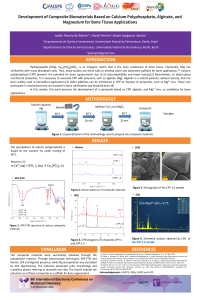
Hydroxyapatite (HAp), Ca10(PO4)6(OH)2, is an inorganic matrix that is the main constituent of bone tissue. Chemically, HAp has similarities with many phosphate salts. Thus, many studies use these salts to develop novel and optimized scaffolds for bone applications. Calcium polyphosphate (CPP) presents the potential for bone replacements due to its biocompatibility and lower toxicity. Nevertheless, to obtain good mechanical properties, it is necessary to associate CPP with polymers, such as alginate. Alginate is a natural polymer, without toxicity, that has been widely used in biomedical applications. Other additives can be introduced in CPP to improve its properties, such as Mg2+ ions. These ions participate in mechanisms that are involved in bone calcification and decalcification. In this context, this work presents the development of a composite based on CPP, alginate, and Mg2+ ions, as candidates for bone applications. The precipitation of CPP achieved the composites in an aqueous solution, containing pre-solubilized alginate, followed by the addition of Mg2+. The materials were characterized by thermogravimetric analysis, scanning electron microscopy, dispersive energy spectroscopy, x-ray diffraction, Raman, and infrared spectroscopy. The results confirmed the formation of composites with different phosphate/alginate ratios, showing a chemical composition with the potential to be evaluated for bone applications.
Keywords
biomaterial
bone tissue
calcium polyphosphate
composite
Poster
ecmc_2020_poster_joalen.pdf
Pentoxifylline and pirfenidone sensitize pancreatic cancer cells to gemcitabine treatment
Thalidomide repositioning: derivatives with promising anti- breast cancer effects