Event submissions
Published

This submission belongs to the session B. General: Posters of the event 6th International Electronic Conference on Medicinal Chemistry
Published date
06 Nov, 2020
Citation
Alexia Barbarossa, Alessia Carocci, Alessia Catalano, Jessica Ceramella, Anna Caruso, Domenico Iacopetta, Camillo Rosano, Maria Stefania Sinicropi, Carlo Franchini, Thalidomide repositioning: derivatives with promising anti- breast cancer effects, in Proceedings of 6th International Electronic Conference on Medicinal Chemistry, 1 November–30 November 2020, MDPI: Basel, Switzerland, doi: 10.3390/ECMC2020-07475
Share
Email
Facebook
Twitter
LinkedIn
Thalidomide repositioning: derivatives with promising anti- breast cancer effects
'%3e%3cpath%20d='M12.6647%2010.9104C12.4176%2010.325%2012.0589%209.7933%2011.6088%209.34485C11.16%208.89511%2010.6283%208.53653%2010.0432%208.28891C10.038%208.28629%2010.0327%208.28498%2010.0275%208.28236C10.8437%207.69282%2011.3743%206.73252%2011.3743%205.64907C11.3743%203.85423%209.92005%202.40002%208.12522%202.40002C6.33038%202.40002%204.87618%203.85423%204.87618%205.64907C4.87618%206.73252%205.40677%207.69282%206.22296%208.28367C6.21772%208.28629%206.21248%208.2876%206.20724%208.29022C5.62031%208.53783%205.09365%208.89287%204.64167%209.34616C4.19192%209.79496%203.83334%2010.3266%203.58573%2010.9117C3.34247%2011.4846%203.21128%2012.0987%203.19925%2012.721C3.1989%2012.735%203.20135%2012.7489%203.20646%2012.7619C3.21157%2012.7749%203.21924%2012.7868%203.22901%2012.7968C3.23877%2012.8068%203.25045%2012.8148%203.26334%2012.8202C3.27623%2012.8256%203.29007%2012.8284%203.30406%2012.8284H4.09012C4.14776%2012.8284%204.19362%2012.7825%204.19493%2012.7262C4.22113%2011.7148%204.62726%2010.7676%205.34519%2010.0497C6.08802%209.30686%207.07452%208.89811%208.12522%208.89811C9.17592%208.89811%2010.1624%209.30686%2010.9052%2010.0497C11.6232%2010.7676%2012.0293%2011.7148%2012.0555%2012.7262C12.0568%2012.7839%2012.1027%2012.8284%2012.1603%2012.8284H12.9464C12.9604%2012.8284%2012.9742%2012.8256%2012.9871%2012.8202C13%2012.8148%2013.0117%2012.8068%2013.0214%2012.7968C13.0312%2012.7868%2013.0389%2012.7749%2013.044%2012.7619C13.0491%2012.7489%2013.0515%2012.735%2013.0512%2012.721C13.0381%2012.0947%2012.9084%2011.4856%2012.6647%2010.9104ZM8.12522%207.90243C7.52388%207.90243%206.95792%207.66793%206.53214%207.24215C6.10636%206.81636%205.87185%206.2504%205.87185%205.64907C5.87185%205.04773%206.10636%204.48177%206.53214%204.05599C6.95792%203.63021%207.52388%203.3957%208.12522%203.3957C8.72655%203.3957%209.29252%203.63021%209.7183%204.05599C10.1441%204.48177%2010.3786%205.04773%2010.3786%205.64907C10.3786%206.2504%2010.1441%206.81636%209.7183%207.24215C9.29252%207.66793%208.72655%207.90243%208.12522%207.90243Z'%20fill='%235D1EE1'/%3e%3c/g%3e%3c/svg%3e)
Alexia Barbarossa 1
Alessia Carocci 2
Alessia Catalano 2

Jessica Ceramella 3

Anna Caruso 3

Domenico Iacopetta 3

Camillo Rosano 4

Maria Stefania Sinicropi 3
Carlo Franchini 2
1. Department of Pharmacy-Drug Sciences, via Orabona, 4, University of Bari “A. Moro”, 70126 Bari.
2. Department of Pharmacy-Drug Sciences, via Orabona, 4, University of Bari “A. Moro”, 70126 Bari
3. Department of Pharmacy, Health and Nutritional Sciences, University of Calabria, 87036, Arcavacata di Rende (Italy)
4. Biopolymers and Proteomics IRCCS, Ospedale Policlinico San Martino – IST, Largo R. Benzi 10, 16132 Genova (Italy)
Abstract
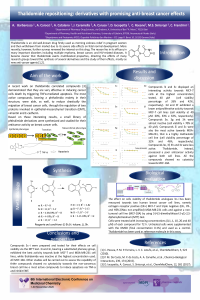
Thalidomide is an old well-known drug firstly used as morning sickness relief in pregnant women and then withdrawn from market due to its severe side effects on fetal normal development. More recently, however, further surveys renewed the interest on this drug. The reason lies in its efficacy in many important disorders including multiple myeloma, breast cancer, and HIV-related diseases. It became clearer that thalidomide exerts multifaceted properties, directing the efforts of many research groups toward the synthesis of several derivatives and the study of their effects, mostly as new anticancer agents. A recent work on thalidomide correlated compounds demonstrated that they are very effective in inducing cancer cells death by triggering TNFα-mediated apoptosis. The most active compounds, bearing a phthalimido moiety in their structure, were able, as well, to reduce drastically the migration of breast cancer cells, through the regulation of two proteins involved in epithelial-mesenchymal transition (EMT), vimentin and E-cadherin. Based on these interesting results, a small library of phthalimide derivatives were synthesized and studied for their antitumor activity on breast cancer cells, particularly on the estrogen-positive (ER+) MCF-7 and the triple negative MDA-MB-231 cells. In this study we report the interesting preliminary results of these compounds as potential new anti-breast cancer agents.
Keywords
breast cancer treatment
phthalimide derivatives
thalidomide repositioning
Poster
Barbarossa et al. Thalidomide repositionin derivatives with promising anti breast cancer effects..pdf
Development of composite biomaterials based on calcium polyphosphate, alginate, and magnesium for bone tissue applications
Antimalarial activity of novel imidazolidinedione derivatives