Event submissions
Published

This submission belongs to the session B. General: Posters of the event 6th International Electronic Conference on Medicinal Chemistry
Published date
06 Nov, 2020
Citation
Gabriel S. Oliveira, Tânia Silva, Maria Salomé Gomes, Paula Gomes, Cátia Teixeira, Designing a new antimycobacterial peptide to tackle Mycobacterium avium, in Proceedings of 6th International Electronic Conference on Medicinal Chemistry, 1 November–30 November 2020, MDPI: Basel, Switzerland, doi: 10.3390/ECMC2020-07479
Share
Email
Facebook
Twitter
LinkedIn
Designing a new antimycobacterial peptide to tackle Mycobacterium avium
'%3e%3cpath%20d='M12.6647%2010.9104C12.4176%2010.325%2012.0589%209.7933%2011.6088%209.34485C11.16%208.89511%2010.6283%208.53653%2010.0432%208.28891C10.038%208.28629%2010.0327%208.28498%2010.0275%208.28236C10.8437%207.69282%2011.3743%206.73252%2011.3743%205.64907C11.3743%203.85423%209.92005%202.40002%208.12522%202.40002C6.33038%202.40002%204.87618%203.85423%204.87618%205.64907C4.87618%206.73252%205.40677%207.69282%206.22296%208.28367C6.21772%208.28629%206.21248%208.2876%206.20724%208.29022C5.62031%208.53783%205.09365%208.89287%204.64167%209.34616C4.19192%209.79496%203.83334%2010.3266%203.58573%2010.9117C3.34247%2011.4846%203.21128%2012.0987%203.19925%2012.721C3.1989%2012.735%203.20135%2012.7489%203.20646%2012.7619C3.21157%2012.7749%203.21924%2012.7868%203.22901%2012.7968C3.23877%2012.8068%203.25045%2012.8148%203.26334%2012.8202C3.27623%2012.8256%203.29007%2012.8284%203.30406%2012.8284H4.09012C4.14776%2012.8284%204.19362%2012.7825%204.19493%2012.7262C4.22113%2011.7148%204.62726%2010.7676%205.34519%2010.0497C6.08802%209.30686%207.07452%208.89811%208.12522%208.89811C9.17592%208.89811%2010.1624%209.30686%2010.9052%2010.0497C11.6232%2010.7676%2012.0293%2011.7148%2012.0555%2012.7262C12.0568%2012.7839%2012.1027%2012.8284%2012.1603%2012.8284H12.9464C12.9604%2012.8284%2012.9742%2012.8256%2012.9871%2012.8202C13%2012.8148%2013.0117%2012.8068%2013.0214%2012.7968C13.0312%2012.7868%2013.0389%2012.7749%2013.044%2012.7619C13.0491%2012.7489%2013.0515%2012.735%2013.0512%2012.721C13.0381%2012.0947%2012.9084%2011.4856%2012.6647%2010.9104ZM8.12522%207.90243C7.52388%207.90243%206.95792%207.66793%206.53214%207.24215C6.10636%206.81636%205.87185%206.2504%205.87185%205.64907C5.87185%205.04773%206.10636%204.48177%206.53214%204.05599C6.95792%203.63021%207.52388%203.3957%208.12522%203.3957C8.72655%203.3957%209.29252%203.63021%209.7183%204.05599C10.1441%204.48177%2010.3786%205.04773%2010.3786%205.64907C10.3786%206.2504%2010.1441%206.81636%209.7183%207.24215C9.29252%207.66793%208.72655%207.90243%208.12522%207.90243Z'%20fill='%235D1EE1'/%3e%3c/g%3e%3c/svg%3e)
Gabriel S. Oliveira 1,2,3,4
Tânia Silva 1,2,3

Maria Salomé Gomes 1,2,3

Paula Gomes 4
Cátia Teixeira 4
1. ICBAS - Instituto de Ciências Biomédicas Abel Salazar da Universidade do Porto
2. i3S - Instituto de Investigação e Inovação em Saúde da Universidade do Porto
3. IBMC - Instituto de Biologia Molecular e Celular, Universidade do Porto
4. LAQV/REQUIMTE, Departamento de Química e Bioquímica, Faculdade de Ciências da Universidade do Porto
Abstract
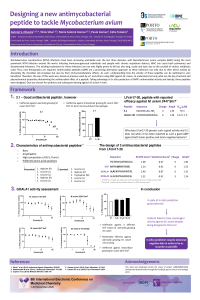
The incidence of nontuberculous mycobacteria (NTM) infections has been increasing over the last decades and the most prominent NTM infection is caused by the Mycobacterium avium complex (MAC). M. avium is considered an opportunistic pathogen, causing disease in individuals with a history of chronic lung disease or immunosuppression. Treatment of this infection requires a multi-drug regimen, lasting until the patient is culture-negative for one year. Highly toxic to the patient, it is imperative to find new antimicrobial agents.
Antimicrobial peptides (AMP) have taken the role of being the most promising substitute for antibiotics over the last few decades. Found in every living organism, they not only display direct antimicrobial efficacy against viruses, fungi and bacteria but also display anti-inflammatory, anti-cancer and wound healing properties.
Therefore, this work is aimed at testing existing peptides, with reported good activities towards Gram-positive and Gram-negative bacteria, against M. avium. Moreover, using previous knowledge on peptides with good activity against M. avium, we intended to understand what are the key structural and physicochemical properties determining the antimycobacterial effect of a peptide. Taking advantage of in silico predictors of AMP’s antimicrobial activity and toxicity, several peptides were designed and one was chosen for synthesis and for testing against M. avium in vitro.
Keywords
antimicrobial peptides
Mycobacterium avium
peptide synthesis
Poster
Poster JorgeOliveira PDF.pdf
New 5-HT1A receptor ligands as promising inhibitors of the growth of Plasmodium falciparum
Interaction between olanzapine and human serum albumin and effect of flavonoids on the binding: A spectroscopic study