Event submissions
Published

This submission belongs to the session B. General: Posters of the event 6th International Electronic Conference on Medicinal Chemistry
Published date
06 Nov, 2020
Citation
Catarina Antunes, Cristina Xavier, Júlio Oliveira, Lúcio Santos, M. Helena Vasconcelos, Pirfenidone sensitizes NSCLC cells to the antitumor effect of vinorelbine, in Proceedings of 6th International Electronic Conference on Medicinal Chemistry, 1 November–30 November 2020, MDPI: Basel, Switzerland, doi: 10.3390/ECMC2020-07481
Share
Email
Facebook
Twitter
LinkedIn
Pirfenidone sensitizes NSCLC cells to the antitumor effect of vinorelbine

Catarina Antunes 1,2,3

Cristina Xavier 1,4
'%3e%3cpath%20d='M12.6647%2010.9104C12.4176%2010.325%2012.0589%209.7933%2011.6088%209.34485C11.16%208.89511%2010.6283%208.53653%2010.0432%208.28891C10.038%208.28629%2010.0327%208.28498%2010.0275%208.28236C10.8437%207.69282%2011.3743%206.73252%2011.3743%205.64907C11.3743%203.85423%209.92005%202.40002%208.12522%202.40002C6.33038%202.40002%204.87618%203.85423%204.87618%205.64907C4.87618%206.73252%205.40677%207.69282%206.22296%208.28367C6.21772%208.28629%206.21248%208.2876%206.20724%208.29022C5.62031%208.53783%205.09365%208.89287%204.64167%209.34616C4.19192%209.79496%203.83334%2010.3266%203.58573%2010.9117C3.34247%2011.4846%203.21128%2012.0987%203.19925%2012.721C3.1989%2012.735%203.20135%2012.7489%203.20646%2012.7619C3.21157%2012.7749%203.21924%2012.7868%203.22901%2012.7968C3.23877%2012.8068%203.25045%2012.8148%203.26334%2012.8202C3.27623%2012.8256%203.29007%2012.8284%203.30406%2012.8284H4.09012C4.14776%2012.8284%204.19362%2012.7825%204.19493%2012.7262C4.22113%2011.7148%204.62726%2010.7676%205.34519%2010.0497C6.08802%209.30686%207.07452%208.89811%208.12522%208.89811C9.17592%208.89811%2010.1624%209.30686%2010.9052%2010.0497C11.6232%2010.7676%2012.0293%2011.7148%2012.0555%2012.7262C12.0568%2012.7839%2012.1027%2012.8284%2012.1603%2012.8284H12.9464C12.9604%2012.8284%2012.9742%2012.8256%2012.9871%2012.8202C13%2012.8148%2013.0117%2012.8068%2013.0214%2012.7968C13.0312%2012.7868%2013.0389%2012.7749%2013.044%2012.7619C13.0491%2012.7489%2013.0515%2012.735%2013.0512%2012.721C13.0381%2012.0947%2012.9084%2011.4856%2012.6647%2010.9104ZM8.12522%207.90243C7.52388%207.90243%206.95792%207.66793%206.53214%207.24215C6.10636%206.81636%205.87185%206.2504%205.87185%205.64907C5.87185%205.04773%206.10636%204.48177%206.53214%204.05599C6.95792%203.63021%207.52388%203.3957%208.12522%203.3957C8.72655%203.3957%209.29252%203.63021%209.7183%204.05599C10.1441%204.48177%2010.3786%205.04773%2010.3786%205.64907C10.3786%206.2504%2010.1441%206.81636%209.7183%207.24215C9.29252%207.66793%208.72655%207.90243%208.12522%207.90243Z'%20fill='%235D1EE1'/%3e%3c/g%3e%3c/svg%3e)
Júlio Oliveira 5

Lúcio Santos 6
M. Helena Vasconcelos 1,4,7
1. i3S – Instituto de Investigação e Inovação em Saúde, University of Porto, Porto, Portugal
2. Cancer Drug Resitance Group – IPATIMUP -Instituto de Patologia e Imunologia Molecular da Universidade do Porto, Porto, Portugal
3. FMUP-Faculty of Medicine of the University of Porto, Porto, Portugal
4. Cancer Drug Resitance Group –IPATIMUP-Instituto de Patologia e Imunologia Molecular da Universidade do Porto, Porto, Portugal
5. Department of Medical Oncology, IPO – Portuguese Institute of Oncology, Porto, Portugal
6. Experimental Pathology and Therapeutics Group and Surgical Oncology Department, IPO - Portuguese Institute of Oncology, Porto, Portugal
7. Department of Biological Sciences, FFUP - Faculty of Pharmacy of the University of Porto, Porto, Portugal
Abstract
Drug repurposing in cancer emerged as a strategy to identify antitumor potential in drugs clinically approved for the treatment of other diseases, offering new treatment possibilities especially for cancers with limited therapeutic alternatives, as the non-small cell lung cancer (NSCLC). Currently, vinorelbine, an anti-mitotic drug, is used for the treatment of NSCLC. The combination of vinorelbine with repurposed drugs that may increase its efficacy, with a tolerable safety profile, is an attractive therapeutic approach. Pirfenidone, an approved anti-fibrotic drug, has been previously demonstrated to sensitize different cancer cells to the effect of some anti-cancer agents. Therefore, our work aimed to assess the potential off-target effect of pirfenidone as a chemosensitizer of NSCLC cells to Vinorelbine.
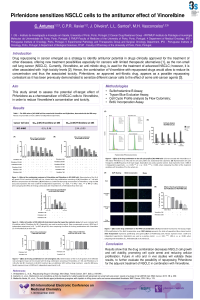
Treatment of NCI-H460 NSCLC cells with pirfenidone enhanced the sensitivity of these cells to vinorelbine (determined with the Sulforhodamine B assay). This was verified in cells treated with the GI50 concentration of Pirfenidone (2mM) with the following concentrations of vinorelbine: 7nM (GI50), 3.5 nm and 1.75 nm. The strongest combination treatment increased the % of cells in the G1 phase of the cell cycle (determined by flow cytometry) and reduced cell proliferation (assessed with the BrdU assay). Importantly, the combined treatment (vinorelbine 7nM and pirfenidone 2mM) did not show toxicity in non-tumorigenic MCF10A cells.
Future work will validate these results in other cell lines and in xenograft mice models of NSCLC, to evaluate the possibility of repurposing pirfenidone for the treatment of NSCLC in combination with Vinorelbine approved regimens.
Keywords
drug repurposing
non-small cell lung cancer
pirfenidone
vinorelbine
Poster
Poster ECMC 2020.pdf
Interaction between olanzapine and human serum albumin and effect of flavonoids on the binding: A spectroscopic study
Synthesis of new curcuminoid derivatives with potential antioxidant and hypoglycemic properties