Event submissions
Published

This submission belongs to the session B. General: Posters of the event 6th International Electronic Conference on Medicinal Chemistry
Published date
06 Nov, 2020
Citation
Catarina Henriques, Ana P. Lopes, M. Fátima M. M. Piedade, M. Paula Robalo, Synthesis of new curcuminoid derivatives with potential antioxidant and hypoglycemic properties, in Proceedings of 6th International Electronic Conference on Medicinal Chemistry, 1 November–30 November 2020, MDPI: Basel, Switzerland, doi: 10.3390/ECMC2020-07482
Share
Email
Facebook
Twitter
LinkedIn
Synthesis of new curcuminoid derivatives with potential antioxidant and hypoglycemic properties
'%3e%3cpath%20d='M12.6647%2010.9104C12.4176%2010.325%2012.0589%209.7933%2011.6088%209.34485C11.16%208.89511%2010.6283%208.53653%2010.0432%208.28891C10.038%208.28629%2010.0327%208.28498%2010.0275%208.28236C10.8437%207.69282%2011.3743%206.73252%2011.3743%205.64907C11.3743%203.85423%209.92005%202.40002%208.12522%202.40002C6.33038%202.40002%204.87618%203.85423%204.87618%205.64907C4.87618%206.73252%205.40677%207.69282%206.22296%208.28367C6.21772%208.28629%206.21248%208.2876%206.20724%208.29022C5.62031%208.53783%205.09365%208.89287%204.64167%209.34616C4.19192%209.79496%203.83334%2010.3266%203.58573%2010.9117C3.34247%2011.4846%203.21128%2012.0987%203.19925%2012.721C3.1989%2012.735%203.20135%2012.7489%203.20646%2012.7619C3.21157%2012.7749%203.21924%2012.7868%203.22901%2012.7968C3.23877%2012.8068%203.25045%2012.8148%203.26334%2012.8202C3.27623%2012.8256%203.29007%2012.8284%203.30406%2012.8284H4.09012C4.14776%2012.8284%204.19362%2012.7825%204.19493%2012.7262C4.22113%2011.7148%204.62726%2010.7676%205.34519%2010.0497C6.08802%209.30686%207.07452%208.89811%208.12522%208.89811C9.17592%208.89811%2010.1624%209.30686%2010.9052%2010.0497C11.6232%2010.7676%2012.0293%2011.7148%2012.0555%2012.7262C12.0568%2012.7839%2012.1027%2012.8284%2012.1603%2012.8284H12.9464C12.9604%2012.8284%2012.9742%2012.8256%2012.9871%2012.8202C13%2012.8148%2013.0117%2012.8068%2013.0214%2012.7968C13.0312%2012.7868%2013.0389%2012.7749%2013.044%2012.7619C13.0491%2012.7489%2013.0515%2012.735%2013.0512%2012.721C13.0381%2012.0947%2012.9084%2011.4856%2012.6647%2010.9104ZM8.12522%207.90243C7.52388%207.90243%206.95792%207.66793%206.53214%207.24215C6.10636%206.81636%205.87185%206.2504%205.87185%205.64907C5.87185%205.04773%206.10636%204.48177%206.53214%204.05599C6.95792%203.63021%207.52388%203.3957%208.12522%203.3957C8.72655%203.3957%209.29252%203.63021%209.7183%204.05599C10.1441%204.48177%2010.3786%205.04773%2010.3786%205.64907C10.3786%206.2504%2010.1441%206.81636%209.7183%207.24215C9.29252%207.66793%208.72655%207.90243%208.12522%207.90243Z'%20fill='%235D1EE1'/%3e%3c/g%3e%3c/svg%3e)
Catarina Henriques 1,2
Ana P. Lopes 1,2
M. Fátima M. M. Piedade 2,3
M. Paula Robalo 1,2
1. Área Departamental de Engenharia Química, ISEL, Instituto Politécnico de Lisboa, R. Conselheiro Emídio Navarro, 1959-007 Lisboa, Portugal
2. CQE, Complexo I, Instituto Superior Técnico da Universidade de Lisboa, Av. Rovisco Pais, 1049-001 Lisboa, Portugal
3. Departamento de Química e Bioquímica, Faculdade de Ciências da Universidade de Lisboa, Campo Grande, 1749-016 Lisboa, Portugal
Abstract
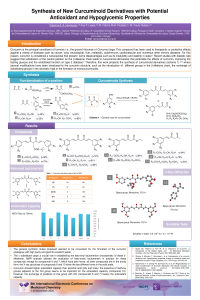
Curcumin is the principal constituent of turmeric i.e., the ground rhizomes of Curcuma longa. This compound has been used to therapeutic or protective effects against a variety of diseases such as cancer, lung, neurological, liver, metabolic, autoimmune, cardiovascular and numerous other chronic diseases. For this reason, curcumin is considered a nutraceutical that present some disadvantages such as its insolubility and stability in water. Recent studies with diabetic rats suggest that substitution of the central position on the b-diketone chain leads to curcuminoid derivatives that potentiate the effects of curcumin, improving the fasting glucose and the endothelial function on type 2 diabetes.
Therefore, this work aims to synthesize curcuminoid derivatives where several modifications have been introduced to the curcumin structure, such as the introduction of different groups in the b-diketone chain, the exchange of substituting groups in the aromatic rings or the formation of monocurcuminoids. The principal synthetic pathway is presented and the products were characterized by the usual spectroscopic and X-ray techniques. Solubility tests in aqueous media and the antioxidant activity of the curcuminoid derivatives were also performed.
Keywords
antioxidants
curcuminoids
diabetes
organic synthesis
Poster
Poster_sciforum040468.pdf
Pirfenidone sensitizes NSCLC cells to the antitumor effect of vinorelbine
Exploring the orphan GPCR GPR18 through novel synthetic cannabidiol derivatives