Event submissions
Published

This submission belongs to the session B. General: Posters of the event 6th International Electronic Conference on Medicinal Chemistry
Published date
06 Nov, 2020
Citation
Diana Zelencova-Gopejenko, Karlis Vilks, Marina Makrecka-Kuka, Edgars Liepinsh, Kristaps Jaudzems, Investigation of protective effects of fatty acid binding protein 3 against long-chain fatty acid derivative-induced damage, in Proceedings of 6th International Electronic Conference on Medicinal Chemistry, 1 November–30 November 2020, MDPI: Basel, Switzerland, doi: 10.3390/ECMC2020-07485
Share
Email
Facebook
Twitter
LinkedIn
Investigation of protective effects of fatty acid binding protein 3 against long-chain fatty acid derivative-induced damage

Diana Zelencova-Gopejenko 1
'%3e%3cpath%20d='M12.6647%2010.9104C12.4176%2010.325%2012.0589%209.7933%2011.6088%209.34485C11.16%208.89511%2010.6283%208.53653%2010.0432%208.28891C10.038%208.28629%2010.0327%208.28498%2010.0275%208.28236C10.8437%207.69282%2011.3743%206.73252%2011.3743%205.64907C11.3743%203.85423%209.92005%202.40002%208.12522%202.40002C6.33038%202.40002%204.87618%203.85423%204.87618%205.64907C4.87618%206.73252%205.40677%207.69282%206.22296%208.28367C6.21772%208.28629%206.21248%208.2876%206.20724%208.29022C5.62031%208.53783%205.09365%208.89287%204.64167%209.34616C4.19192%209.79496%203.83334%2010.3266%203.58573%2010.9117C3.34247%2011.4846%203.21128%2012.0987%203.19925%2012.721C3.1989%2012.735%203.20135%2012.7489%203.20646%2012.7619C3.21157%2012.7749%203.21924%2012.7868%203.22901%2012.7968C3.23877%2012.8068%203.25045%2012.8148%203.26334%2012.8202C3.27623%2012.8256%203.29007%2012.8284%203.30406%2012.8284H4.09012C4.14776%2012.8284%204.19362%2012.7825%204.19493%2012.7262C4.22113%2011.7148%204.62726%2010.7676%205.34519%2010.0497C6.08802%209.30686%207.07452%208.89811%208.12522%208.89811C9.17592%208.89811%2010.1624%209.30686%2010.9052%2010.0497C11.6232%2010.7676%2012.0293%2011.7148%2012.0555%2012.7262C12.0568%2012.7839%2012.1027%2012.8284%2012.1603%2012.8284H12.9464C12.9604%2012.8284%2012.9742%2012.8256%2012.9871%2012.8202C13%2012.8148%2013.0117%2012.8068%2013.0214%2012.7968C13.0312%2012.7868%2013.0389%2012.7749%2013.044%2012.7619C13.0491%2012.7489%2013.0515%2012.735%2013.0512%2012.721C13.0381%2012.0947%2012.9084%2011.4856%2012.6647%2010.9104ZM8.12522%207.90243C7.52388%207.90243%206.95792%207.66793%206.53214%207.24215C6.10636%206.81636%205.87185%206.2504%205.87185%205.64907C5.87185%205.04773%206.10636%204.48177%206.53214%204.05599C6.95792%203.63021%207.52388%203.3957%208.12522%203.3957C8.72655%203.3957%209.29252%203.63021%209.7183%204.05599C10.1441%204.48177%2010.3786%205.04773%2010.3786%205.64907C10.3786%206.2504%2010.1441%206.81636%209.7183%207.24215C9.29252%207.66793%208.72655%207.90243%208.12522%207.90243Z'%20fill='%235D1EE1'/%3e%3c/g%3e%3c/svg%3e)
Karlis Vilks 1
Marina Makrecka-Kuka 1
Edgars Liepinsh 1

Kristaps Jaudzems 1
1. Latvian Institute of Organic Synthesis
Abstract
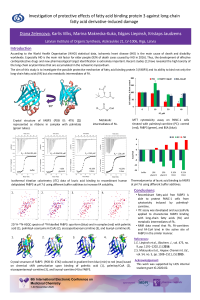
According to the World Health Organisation (WHO) statistical data, ischaemic heart disease (IHD) is the main cause of death and disability worldwide. Especially IHD is the main risk factor for elder people (93% of death cases caused by IHD in 2016). Thus, the development of effective cardioprotective drugs and new pharmacological target identification is extremely important.
Recent studies have revealed the high toxicity of the long-chain acylcarnitines that are accumulated in the ischaemic myocardium. The aim of this study is to investigate the possible protective mechanism of fatty acid binding protein 3 (FABP3) and its ability to bind not only the long-chain fatty acids (FA) but also metabolic intermediates of FA.
The lipoprotective effect of FABP3 towards acylcarnitines was observed in MTT cytotoxicity assay on PANC-1 cells. The addition of purified fatty acid-free FABP3 protected cells against cytotoxicity induced by palmitoylcarnitine.
To characterize the binding of FA and its derivatives to FABP3, an isothermal titration calorimetry (ITC) based assay was developed. It allowed stabilizing the protein and ligands in the solution under physiological pH and prevented micellization/aggregation of FA and acylcarnitines, which has substantial impact on the precision of the ITC experiments. Additionally, 2D 15N-HSQC NMR spectroscopy was used to confirm specific binding of FAs in the active site of FABP3.
Acknowledgement: this work was supported by LIOS internal student grant IG-2020-02.
Keywords
cardioprotectants
FABP3
ITC
NMR
Poster
2020_10_30_sciforum_poster.pdf
Rescuing of neuroprotective peptides by chemical conjugation with lipophilic active pharmaceutical ingredients
Design of nanoparticles functionalized with cell penetrating peptides for the treatment of Alzheimer's disease