Event submissions
Published

This submission belongs to the session B. General: Posters of the event 6th International Electronic Conference on Medicinal Chemistry
Published date
06 Nov, 2020
Citation
Laura Figuerola-Asencio, Paula Morales, Dow P. Hurst, Pingwei Zhao, Patricia H. Reggio, Mary E. Abood, Nadine Jagerovic, Ligand-based drug design approaches for the identification of novel GPR55 modulators, in Proceedings of 6th International Electronic Conference on Medicinal Chemistry, 1 November–30 November 2020, MDPI: Basel, Switzerland, doi: 10.3390/ECMC2020-07487
Share
Email
Facebook
Twitter
LinkedIn
Ligand-based drug design approaches for the identification of novel GPR55 modulators
'%3e%3cpath%20d='M12.6647%2010.9104C12.4176%2010.325%2012.0589%209.7933%2011.6088%209.34485C11.16%208.89511%2010.6283%208.53653%2010.0432%208.28891C10.038%208.28629%2010.0327%208.28498%2010.0275%208.28236C10.8437%207.69282%2011.3743%206.73252%2011.3743%205.64907C11.3743%203.85423%209.92005%202.40002%208.12522%202.40002C6.33038%202.40002%204.87618%203.85423%204.87618%205.64907C4.87618%206.73252%205.40677%207.69282%206.22296%208.28367C6.21772%208.28629%206.21248%208.2876%206.20724%208.29022C5.62031%208.53783%205.09365%208.89287%204.64167%209.34616C4.19192%209.79496%203.83334%2010.3266%203.58573%2010.9117C3.34247%2011.4846%203.21128%2012.0987%203.19925%2012.721C3.1989%2012.735%203.20135%2012.7489%203.20646%2012.7619C3.21157%2012.7749%203.21924%2012.7868%203.22901%2012.7968C3.23877%2012.8068%203.25045%2012.8148%203.26334%2012.8202C3.27623%2012.8256%203.29007%2012.8284%203.30406%2012.8284H4.09012C4.14776%2012.8284%204.19362%2012.7825%204.19493%2012.7262C4.22113%2011.7148%204.62726%2010.7676%205.34519%2010.0497C6.08802%209.30686%207.07452%208.89811%208.12522%208.89811C9.17592%208.89811%2010.1624%209.30686%2010.9052%2010.0497C11.6232%2010.7676%2012.0293%2011.7148%2012.0555%2012.7262C12.0568%2012.7839%2012.1027%2012.8284%2012.1603%2012.8284H12.9464C12.9604%2012.8284%2012.9742%2012.8256%2012.9871%2012.8202C13%2012.8148%2013.0117%2012.8068%2013.0214%2012.7968C13.0312%2012.7868%2013.0389%2012.7749%2013.044%2012.7619C13.0491%2012.7489%2013.0515%2012.735%2013.0512%2012.721C13.0381%2012.0947%2012.9084%2011.4856%2012.6647%2010.9104ZM8.12522%207.90243C7.52388%207.90243%206.95792%207.66793%206.53214%207.24215C6.10636%206.81636%205.87185%206.2504%205.87185%205.64907C5.87185%205.04773%206.10636%204.48177%206.53214%204.05599C6.95792%203.63021%207.52388%203.3957%208.12522%203.3957C8.72655%203.3957%209.29252%203.63021%209.7183%204.05599C10.1441%204.48177%2010.3786%205.04773%2010.3786%205.64907C10.3786%206.2504%2010.1441%206.81636%209.7183%207.24215C9.29252%207.66793%208.72655%207.90243%208.12522%207.90243Z'%20fill='%235D1EE1'/%3e%3c/g%3e%3c/svg%3e)
Laura Figuerola-Asencio 1
Paula Morales 1
Dow P. Hurst 2
Pingwei Zhao 3
Patricia H. Reggio 2
Mary E. Abood 3
Nadine Jagerovic 1
1. Instituto de Química Médica, Consejo Superior de Investigaciones Científicas, Madrid, Spain
2. Center for Drug Discovery, Department of Chemistry and Biochemistry, UNC Greensboro, Greensboro, NC, USA
3. Center for Substance Abuse Research, Department of Anatomy and Cell Biology, Lewis Katz School of Medicine, Temple University, Philadelphia, PA, USA
Abstract
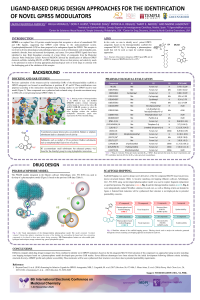
GPR55, a cannabinoid-like receptor, is involved in diverse physiological and pathophysiological conditions. It has been found to be implicated in inflammatory pain, neuropathic pain, metabolic disorder, bone and neuronal development, and cancer indicating the potential of GPR55 ligands as therapeutics. However, there is still a lack of potent and selective GPR55 ligands. These studies are based on the GPR55 antagonist ML192 previously discovered by high-throughput screening.
Using our GPR55 inactive state model, ML192 derivatives were designed, synthesized and evaluated using a β-arrestin recruitment assay in CHO cells overexpressing h-GPR55. These derivatives revealed efficacy as GPR55 antagonists. However, they did not show any increased potency compared with the hit ML192.
In an effort to discover novel potent compounds, fragment replacement core-hopping approaches were performed on the thienopyrimidine scaffold. A pharmacophore model developed upon previous SAR studies was used as core hopping input. The obtained molecules were filtered and analyzed according to different criteria including ADMET and PAINS properties.
In summary, different computer techniques and structure–activity relationship studies have been combined to identify novel potent GPR55 antagonists that may serve as new tools for studying GPR55.
Keywords
antagonist
GPR55
pharmacophore model
scaffold hopping
Poster
POSTER_ECMC_Nov_LAURAFIGUEROLA.pdf
Design of nanoparticles functionalized with cell penetrating peptides for the treatment of Alzheimer's disease
Novel bioactive nucleoside and isonucleotide analogs of therapeutic interest