Event submissions
Published

This submission belongs to the session B. General: Posters of the event 6th International Electronic Conference on Medicinal Chemistry
Published date
06 Nov, 2020
Citation
Sónia Rocha, Daniela Ribeiro, Vera L. M. Silva, Pedro M. O. Gomes, Artur M. S. Silva, Alberto N. Araújo, M. Luísa Corvo, Eduarda Fernandes, Marisa Freitas, Insight into the protein tyrosine phosphatase 1B (PTP1B) inhibitory activity of pyrazoles, in Proceedings of 6th International Electronic Conference on Medicinal Chemistry, 1 November–30 November 2020, MDPI: Basel, Switzerland, doi: 10.3390/ECMC2020-07490
Share
Email
Facebook
Twitter
LinkedIn
Insight into the protein tyrosine phosphatase 1B (PTP1B) inhibitory activity of pyrazoles
'%3e%3cpath%20d='M12.6647%2010.9104C12.4176%2010.325%2012.0589%209.7933%2011.6088%209.34485C11.16%208.89511%2010.6283%208.53653%2010.0432%208.28891C10.038%208.28629%2010.0327%208.28498%2010.0275%208.28236C10.8437%207.69282%2011.3743%206.73252%2011.3743%205.64907C11.3743%203.85423%209.92005%202.40002%208.12522%202.40002C6.33038%202.40002%204.87618%203.85423%204.87618%205.64907C4.87618%206.73252%205.40677%207.69282%206.22296%208.28367C6.21772%208.28629%206.21248%208.2876%206.20724%208.29022C5.62031%208.53783%205.09365%208.89287%204.64167%209.34616C4.19192%209.79496%203.83334%2010.3266%203.58573%2010.9117C3.34247%2011.4846%203.21128%2012.0987%203.19925%2012.721C3.1989%2012.735%203.20135%2012.7489%203.20646%2012.7619C3.21157%2012.7749%203.21924%2012.7868%203.22901%2012.7968C3.23877%2012.8068%203.25045%2012.8148%203.26334%2012.8202C3.27623%2012.8256%203.29007%2012.8284%203.30406%2012.8284H4.09012C4.14776%2012.8284%204.19362%2012.7825%204.19493%2012.7262C4.22113%2011.7148%204.62726%2010.7676%205.34519%2010.0497C6.08802%209.30686%207.07452%208.89811%208.12522%208.89811C9.17592%208.89811%2010.1624%209.30686%2010.9052%2010.0497C11.6232%2010.7676%2012.0293%2011.7148%2012.0555%2012.7262C12.0568%2012.7839%2012.1027%2012.8284%2012.1603%2012.8284H12.9464C12.9604%2012.8284%2012.9742%2012.8256%2012.9871%2012.8202C13%2012.8148%2013.0117%2012.8068%2013.0214%2012.7968C13.0312%2012.7868%2013.0389%2012.7749%2013.044%2012.7619C13.0491%2012.7489%2013.0515%2012.735%2013.0512%2012.721C13.0381%2012.0947%2012.9084%2011.4856%2012.6647%2010.9104ZM8.12522%207.90243C7.52388%207.90243%206.95792%207.66793%206.53214%207.24215C6.10636%206.81636%205.87185%206.2504%205.87185%205.64907C5.87185%205.04773%206.10636%204.48177%206.53214%204.05599C6.95792%203.63021%207.52388%203.3957%208.12522%203.3957C8.72655%203.3957%209.29252%203.63021%209.7183%204.05599C10.1441%204.48177%2010.3786%205.04773%2010.3786%205.64907C10.3786%206.2504%2010.1441%206.81636%209.7183%207.24215C9.29252%207.66793%208.72655%207.90243%208.12522%207.90243Z'%20fill='%235D1EE1'/%3e%3c/g%3e%3c/svg%3e)
Sónia Rocha 1
Daniela Ribeiro 1

Vera L. M. Silva 2
Pedro M. O. Gomes 2

Artur M. S. Silva 2

Alberto N. Araújo 1
M. Luísa Corvo 3

Eduarda Fernandes 1

Marisa Freitas 1
1. LAQV, REQUIMTE, Laboratory of Applied Chemistry, Department of Chemical Sciences, Faculty of Pharmacy, University of Porto, 4050-313 Porto, Portugal.
2. QOPNA & LAQV-REQUIMTE, Department of Chemistry, University of Aveiro, Aveiro, Portugal.
3. Research Institute for Medicines, Faculty of Pharmacy, University of Lisbon, 1649-003 Lisbon, Portugal.
Abstract
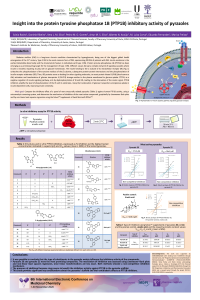
Diabetes mellitus (DM) is a long-term chronic condition characterized by hyperglycemia, being one of the biggest global health emergencies of the 21st century. Type 2 DM is the most common form of DM, representing 90-95% of patients with DM. Insulin resistance is the earliest detectable abnormality and the characteristic feature in individuals with type 2 DM. Protein tyrosine phosphatase 1B (PTP1B) has been emerging as a promising drug target for the management of type 2 DM. PTP1B plays an important role as a negative regulator of the insulin signaling pathway, which act by dephosphorylation of the insulin receptor and insulin receptor substrates, suppressing the insulin signaling cascade. In this study, a panel of 22 new potential PTP1B inhibitor pyrazoles were evaluated against human PTP1B activity. Using a microanalysis screening system, the methodology used was based on the inhibition of the hydrolysis of the substrate p-nitrophenyl phosphate (pNPP) in p-nitrophenolate, followed by reading of the absorbance at 405 nm. The mechanism of inhibition was determined graphically by Lineweaver-Burk plots and by non-linear least squares regression using the SolverTM supplement of Excel Microsoft OfficeTM. The obtained results allowed the establishment of a structure-activity rationale where the pyrazoles 5-(2-hydroxyphenyl)-3-{2-[3-(4-nitrophenyl)-1,2,3,4-tetrahydronaphthyl]}-1-phenylpyrazole and 3-(2-hydroxyphenyl)-5-{2-[3-(4-methoxyphenyl)]-naphthyl}pyrazole excelled as the most potent inhibitors of PTP1B activity, through non-competitive inhibition mechanism. The presence of additional benzene rings in the pyrazole scaffold seems to favour the inhibitory activity. Moreover, the used approach represents a significant launch for the design and assessment of novel PTP1B inhibitors.
Keywords
allosteric inhibitors
diabetes
insulin resistance
insulin signaling
protein tyrosine phosphatase 1B
pyrazoles
synthetic inhibitors
Poster
ECMC Poster Sónia Rocha.pdf
New chalcone analogues with potential bacterial efflux pump inhibitory effect
Norhierridin B, a new hierridin B-based hydroquinone with improved antiproliferative activity