Event submissions
Published

This submission belongs to the session H. Round Table on Parasitic Diseases of the event 6th International Electronic Conference on Medicinal Chemistry
Published date
06 Nov, 2020
Citation
Melanie Fonte, Natália Tassi, Diana Fontinha, Inés Bouzón-Arnáiz, Ricardo Ferraz, Maria J. Araújo, Xavier Fernàndez-Busquets, Miguel Prudêncio, Paula Gomes, Cátia Teixeira, 4,9-Diaminoacridines and 4-aminoacridines as antiplasmodial dual-stage hits, in Proceedings of 6th International Electronic Conference on Medicinal Chemistry, 1 November–30 November 2020, MDPI: Basel, Switzerland, doi: 10.3390/ECMC2020-07493
Share
Email
Facebook
Twitter
LinkedIn
4,9-Diaminoacridines and 4-aminoacridines as antiplasmodial dual-stage hits
'%3e%3cpath%20d='M12.6647%2010.9104C12.4176%2010.325%2012.0589%209.7933%2011.6088%209.34485C11.16%208.89511%2010.6283%208.53653%2010.0432%208.28891C10.038%208.28629%2010.0327%208.28498%2010.0275%208.28236C10.8437%207.69282%2011.3743%206.73252%2011.3743%205.64907C11.3743%203.85423%209.92005%202.40002%208.12522%202.40002C6.33038%202.40002%204.87618%203.85423%204.87618%205.64907C4.87618%206.73252%205.40677%207.69282%206.22296%208.28367C6.21772%208.28629%206.21248%208.2876%206.20724%208.29022C5.62031%208.53783%205.09365%208.89287%204.64167%209.34616C4.19192%209.79496%203.83334%2010.3266%203.58573%2010.9117C3.34247%2011.4846%203.21128%2012.0987%203.19925%2012.721C3.1989%2012.735%203.20135%2012.7489%203.20646%2012.7619C3.21157%2012.7749%203.21924%2012.7868%203.22901%2012.7968C3.23877%2012.8068%203.25045%2012.8148%203.26334%2012.8202C3.27623%2012.8256%203.29007%2012.8284%203.30406%2012.8284H4.09012C4.14776%2012.8284%204.19362%2012.7825%204.19493%2012.7262C4.22113%2011.7148%204.62726%2010.7676%205.34519%2010.0497C6.08802%209.30686%207.07452%208.89811%208.12522%208.89811C9.17592%208.89811%2010.1624%209.30686%2010.9052%2010.0497C11.6232%2010.7676%2012.0293%2011.7148%2012.0555%2012.7262C12.0568%2012.7839%2012.1027%2012.8284%2012.1603%2012.8284H12.9464C12.9604%2012.8284%2012.9742%2012.8256%2012.9871%2012.8202C13%2012.8148%2013.0117%2012.8068%2013.0214%2012.7968C13.0312%2012.7868%2013.0389%2012.7749%2013.044%2012.7619C13.0491%2012.7489%2013.0515%2012.735%2013.0512%2012.721C13.0381%2012.0947%2012.9084%2011.4856%2012.6647%2010.9104ZM8.12522%207.90243C7.52388%207.90243%206.95792%207.66793%206.53214%207.24215C6.10636%206.81636%205.87185%206.2504%205.87185%205.64907C5.87185%205.04773%206.10636%204.48177%206.53214%204.05599C6.95792%203.63021%207.52388%203.3957%208.12522%203.3957C8.72655%203.3957%209.29252%203.63021%209.7183%204.05599C10.1441%204.48177%2010.3786%205.04773%2010.3786%205.64907C10.3786%206.2504%2010.1441%206.81636%209.7183%207.24215C9.29252%207.66793%208.72655%207.90243%208.12522%207.90243Z'%20fill='%235D1EE1'/%3e%3c/g%3e%3c/svg%3e)
Melanie Fonte 1
Natália Tassi 2
Diana Fontinha 3
Inés Bouzón-Arnáiz 4,5

Ricardo Ferraz 2,6
Maria J. Araújo 2

Xavier Fernàndez-Busquets 4,5,7

Miguel Prudêncio 3

Paula Gomes 2
Cátia Teixeira 2
1. LAQV-REQUIMTE, Departamento de Química e Bioquímica, Faculdade de Ciências, Universidade do Porto, Portugal.
2. LAQV-REQUIMTE, Departamento de Química e Bioquímica, Faculdade de Ciências, Universidade do Porto, Portugal
3. Instituto de Medicina Molecular, Faculdade de Medicina, Universidade de Lisboa, Portugal
4. Nanomalaria Group, Institute for Bioengineering of Catalonia (IBEC), The Barcelona Institute of Science and Technology, Spain
5. Barcelona Institute for Global Health (ISGlobal), Barcelona Center for International Health Research (CRESIB), Hospital Clínic-Universitat de Barcelona, Spain
6. Ciências Químicas e das Biomoléculas, Escola Superior de Saúde, Politécnico do Porto, Portugal
7. Nanoscience and Nanotechnology Institute (IN2UB), University of Barcelona, Spain
Abstract
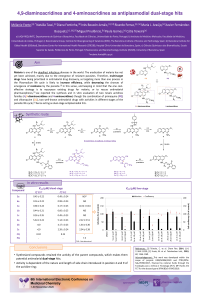
Malaria is one of the deadliest infectious diseases in the world. The eradication of malaria has not yet been achieved, mainly due to the emergence of resistant parasites. Therefore, multi-target drugs have being prioritized in antimalarial drug discovery, as targeting more than one process in the Plasmodium life cycle is likely to increase efficiency, while decreasing the chances of emergence of resistance by the parasite. In this sense, and keeping in mind that the one cost-effective strategy is to repurpose existing drugs for malaria, or to rescue antimalarial pharmacophores, we report the synthesis and in vitro evaluation of two novels acridines families (4,9-diaminoacridines and 4-aminoacridines) through the combination of primaquine (PQ) and chloroquine (CQ), two well-known antimalarial drugs with activities in different stages of the parasite life cycle. All the synthesized compounds retained the activity of the parent drugs against erythrocytic stages of P. falciparum (CQ-sensitive 3D7, and CQ-resistant W2 strains), and liver-stages of P. berghei, hence acting as dual-stage antiplasmodial hits.
Keywords
acridines
antimalarial activity
blood-stage
liver-stage
multi-target drugs
organic synthesis
Poster
2020-06-03_2.ecmc-6_ecmc-5_Poster_template (1).pdf
Synthesis and biological activity of C-glycosyl 3-vinylchromones: Toward novel antioxidant drugs
Initial steps on the synthesis of new antimicrobial fumiquinazoline related alkaloids