Event submissions
Published

This submission belongs to the session B. General: Posters of the event 6th International Electronic Conference on Medicinal Chemistry
Published date
06 Nov, 2020
Citation
Ana Rita Brás, Pedro Fernandes, Tiago Moreira, Andreia Valente, Ana Preto, Ruthenium-based agents as promising metallodrugs to fight colorectal cancer, in Proceedings of 6th International Electronic Conference on Medicinal Chemistry, 1 November–30 November 2020, MDPI: Basel, Switzerland, doi: 10.3390/ECMC2020-07502
Share
Email
Facebook
Twitter
LinkedIn
Ruthenium-based agents as promising metallodrugs to fight colorectal cancer
'%3e%3cpath%20d='M12.6647%2010.9104C12.4176%2010.325%2012.0589%209.7933%2011.6088%209.34485C11.16%208.89511%2010.6283%208.53653%2010.0432%208.28891C10.038%208.28629%2010.0327%208.28498%2010.0275%208.28236C10.8437%207.69282%2011.3743%206.73252%2011.3743%205.64907C11.3743%203.85423%209.92005%202.40002%208.12522%202.40002C6.33038%202.40002%204.87618%203.85423%204.87618%205.64907C4.87618%206.73252%205.40677%207.69282%206.22296%208.28367C6.21772%208.28629%206.21248%208.2876%206.20724%208.29022C5.62031%208.53783%205.09365%208.89287%204.64167%209.34616C4.19192%209.79496%203.83334%2010.3266%203.58573%2010.9117C3.34247%2011.4846%203.21128%2012.0987%203.19925%2012.721C3.1989%2012.735%203.20135%2012.7489%203.20646%2012.7619C3.21157%2012.7749%203.21924%2012.7868%203.22901%2012.7968C3.23877%2012.8068%203.25045%2012.8148%203.26334%2012.8202C3.27623%2012.8256%203.29007%2012.8284%203.30406%2012.8284H4.09012C4.14776%2012.8284%204.19362%2012.7825%204.19493%2012.7262C4.22113%2011.7148%204.62726%2010.7676%205.34519%2010.0497C6.08802%209.30686%207.07452%208.89811%208.12522%208.89811C9.17592%208.89811%2010.1624%209.30686%2010.9052%2010.0497C11.6232%2010.7676%2012.0293%2011.7148%2012.0555%2012.7262C12.0568%2012.7839%2012.1027%2012.8284%2012.1603%2012.8284H12.9464C12.9604%2012.8284%2012.9742%2012.8256%2012.9871%2012.8202C13%2012.8148%2013.0117%2012.8068%2013.0214%2012.7968C13.0312%2012.7868%2013.0389%2012.7749%2013.044%2012.7619C13.0491%2012.7489%2013.0515%2012.735%2013.0512%2012.721C13.0381%2012.0947%2012.9084%2011.4856%2012.6647%2010.9104ZM8.12522%207.90243C7.52388%207.90243%206.95792%207.66793%206.53214%207.24215C6.10636%206.81636%205.87185%206.2504%205.87185%205.64907C5.87185%205.04773%206.10636%204.48177%206.53214%204.05599C6.95792%203.63021%207.52388%203.3957%208.12522%203.3957C8.72655%203.3957%209.29252%203.63021%209.7183%204.05599C10.1441%204.48177%2010.3786%205.04773%2010.3786%205.64907C10.3786%206.2504%2010.1441%206.81636%209.7183%207.24215C9.29252%207.66793%208.72655%207.90243%208.12522%207.90243Z'%20fill='%235D1EE1'/%3e%3c/g%3e%3c/svg%3e)
Ana Rita Brás 1,2,3
Pedro Fernandes 1,2
Tiago Moreira 1

Andreia Valente 3

Ana Preto 1,2
1. CBMA – Centre of Molecular and Environmental Biology, University of Minho, Braga, Portugal
2. IBS-Institute of Science and Innovation for Bio-Sustainability, University of Minho, Braga, Portugal
3. CQE – Centro de Química Estrutural, Faculdade de Ciências da Universidade de Lisboa, Lisbon, Portugal
Abstract
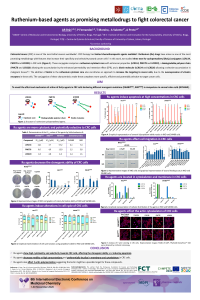
Colorectal cancer (CRC) is one of the most lethal cancers worldwide, however it has limited chemotherapeutic agents available. Besides, CRC harboring KRAS and BRAF mutations are associated with resistance to EGFR inhibitors what constitutes a relevant clinical problem. Ruthenium (Ru) drugs had arisen as one of the most promising metallodrugs with features that increase their specificity and selectivity toward cancer cells. With this in mind, a new family of Ru-cyclopentadienyl conjugates was designed using macromolecules and/or biomolecules to increase selectivity and efficiency. In this work, we used two CRC-derived cell lines with KRAS and BRAF mutations and a normal colon cell line to study antiproliferative activity, cell death mechanism, cellular migration, intracellular distribution, MAPK-ERK and PI3K-AKT signaling pathways and actin cytoskeleton effects of the compounds. Our results revealed that Ru agents are more cytotoxic for cancer cells, inhibit in a high extent the clonogenic ability, induce apoptosis and decrease motility at high concentrations and preferentially localize in membrane and cytoskeleton of CRC cells. Ru agents also affected F-actin polymerization suggesting that actin might be a possible target for these compounds. Overall our results showed that Ru compounds present promising anticancer activity in CRC cells what could bring new avenues in CRC therapy.
Acknowledgements The authors thank the Portuguese Foundation for Science and Technology (Fundação para a Ciência e Tecnologia, FCT) within the scope of projects UIDB/00100/2020 (Centro de Química Estrutural) and PTDC/QUI-QIN/28662/2017. Ana Rita Brás thanks FCT for her Ph.D. Grant (SFRH/BD/139271/2018). A. Valente acknowledges the CEECIND 2017 Initiative (CEECCIND/01974/2017).
Keywords
chemotherapy
colorectal cancer
ruthenium
Poster
ecmc-6_Ana Rita Brás Poster 29.10.20.pdf
Synthesis, pharmacological, and biological evaluation of pyridine-based MIF‑1 peptidomimetics as positive allosteric modulators of D2R
Optimizing the oxazoloisoindolinone family: Identification and biological evaluation of a potent and selective indole-based p53 activator in human colorectal cancer