Event submissions
Published

This submission belongs to the session J. Posters of the event The 1st International Electronic Conference on Catalysis Sciences
Published date
09 Nov, 2020
Citation
Anca Vasile, Florica Papa, Veronica Bratan, Mircea Teodorescu, Cornel Munteanu, Ioan Balint, Comparative Catalytic and Photocatalytic Reduction of NO₃⁻ by the in Situ Generated Solar H₂ over Pt-Cu/TiO₂ Catalysts, in Proceedings of The 1st International Electronic Conference on Catalysis Sciences, 10 November–30 November 2020, MDPI: Basel, Switzerland, doi: 10.3390/ECCS2020-07533
Share
Email
Facebook
Twitter
LinkedIn
Comparative Catalytic and Photocatalytic Reduction of NO3- by the in Situ Generated Solar H2 over Pt-Cu/TiO2 Catalysts

Anca Vasile 1

Florica Papa 1
'%3e%3cpath%20d='M12.6647%2010.9104C12.4176%2010.325%2012.0589%209.7933%2011.6088%209.34485C11.16%208.89511%2010.6283%208.53653%2010.0432%208.28891C10.038%208.28629%2010.0327%208.28498%2010.0275%208.28236C10.8437%207.69282%2011.3743%206.73252%2011.3743%205.64907C11.3743%203.85423%209.92005%202.40002%208.12522%202.40002C6.33038%202.40002%204.87618%203.85423%204.87618%205.64907C4.87618%206.73252%205.40677%207.69282%206.22296%208.28367C6.21772%208.28629%206.21248%208.2876%206.20724%208.29022C5.62031%208.53783%205.09365%208.89287%204.64167%209.34616C4.19192%209.79496%203.83334%2010.3266%203.58573%2010.9117C3.34247%2011.4846%203.21128%2012.0987%203.19925%2012.721C3.1989%2012.735%203.20135%2012.7489%203.20646%2012.7619C3.21157%2012.7749%203.21924%2012.7868%203.22901%2012.7968C3.23877%2012.8068%203.25045%2012.8148%203.26334%2012.8202C3.27623%2012.8256%203.29007%2012.8284%203.30406%2012.8284H4.09012C4.14776%2012.8284%204.19362%2012.7825%204.19493%2012.7262C4.22113%2011.7148%204.62726%2010.7676%205.34519%2010.0497C6.08802%209.30686%207.07452%208.89811%208.12522%208.89811C9.17592%208.89811%2010.1624%209.30686%2010.9052%2010.0497C11.6232%2010.7676%2012.0293%2011.7148%2012.0555%2012.7262C12.0568%2012.7839%2012.1027%2012.8284%2012.1603%2012.8284H12.9464C12.9604%2012.8284%2012.9742%2012.8256%2012.9871%2012.8202C13%2012.8148%2013.0117%2012.8068%2013.0214%2012.7968C13.0312%2012.7868%2013.0389%2012.7749%2013.044%2012.7619C13.0491%2012.7489%2013.0515%2012.735%2013.0512%2012.721C13.0381%2012.0947%2012.9084%2011.4856%2012.6647%2010.9104ZM8.12522%207.90243C7.52388%207.90243%206.95792%207.66793%206.53214%207.24215C6.10636%206.81636%205.87185%206.2504%205.87185%205.64907C5.87185%205.04773%206.10636%204.48177%206.53214%204.05599C6.95792%203.63021%207.52388%203.3957%208.12522%203.3957C8.72655%203.3957%209.29252%203.63021%209.7183%204.05599C10.1441%204.48177%2010.3786%205.04773%2010.3786%205.64907C10.3786%206.2504%2010.1441%206.81636%209.7183%207.24215C9.29252%207.66793%208.72655%207.90243%208.12522%207.90243Z'%20fill='%235D1EE1'/%3e%3c/g%3e%3c/svg%3e)
Veronica Bratan 1
Mircea Teodorescu 2
Cornel Munteanu 1

Ioan Balint 1
1. “Ilie Murgulescu” Institute of Physical Chemistry of the Romanian Academy, 202 Spl. Independentei, 060021 Bucharest, Romania, Phone: +40-21-3121147
2. University Politehnica of Bucharest, Faculty of Applied Chemistry and Materials Science, 1-7 Gh. Polizu Street, 011061 Bucharest, Romania
Abstract
Studies on the nitrate reduction reaction have shown that the bimetallic catalysts may be more efficient compared to the monometallic ones. To reduce nitrate, it is necessary to activate the precious metal by addition of a promoting second metal. Some studies have pointed out the relevance of the structure and geometry of the metal particles in the final mechanism of nitrate reduction. Well-defined nanoparticles could be used to catalyze structure-sensitive reactions with practical importance (pollution control).
Our investigation aimed to make deeper insight into NO3- catalytic reduction and photocatalytic reduction mechanisms. Two types of Pt-Cu supported on TiO2 materials were employed in order to study the nitrate removal from aqueous phase and the ability of obtaining and using the in situ generated solar H2 as reducing agent. The prepared catalysts were characterized and tested in photocatalytic/catalytic reduction of nitrate in aqueous solution in water splitting reaction. A correlation between the catalytic/photocatalytic performances of the supported Pt-Cu catalysts and their associated physicochemical and adsorption properties has been made. The catalysts activity for the nitrate reduction can be directly related to the interactions between platinum and copper. Deposition with Pt nanoparticles was found to contribute to enhance the photocatalytic activity toward H2 production from aqueous solution. Our future research aims at optimizing the photocatalytic system having as future possible applications for hydrogen production using sunlight and water as the hydrogen source.
Keywords
Pt Nanoparticles
Pt-Cu/TiO2
Catalytic reduction of nitrate
Photocatalytic water splitting
Hydrogen generation.
Poster
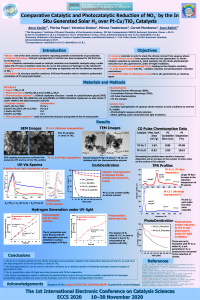
Poster_ECCS 2020_ Anca Vasile.pdf
Combined DFT and operando Spectroscopic Study of the Water-Gas Shift Reaction over Ceria based Catalysts: The Role of the Noble Metal and Ceria Faceting
Activated Biochar-Based Metal Catalysts for Steam Reforming of Pyrolysis Bio-Oil Model Compound