Event submissions
Published

This submission belongs to the session I. Invited Session. e-WSeS 2020 of the event The 1st International Electronic Conference on Catalysis Sciences
Published date
09 Nov, 2020
Citation
Giuliana P. Zugno, Paloma T. Birmann, Renata Azevedo Balaguez, Evelyn Terhaag, Fábio Zazyki Galetto, Lucielli Savegnago, In Vitro Evaluation of the Antioxidant Capacity of Molecular Hybrids Compounds of Ditert-Butylphenolic Betacalcogenamine Containing Tellurium, in Proceedings of The 1st International Electronic Conference on Catalysis Sciences, 10 November–30 November 2020, MDPI: Basel, Switzerland, doi: 10.3390/ECCS2020-07551
Share
Email
Facebook
Twitter
LinkedIn
In Vitro Evaluation of the Antioxidant Capacity of Molecular Hybrids Compounds of Ditert-Butylphenolic Betacalcogenamine Containing Tellurium
'%3e%3cpath%20d='M12.6647%2010.9104C12.4176%2010.325%2012.0589%209.7933%2011.6088%209.34485C11.16%208.89511%2010.6283%208.53653%2010.0432%208.28891C10.038%208.28629%2010.0327%208.28498%2010.0275%208.28236C10.8437%207.69282%2011.3743%206.73252%2011.3743%205.64907C11.3743%203.85423%209.92005%202.40002%208.12522%202.40002C6.33038%202.40002%204.87618%203.85423%204.87618%205.64907C4.87618%206.73252%205.40677%207.69282%206.22296%208.28367C6.21772%208.28629%206.21248%208.2876%206.20724%208.29022C5.62031%208.53783%205.09365%208.89287%204.64167%209.34616C4.19192%209.79496%203.83334%2010.3266%203.58573%2010.9117C3.34247%2011.4846%203.21128%2012.0987%203.19925%2012.721C3.1989%2012.735%203.20135%2012.7489%203.20646%2012.7619C3.21157%2012.7749%203.21924%2012.7868%203.22901%2012.7968C3.23877%2012.8068%203.25045%2012.8148%203.26334%2012.8202C3.27623%2012.8256%203.29007%2012.8284%203.30406%2012.8284H4.09012C4.14776%2012.8284%204.19362%2012.7825%204.19493%2012.7262C4.22113%2011.7148%204.62726%2010.7676%205.34519%2010.0497C6.08802%209.30686%207.07452%208.89811%208.12522%208.89811C9.17592%208.89811%2010.1624%209.30686%2010.9052%2010.0497C11.6232%2010.7676%2012.0293%2011.7148%2012.0555%2012.7262C12.0568%2012.7839%2012.1027%2012.8284%2012.1603%2012.8284H12.9464C12.9604%2012.8284%2012.9742%2012.8256%2012.9871%2012.8202C13%2012.8148%2013.0117%2012.8068%2013.0214%2012.7968C13.0312%2012.7868%2013.0389%2012.7749%2013.044%2012.7619C13.0491%2012.7489%2013.0515%2012.735%2013.0512%2012.721C13.0381%2012.0947%2012.9084%2011.4856%2012.6647%2010.9104ZM8.12522%207.90243C7.52388%207.90243%206.95792%207.66793%206.53214%207.24215C6.10636%206.81636%205.87185%206.2504%205.87185%205.64907C5.87185%205.04773%206.10636%204.48177%206.53214%204.05599C6.95792%203.63021%207.52388%203.3957%208.12522%203.3957C8.72655%203.3957%209.29252%203.63021%209.7183%204.05599C10.1441%204.48177%2010.3786%205.04773%2010.3786%205.64907C10.3786%206.2504%2010.1441%206.81636%209.7183%207.24215C9.29252%207.66793%208.72655%207.90243%208.12522%207.90243Z'%20fill='%235D1EE1'/%3e%3c/g%3e%3c/svg%3e)
Giuliana P. Zugno 1
Paloma T. Birmann 1
Renata Azevedo Balaguez 2
Evelyn Terhaag 2
Fábio Zazyki Galetto 2
Lucielli Savegnago 1
1. Research Group on Neurobiotechnology - GPN, CDTec, Federal University of Pelotas, UFPel, Pelotas, RS, Brazil
2. Laboratory of Multicomponent Synthesis - LaSIMC, Federal University of Santa Catarina, UFSC, SC, Brazil
Abstract
The antioxidant potential of phenolic compounds has been extensively investigated because oxidative stress is a hallmark of a variety of human diseases. In this study, we demonstrated antioxidant activity of the molecular hybrids compounds of di-tert-butylphenolic betacalcogenamine in 1,1-diphenyl-2-picryl-hydrazyl (DPPH•+), 2,2’-azino-bis (3-ethylbenzthiazoline-6-sulfonic acid) (ABTS+) radicals scavenging, and ferric ion reducing antioxidant power (FRAP) assays. The compounds N-cyclohexyl-2-(3,5-di-tert-butyl-4-hydroxyphenyl)-2-(N-(2-(phenyltellanyl)ethyl)acetamido)acetamide, and N-(tert-butyl)-2-(3,5-di-tert-butyl-4-hydroxyphenyl)-2-(N-(2-(phenyltellanyl)ethyl)acetamido)acetamide were diluted in dimethylsulfoxide (DMSO) and tested at 0.1 µM, 1 µM, 10 µM, 50 µM and 100 µM concentrations. All in vitro analyses were performed in triplicates and statistically analyzed using one-way ANOVA followed by Tukey’s pos hoc test. Data were presented as mean ± standard error of the mean (SEM), and the statistical significance level was set at p < 0.05. In addition, maximum inhibition (IMáx) and the half maximal inhibitory concentration (IC50) were calculated. Our data revealed that both compounds had radical scavenging efficiency in the DPPH•+, and ABTS+ assays when compared to control. In addition, in the FRAP assay, the compounds exhibited ferric-reducing ability when compared to control, reinforcing the previous results. These findings show that molecular hybrids compounds of di-tert-butylphenolic betacalcogenamine containing tellurium are promising targets for further studies regarding their antioxidant potential in the treatment of pathophysiology related to oxidative impairment.
Keywords
Tellurium
phenolic compounds
antioxidant
Poster
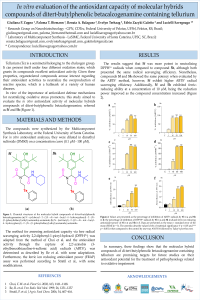
Poster - In vitro evaluation of the antioxidant capacity of molecular hybrids compounds of di-tert-butylphenolic betacalcogenamine containing tellurium_abstract_Giuliana Zugno.pdf
Distribution of Charged and Hydrophobic Amino Acids on the Surfaces of Two Types of Beta-Fructosidase from Thermotoga maritima
Paradoxical Behavior of Organodiselenides: Pro-oxidant to Antioxidant