Event submissions
Published
 10.3390/foods_2020-07590 (registering DOI)
 This submission belongs to the session 9. Innovative Food Additives and Ingredients of the event 1st International Electronic Conference on Food Science and Functional Foods
Published date
09 Nov, 2020
Citation
CLARICE SILVA E SOUZA, Pamella C. Anunciação, Ceres M. Della Lucia, Rosana G. Rodrigues das Dôres, Regina Célia R. de M. Milagres, Helena M. Pinheiro Sant'ana, Kumquat (Fortunella margarita): a good alternative for the ingestion of nutrients and bioactive compounds, in Proceedings of 1st International Electronic Conference on Food Science and Functional Foods, 10 November–25 November 2020, MDPI: Basel, Switzerland, doi: 10.3390/foods_2020-07590
Share
Email
Facebook
Twitter
LinkedIn
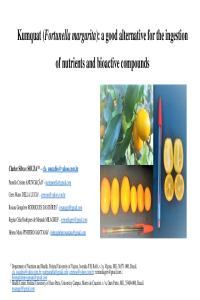
Kumquat (Fortunella margarita): a good alternative for the ingestion of nutrients and bioactive compounds
'%3e%3cpath%20d='M12.6647%2010.9104C12.4176%2010.325%2012.0589%209.7933%2011.6088%209.34485C11.16%208.89511%2010.6283%208.53653%2010.0432%208.28891C10.038%208.28629%2010.0327%208.28498%2010.0275%208.28236C10.8437%207.69282%2011.3743%206.73252%2011.3743%205.64907C11.3743%203.85423%209.92005%202.40002%208.12522%202.40002C6.33038%202.40002%204.87618%203.85423%204.87618%205.64907C4.87618%206.73252%205.40677%207.69282%206.22296%208.28367C6.21772%208.28629%206.21248%208.2876%206.20724%208.29022C5.62031%208.53783%205.09365%208.89287%204.64167%209.34616C4.19192%209.79496%203.83334%2010.3266%203.58573%2010.9117C3.34247%2011.4846%203.21128%2012.0987%203.19925%2012.721C3.1989%2012.735%203.20135%2012.7489%203.20646%2012.7619C3.21157%2012.7749%203.21924%2012.7868%203.22901%2012.7968C3.23877%2012.8068%203.25045%2012.8148%203.26334%2012.8202C3.27623%2012.8256%203.29007%2012.8284%203.30406%2012.8284H4.09012C4.14776%2012.8284%204.19362%2012.7825%204.19493%2012.7262C4.22113%2011.7148%204.62726%2010.7676%205.34519%2010.0497C6.08802%209.30686%207.07452%208.89811%208.12522%208.89811C9.17592%208.89811%2010.1624%209.30686%2010.9052%2010.0497C11.6232%2010.7676%2012.0293%2011.7148%2012.0555%2012.7262C12.0568%2012.7839%2012.1027%2012.8284%2012.1603%2012.8284H12.9464C12.9604%2012.8284%2012.9742%2012.8256%2012.9871%2012.8202C13%2012.8148%2013.0117%2012.8068%2013.0214%2012.7968C13.0312%2012.7868%2013.0389%2012.7749%2013.044%2012.7619C13.0491%2012.7489%2013.0515%2012.735%2013.0512%2012.721C13.0381%2012.0947%2012.9084%2011.4856%2012.6647%2010.9104ZM8.12522%207.90243C7.52388%207.90243%206.95792%207.66793%206.53214%207.24215C6.10636%206.81636%205.87185%206.2504%205.87185%205.64907C5.87185%205.04773%206.10636%204.48177%206.53214%204.05599C6.95792%203.63021%207.52388%203.3957%208.12522%203.3957C8.72655%203.3957%209.29252%203.63021%209.7183%204.05599C10.1441%204.48177%2010.3786%205.04773%2010.3786%205.64907C10.3786%206.2504%2010.1441%206.81636%209.7183%207.24215C9.29252%207.66793%208.72655%207.90243%208.12522%207.90243Z'%20fill='%235D1EE1'/%3e%3c/g%3e%3c/svg%3e)
CLARICE SILVA E SOUZA 1
Pamella C. Anunciação 2
Ceres M. Della Lucia 3
Rosana G. Rodrigues das Dôres 4
Regina Célia R. de M. Milagres 2
Helena M. Pinheiro Sant'ana 2
1. Szent István University, Gödöllő, Hungary
2. Universidade Federal de Viçosa, Viçosa, MG, Brasil.
3. Universidade Federal de Viçosa, Viçosa, MG, Brasil.
4. Universidade Federal de Ouro Preto, Ouro Preto, MG, Brasil.
Abstract
Citrus fruit is preferred in the choice of consumers. Kumquat (F. margarita) is an unconventional citrus of increasing consumer interest because of its exotic flavor, and its functional potential that offers health benefits to consumers. It is a fruit traditionally consumed by whole fruit (peel and pulp), giving this fruit a distinctive flavor. For this reason, this study analyzed physical, chemical and nutritional characteristics of kumquat (peel+pulp). The physicochemical analysis was performed according to the Adolfo Lutz Institute. Analysis of moisture, ashes, macronutrients and total dietary fiber was according to AOAC. Minerals were analyzed by inductively coupled plasma optical emission spectrometry. Vitamins C and E, carotenoids and flavonoids were analyzed by HPLC. Phenolic compounds (Folin-Ciocalteu) and antioxidant capacity (DPPH) were determined by spectrophotometry. The kumquat had low pH, soluble solids content and low caloric value. It was a source of dietary fiber, minerals (K, Ca, P, Mg) and carotenoids, the most expressive was α-carotene (661.81 μg.100 g-1). The ascorbic acid concentration was 2326.24 μg.100 g-1. α-tocopherol (569.00 μg.100 g-1) was the most expressive component of vitamin E. There was a presence of apigenin and eriodictyol. The fruit (peel+pulp) has a high concentration of total phenolic compounds (98.55 ± 1.93 mg GAE.100 g-1) and good antioxidant capacity (62%) was found. Kumquat is a good source of fiber and vitamin A and, due to its antioxidant capacity and the presence of other essential and beneficial nutrients for a diet, consumption of kumquat can be suggested to complement the diet. This fruit is a viable food alternative and its consumption should be encouraged, contributing as a source of income, sovereignty and food security.
Keywords
antioxidant
alternative food
citrus
HPLC
phenolic
vitamins
Manuscript
sciforum-032744_corrections.pdf
Poster
ppt 28_10_20.pdf
Effect of Packaging on Microbial Survival and Physicochemical Characteristics of Non-Thermally Preserved Green Spanish-Style Olives