Event submissions
Published

This submission belongs to the session S3. Green Polymers: Durability & Aging, Degradation & Biodegradation of the event The First International Conference on “Green” Polymer Materials 2020
Published date
09 Nov, 2020
Citation
Kyann De Smit, Yoshi Marien, Kevin Van Geem, Paul Van Steenberge, Dagmar Raphael D'hooge, Green degradable (co)polyacrylics: a kinetic Monte Carlo study, in Proceedings of The First International Conference on “Green” Polymer Materials 2020, 5 November–25 November 2020, MDPI: Basel, Switzerland, doi: 10.3390/CGPM2020-07592
Share
Email
Facebook
Twitter
LinkedIn
Green degradable (co)polyacrylics: a kinetic Monte Carlo study
'%3e%3cpath%20d='M12.6647%2010.9104C12.4176%2010.325%2012.0589%209.7933%2011.6088%209.34485C11.16%208.89511%2010.6283%208.53653%2010.0432%208.28891C10.038%208.28629%2010.0327%208.28498%2010.0275%208.28236C10.8437%207.69282%2011.3743%206.73252%2011.3743%205.64907C11.3743%203.85423%209.92005%202.40002%208.12522%202.40002C6.33038%202.40002%204.87618%203.85423%204.87618%205.64907C4.87618%206.73252%205.40677%207.69282%206.22296%208.28367C6.21772%208.28629%206.21248%208.2876%206.20724%208.29022C5.62031%208.53783%205.09365%208.89287%204.64167%209.34616C4.19192%209.79496%203.83334%2010.3266%203.58573%2010.9117C3.34247%2011.4846%203.21128%2012.0987%203.19925%2012.721C3.1989%2012.735%203.20135%2012.7489%203.20646%2012.7619C3.21157%2012.7749%203.21924%2012.7868%203.22901%2012.7968C3.23877%2012.8068%203.25045%2012.8148%203.26334%2012.8202C3.27623%2012.8256%203.29007%2012.8284%203.30406%2012.8284H4.09012C4.14776%2012.8284%204.19362%2012.7825%204.19493%2012.7262C4.22113%2011.7148%204.62726%2010.7676%205.34519%2010.0497C6.08802%209.30686%207.07452%208.89811%208.12522%208.89811C9.17592%208.89811%2010.1624%209.30686%2010.9052%2010.0497C11.6232%2010.7676%2012.0293%2011.7148%2012.0555%2012.7262C12.0568%2012.7839%2012.1027%2012.8284%2012.1603%2012.8284H12.9464C12.9604%2012.8284%2012.9742%2012.8256%2012.9871%2012.8202C13%2012.8148%2013.0117%2012.8068%2013.0214%2012.7968C13.0312%2012.7868%2013.0389%2012.7749%2013.044%2012.7619C13.0491%2012.7489%2013.0515%2012.735%2013.0512%2012.721C13.0381%2012.0947%2012.9084%2011.4856%2012.6647%2010.9104ZM8.12522%207.90243C7.52388%207.90243%206.95792%207.66793%206.53214%207.24215C6.10636%206.81636%205.87185%206.2504%205.87185%205.64907C5.87185%205.04773%206.10636%204.48177%206.53214%204.05599C6.95792%203.63021%207.52388%203.3957%208.12522%203.3957C8.72655%203.3957%209.29252%203.63021%209.7183%204.05599C10.1441%204.48177%2010.3786%205.04773%2010.3786%205.64907C10.3786%206.2504%2010.1441%206.81636%209.7183%207.24215C9.29252%207.66793%208.72655%207.90243%208.12522%207.90243Z'%20fill='%235D1EE1'/%3e%3c/g%3e%3c/svg%3e)
Kyann De Smit 1
Yoshi Marien 1

Kevin Van Geem 1
Paul Van Steenberge 1

Dagmar Raphael D'hooge 1,2
1. Laboratory for Chemical Technology (LCT), Ghent University, Technologiepark 125, 9052 Zwijnaarde, Belgium.
2. Centre for Textile Science and Engineering (CTSE), Ghent University, Technologiepark 70a, 9052 Zwijnaarde, Belgium.
Abstract
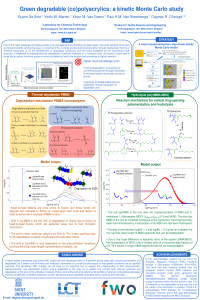
One of the major challenges for todays society is the management and handling of plastic/polymer waste. Two main solutions have been put forward towards solving this issue: (i) recycling of the currently existing bulk polymers either through mechanical, thermal or chemical treatments or (ii) the development of degradable substitutes with the same or even better properties as the conventional bulk polymers. A bottleneck in both cases is understanding the degradation of polymer materials on a molecular level, as polymer chains tend to break first at certain functional groups or structural defects of which the location and prevalence is highly important. In this work we present a unified matrix-based elementary step driven kinetic Monte Carlo (kMC) strategy modeling both for the polymerization and degradation of conventional and (bio)degradable polymer materials. This model is able to track the location and quantity of these structural defects or functional groups throughout both polymerisation and degradation. The ultimate focus is on the radical copolymerization of MMA with 2-methylene-1,3-dioxepane (MDO) and the subsequent hydrolysis of the resulting poly(MMA-MDO) toward biodegradable and functional oligomers. [1,2] We highlight the relevance of product heterogeneity resulting from batch operation and its influence on the (bio)degradation of the copolymers.
[1] D. Gigmes, P.H.M. Van Steenberge, D. Diri, D.R. D’hooge, Y. Guillaneuf, C. Lefay ‘Macromol. Rapid Commun. 2018, 39, 1800193
[2] K. De Smit, Y.W. Marien, K.M. Van Geem, P.H.M. Van Steenberge, D.R. D’hooge React. Chem. Eng. 2020. https://doi.org/10.1039/d0re00266f. in press
Keywords
stochastic modeling
macromolecular design
(bio)degradability
polymerization kinetics
Manuscript
abstractConference.pdf
Poster
posterEconference.pdf
Fabrication and Characterization of Air-jet-Spun Nanofibers and Thin Films from Corn Zein Protein for the Delivery of Therapeutic Molecules
Electrospun Silk-Cellulose Composite Nanomaterials using Ionic Liquid Regenerated Films