Event submissions
Published
 10.3390/foods_2020-07602 (registering DOI)
 This submission belongs to the session 5. Food Safety and Sustainable Development of the event 1st International Electronic Conference on Food Science and Functional Foods
Published date
09 Nov, 2020
Citation
Sofia Agriopoulou, Vasiliki Skiada, Eygenia Stamatelopoulou, Panagiotis Tsarouhas, Theodoros Varzakas, Investigation and comparison of the two dominant mono-cultivar extra virgin olive oils cultivated in the southern region of Peloponnese, according their sterolic and fatty acid profile., in Proceedings of 1st International Electronic Conference on Food Science and Functional Foods, 10 November–25 November 2020, MDPI: Basel, Switzerland, doi: 10.3390/foods_2020-07602
Share
Email
Facebook
Twitter
LinkedIn
Investigation and comparison of the two dominant mono-cultivar extra virgin olive oils cultivated in the southern region of Peloponnese, according their sterolic and fatty acid profile.

Sofia Agriopoulou 1
'%3e%3cpath%20d='M12.6647%2010.9104C12.4176%2010.325%2012.0589%209.7933%2011.6088%209.34485C11.16%208.89511%2010.6283%208.53653%2010.0432%208.28891C10.038%208.28629%2010.0327%208.28498%2010.0275%208.28236C10.8437%207.69282%2011.3743%206.73252%2011.3743%205.64907C11.3743%203.85423%209.92005%202.40002%208.12522%202.40002C6.33038%202.40002%204.87618%203.85423%204.87618%205.64907C4.87618%206.73252%205.40677%207.69282%206.22296%208.28367C6.21772%208.28629%206.21248%208.2876%206.20724%208.29022C5.62031%208.53783%205.09365%208.89287%204.64167%209.34616C4.19192%209.79496%203.83334%2010.3266%203.58573%2010.9117C3.34247%2011.4846%203.21128%2012.0987%203.19925%2012.721C3.1989%2012.735%203.20135%2012.7489%203.20646%2012.7619C3.21157%2012.7749%203.21924%2012.7868%203.22901%2012.7968C3.23877%2012.8068%203.25045%2012.8148%203.26334%2012.8202C3.27623%2012.8256%203.29007%2012.8284%203.30406%2012.8284H4.09012C4.14776%2012.8284%204.19362%2012.7825%204.19493%2012.7262C4.22113%2011.7148%204.62726%2010.7676%205.34519%2010.0497C6.08802%209.30686%207.07452%208.89811%208.12522%208.89811C9.17592%208.89811%2010.1624%209.30686%2010.9052%2010.0497C11.6232%2010.7676%2012.0293%2011.7148%2012.0555%2012.7262C12.0568%2012.7839%2012.1027%2012.8284%2012.1603%2012.8284H12.9464C12.9604%2012.8284%2012.9742%2012.8256%2012.9871%2012.8202C13%2012.8148%2013.0117%2012.8068%2013.0214%2012.7968C13.0312%2012.7868%2013.0389%2012.7749%2013.044%2012.7619C13.0491%2012.7489%2013.0515%2012.735%2013.0512%2012.721C13.0381%2012.0947%2012.9084%2011.4856%2012.6647%2010.9104ZM8.12522%207.90243C7.52388%207.90243%206.95792%207.66793%206.53214%207.24215C6.10636%206.81636%205.87185%206.2504%205.87185%205.64907C5.87185%205.04773%206.10636%204.48177%206.53214%204.05599C6.95792%203.63021%207.52388%203.3957%208.12522%203.3957C8.72655%203.3957%209.29252%203.63021%209.7183%204.05599C10.1441%204.48177%2010.3786%205.04773%2010.3786%205.64907C10.3786%206.2504%2010.1441%206.81636%209.7183%207.24215C9.29252%207.66793%208.72655%207.90243%208.12522%207.90243Z'%20fill='%235D1EE1'/%3e%3c/g%3e%3c/svg%3e)
Vasiliki Skiada 1
Eygenia Stamatelopoulou 1

Panagiotis Tsarouhas 2

Theodoros Varzakas 1
1. Department of Food Science and Technology, University of the Peloponnese, Antikalamos, 24100 Kalamata, Greece
2. Department of Supply Chain Management (Logistics), International Hellenic University, Kanellopoulou 2,
60100 Katerini, Greece
Abstract
Greece is ranked third among olive oil-producing countries, after Spain and Italy, with the region of Peloponnese representing one of the most important olive oil producing regions. However, very little information is available regarding the profile of the two major olive cultivars (cv. Koroneiki and cv. Mastoides) cultivated in the southern part of Peloponnese. Hence, the first aim of this work is to evaluate and compare the qualitative and chemical parameters of Koroneiki and Mastoides olive oils obtained from the southern region of Peloponnese and secondly to report and evaluate to what extent olive oils of cv. Koroneiki meet the requirements of the amended EU regulation in order to be classified as “Kalamata Protected Designation of Origin (PDO)” certified olive oils. Analysis of variance and principal component analysis of the 112 analyzed olive oil samples showed substantial compositional differences in the fatty acid and sterolic profile between Koroneiki and Mastoides cultivars demonstrating that those chemical parameters could be a potential indicator for olive oil discrimination in terms of their botanical origin. As far as Kalamata PDO status is concerned, the detailed analysis of the examined Koroneiki olive oil samples revealed some fluctuations from the relevant established EU regulatory limits. Results showed low concentrations of total sterols, with 66.7% of the examined samples being below the regulated set limits for Kalamata PDO status; high concentrations of campesterol, with a total of 21.7%, exceeding the legal maximum limit of 4.0%; and a slight tendency of high total erythrodiol content. As this work is the first systematic attempt focusing on the evaluation of the chemical characteristics of the two dominant olive cultivars of southern Peloponnese, further in depth research, with a higher number of samples, more examined parameters and a higher number of crop years, is under way.
Keywords
extra virgin olive oil
Koroneiki and Mastoides olive oils
chemical characteristics
total sterols
Peloponnese
Greece
Manuscript
sciforum_033270_original_Koroneiki_Mastoides_After_minor_25_10_2020-done.pdf
Poster
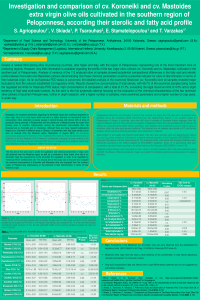
Poster_Koroneiki Mastoides_25_10_2020.pdf
Incorporation of Spirulina platensis on traditional Greek soft cheese with respect to its nutritional and sensory perspectives
Comparative ANN-TLBO and RSM optimisation approach for bioactive potential of microwave convective dried mango (Mangifera indica)