Event submissions
Published

This submission belongs to the session G. Applied Biosciences and Bioengineering of the event The 1st International Electronic Conference on Applied Sciences
Published date
09 Nov, 2020
Citation
Georgia Korompili, Labros Kokkalas, Nicolas -Alexander Tatlas, Stelios A. Mitilineos, Marios Kouvaras, Stelios M. Potirakis, Breathing sound detector as a means to identify possible apneic periods from tracheal sound recordings, in Proceedings of The 1st International Electronic Conference on Applied Sciences, 10 November–30 November 2020, MDPI: Basel, Switzerland, doi: 10.3390/ASEC2020-07603
Share
Email
Facebook
Twitter
LinkedIn
Breathing sound detector as a means to identify possible apneic periods from tracheal sound recordings
'%3e%3cpath%20d='M12.6647%2010.9104C12.4176%2010.325%2012.0589%209.7933%2011.6088%209.34485C11.16%208.89511%2010.6283%208.53653%2010.0432%208.28891C10.038%208.28629%2010.0327%208.28498%2010.0275%208.28236C10.8437%207.69282%2011.3743%206.73252%2011.3743%205.64907C11.3743%203.85423%209.92005%202.40002%208.12522%202.40002C6.33038%202.40002%204.87618%203.85423%204.87618%205.64907C4.87618%206.73252%205.40677%207.69282%206.22296%208.28367C6.21772%208.28629%206.21248%208.2876%206.20724%208.29022C5.62031%208.53783%205.09365%208.89287%204.64167%209.34616C4.19192%209.79496%203.83334%2010.3266%203.58573%2010.9117C3.34247%2011.4846%203.21128%2012.0987%203.19925%2012.721C3.1989%2012.735%203.20135%2012.7489%203.20646%2012.7619C3.21157%2012.7749%203.21924%2012.7868%203.22901%2012.7968C3.23877%2012.8068%203.25045%2012.8148%203.26334%2012.8202C3.27623%2012.8256%203.29007%2012.8284%203.30406%2012.8284H4.09012C4.14776%2012.8284%204.19362%2012.7825%204.19493%2012.7262C4.22113%2011.7148%204.62726%2010.7676%205.34519%2010.0497C6.08802%209.30686%207.07452%208.89811%208.12522%208.89811C9.17592%208.89811%2010.1624%209.30686%2010.9052%2010.0497C11.6232%2010.7676%2012.0293%2011.7148%2012.0555%2012.7262C12.0568%2012.7839%2012.1027%2012.8284%2012.1603%2012.8284H12.9464C12.9604%2012.8284%2012.9742%2012.8256%2012.9871%2012.8202C13%2012.8148%2013.0117%2012.8068%2013.0214%2012.7968C13.0312%2012.7868%2013.0389%2012.7749%2013.044%2012.7619C13.0491%2012.7489%2013.0515%2012.735%2013.0512%2012.721C13.0381%2012.0947%2012.9084%2011.4856%2012.6647%2010.9104ZM8.12522%207.90243C7.52388%207.90243%206.95792%207.66793%206.53214%207.24215C6.10636%206.81636%205.87185%206.2504%205.87185%205.64907C5.87185%205.04773%206.10636%204.48177%206.53214%204.05599C6.95792%203.63021%207.52388%203.3957%208.12522%203.3957C8.72655%203.3957%209.29252%203.63021%209.7183%204.05599C10.1441%204.48177%2010.3786%205.04773%2010.3786%205.64907C10.3786%206.2504%2010.1441%206.81636%209.7183%207.24215C9.29252%207.66793%208.72655%207.90243%208.12522%207.90243Z'%20fill='%235D1EE1'/%3e%3c/g%3e%3c/svg%3e)
Georgia Korompili 1
Labros Kokkalas 1
Nicolas -Alexander Tatlas 1
Stelios A. Mitilineos 1
Marios Kouvaras 1

Stelios M. Potirakis 1
1. Department of Electrical and Electronic Engineering, University of West Attica, Greece
Abstract
Tracheal sound represents an easily acquired and processed signal that is particularly popular in the evolution of smartphone-based systems for Sleep Apnea Syndrome (SAS) diagnosis. SAS is characterized by partial or complete breath cessation for at least 10 s. The developed algorithms mainly rely on neural networks focusing on the Apnea/Hypopnea Index (AHI) extraction; this index corresponds to the apneic episodes’ count per sleeping hour. Though reported accurate in AHI estimation, neural networks are severely affected by the inter- and intra-patient breathing sound variability. Alternatively, breathing detection algorithms can contribute in identifying the dominant sound patterns within the apnea event. Similar works propose silence detection to locate apnea onset, eventually neglecting hypopnea, often accompanied by snoring. In this work, we employ four features: zero-crossing rate, signal power, Tsallis entropy and Shannon information to discriminate breathing from silent frames. These features are extracted independently by tracheal sound recordings from 178 patients undergoing a sleep study. A candidate apnea corresponds to silence detected by at least one feature for a minimum duration of 5 s. Additionally, a reduction of the mean signal power, in the detected breathing frames, is indicative of hypopnea. The algorithm presents a maximum sensitivity per patient 98.75 % and it can locate the end of 80.45 % of all annotated episodes (32824 out of 40800) with an error less than 10 s. Despite the non-negligible number of false positive detections, the proposed algorithm proves the dominance of the described sound pattern in the majority of the apnea/hypopnea episodes.
Keywords
tracheal sound
breathing detector
apnea-hypopnea index
sleep apnea syndrome
Manuscript
038507-done.pdf
Poster
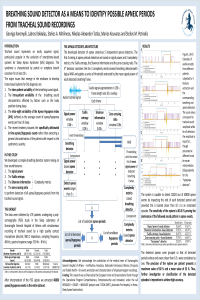
ASEC_poster_korompili.pdf
Dentin exposure after tooth preparation for porcelain laminate veneers: A microscopical analysis
Cusps deformation of MOD cavities restored with high-viscosity and low-viscosity bulk-fill composites through the bulk-fill and the incremental layering techniques