Event submissions
Published

This submission belongs to the session J. Posters of the event The 1st International Electronic Conference on Catalysis Sciences
Published date
09 Nov, 2020
Citation
Abdulhafiz Usman, Daniel Higgins, Keith Hohn, Single-Molecule Fluorescence Spectroscopy Studies of the Microenvironment of Graded Amine-Functionalized Silica Surfaces, in Proceedings of The 1st International Electronic Conference on Catalysis Sciences, 10 November–30 November 2020, MDPI: Basel, Switzerland, doi: 10.3390/ECCS2020-07607
Share
Email
Facebook
Twitter
LinkedIn
Single-Molecule Fluorescence Spectroscopy Studies of the Microenvironment of Graded Amine-Functionalized Silica Surfaces
'%3e%3cpath%20d='M12.6647%2010.9104C12.4176%2010.325%2012.0589%209.7933%2011.6088%209.34485C11.16%208.89511%2010.6283%208.53653%2010.0432%208.28891C10.038%208.28629%2010.0327%208.28498%2010.0275%208.28236C10.8437%207.69282%2011.3743%206.73252%2011.3743%205.64907C11.3743%203.85423%209.92005%202.40002%208.12522%202.40002C6.33038%202.40002%204.87618%203.85423%204.87618%205.64907C4.87618%206.73252%205.40677%207.69282%206.22296%208.28367C6.21772%208.28629%206.21248%208.2876%206.20724%208.29022C5.62031%208.53783%205.09365%208.89287%204.64167%209.34616C4.19192%209.79496%203.83334%2010.3266%203.58573%2010.9117C3.34247%2011.4846%203.21128%2012.0987%203.19925%2012.721C3.1989%2012.735%203.20135%2012.7489%203.20646%2012.7619C3.21157%2012.7749%203.21924%2012.7868%203.22901%2012.7968C3.23877%2012.8068%203.25045%2012.8148%203.26334%2012.8202C3.27623%2012.8256%203.29007%2012.8284%203.30406%2012.8284H4.09012C4.14776%2012.8284%204.19362%2012.7825%204.19493%2012.7262C4.22113%2011.7148%204.62726%2010.7676%205.34519%2010.0497C6.08802%209.30686%207.07452%208.89811%208.12522%208.89811C9.17592%208.89811%2010.1624%209.30686%2010.9052%2010.0497C11.6232%2010.7676%2012.0293%2011.7148%2012.0555%2012.7262C12.0568%2012.7839%2012.1027%2012.8284%2012.1603%2012.8284H12.9464C12.9604%2012.8284%2012.9742%2012.8256%2012.9871%2012.8202C13%2012.8148%2013.0117%2012.8068%2013.0214%2012.7968C13.0312%2012.7868%2013.0389%2012.7749%2013.044%2012.7619C13.0491%2012.7489%2013.0515%2012.735%2013.0512%2012.721C13.0381%2012.0947%2012.9084%2011.4856%2012.6647%2010.9104ZM8.12522%207.90243C7.52388%207.90243%206.95792%207.66793%206.53214%207.24215C6.10636%206.81636%205.87185%206.2504%205.87185%205.64907C5.87185%205.04773%206.10636%204.48177%206.53214%204.05599C6.95792%203.63021%207.52388%203.3957%208.12522%203.3957C8.72655%203.3957%209.29252%203.63021%209.7183%204.05599C10.1441%204.48177%2010.3786%205.04773%2010.3786%205.64907C10.3786%206.2504%2010.1441%206.81636%209.7183%207.24215C9.29252%207.66793%208.72655%207.90243%208.12522%207.90243Z'%20fill='%235D1EE1'/%3e%3c/g%3e%3c/svg%3e)
Abdulhafiz Usman 1
Daniel Higgins 1

Keith Hohn 2
1. Kansas State University
2. Miami University
Abstract
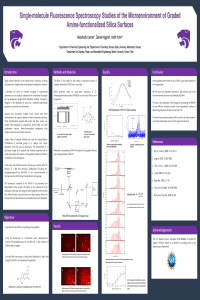
Single-molecule fluorescence spectroscopy was used to study the behavior of a 2-hydroxy substituted nile red (NR-OH) dye in silica films incorporating amine gradients. These amine gradients were made by the vapor-phase deposition of 3-aminopropyltrimethoxysilane (3-APTMOS) onto microporous silica base layers in a humidity-controlled chamber. Water contact angle and ellipsometry measurements were used to confirm the formation of amine gradients. X-ray photoelectron spectroscopy (XPS) measurement of the nitrogen content of the gradient films showed that there was a gradual decrease in the amine content of the gradient films away from the 3-APTMOS reservoir. Bulk fluorescence studies of the dye in basic media of varying strengths showed that there is a hypsochromic shift in the emission maxima of the spectra with increasing basicity. Two-color fluorescence videos acquired along the gradients showed that the fluorescence of the dye was more intense in the 580/40 nm channel (where the deprotonated form of the dye is more prevalent) than the 640/40 nm channel at the high amine end of the films. With decrease in the amine content of the films, the fluorescence of the 580/40 nm channel decreases relative to the 640/40 nm channel. This study can aid in understanding the nature of active sites of bifunctional catalysts for an aldol condensation reaction carried out at the single molecule level.
Keywords
fluorescence spectroscopy
single-molecule
catalysis
characterization
Poster
Abdulhafiz Usman.pdf
Layered Architectures Based on Transition Metals as Efficient Light Harvesters for Depollution Reactions under Sunlight Irradiation
UV-Sensitivity of Free and Immobilized on Chitosan Matrix Proteases