Event submissions
Published

This submission belongs to the session J. Posters of the event The 1st International Electronic Conference on Catalysis Sciences
Published date
09 Nov, 2020
Citation
Violeta-Carolina Niculescu, Marius Miricioiu, Amalia Soare, Adriana Marinoiu, Daniela Ion-Ebrasu, Marius Constantinescu, Felicia Bucura, SBA-3-based Nanocatalysts Application in Nile Blue Removal from Wastewater, in Proceedings of The 1st International Electronic Conference on Catalysis Sciences, 10 November–30 November 2020, MDPI: Basel, Switzerland, doi: 10.3390/ECCS2020-07619
Share
Email
Facebook
Twitter
LinkedIn
SBA-3-based Nanocatalysts Application in Nile Blue Removal from Wastewater

Violeta-Carolina Niculescu 1
'%3e%3cpath%20d='M12.6647%2010.9104C12.4176%2010.325%2012.0589%209.7933%2011.6088%209.34485C11.16%208.89511%2010.6283%208.53653%2010.0432%208.28891C10.038%208.28629%2010.0327%208.28498%2010.0275%208.28236C10.8437%207.69282%2011.3743%206.73252%2011.3743%205.64907C11.3743%203.85423%209.92005%202.40002%208.12522%202.40002C6.33038%202.40002%204.87618%203.85423%204.87618%205.64907C4.87618%206.73252%205.40677%207.69282%206.22296%208.28367C6.21772%208.28629%206.21248%208.2876%206.20724%208.29022C5.62031%208.53783%205.09365%208.89287%204.64167%209.34616C4.19192%209.79496%203.83334%2010.3266%203.58573%2010.9117C3.34247%2011.4846%203.21128%2012.0987%203.19925%2012.721C3.1989%2012.735%203.20135%2012.7489%203.20646%2012.7619C3.21157%2012.7749%203.21924%2012.7868%203.22901%2012.7968C3.23877%2012.8068%203.25045%2012.8148%203.26334%2012.8202C3.27623%2012.8256%203.29007%2012.8284%203.30406%2012.8284H4.09012C4.14776%2012.8284%204.19362%2012.7825%204.19493%2012.7262C4.22113%2011.7148%204.62726%2010.7676%205.34519%2010.0497C6.08802%209.30686%207.07452%208.89811%208.12522%208.89811C9.17592%208.89811%2010.1624%209.30686%2010.9052%2010.0497C11.6232%2010.7676%2012.0293%2011.7148%2012.0555%2012.7262C12.0568%2012.7839%2012.1027%2012.8284%2012.1603%2012.8284H12.9464C12.9604%2012.8284%2012.9742%2012.8256%2012.9871%2012.8202C13%2012.8148%2013.0117%2012.8068%2013.0214%2012.7968C13.0312%2012.7868%2013.0389%2012.7749%2013.044%2012.7619C13.0491%2012.7489%2013.0515%2012.735%2013.0512%2012.721C13.0381%2012.0947%2012.9084%2011.4856%2012.6647%2010.9104ZM8.12522%207.90243C7.52388%207.90243%206.95792%207.66793%206.53214%207.24215C6.10636%206.81636%205.87185%206.2504%205.87185%205.64907C5.87185%205.04773%206.10636%204.48177%206.53214%204.05599C6.95792%203.63021%207.52388%203.3957%208.12522%203.3957C8.72655%203.3957%209.29252%203.63021%209.7183%204.05599C10.1441%204.48177%2010.3786%205.04773%2010.3786%205.64907C10.3786%206.2504%2010.1441%206.81636%209.7183%207.24215C9.29252%207.66793%208.72655%207.90243%208.12522%207.90243Z'%20fill='%235D1EE1'/%3e%3c/g%3e%3c/svg%3e)
Marius Miricioiu 2
Amalia Soare 3

Adriana Marinoiu 3

Daniela Ion-Ebrasu 3
Marius Constantinescu 3
Felicia Bucura 3
1. National Research and Development Institute for Cryogenic and Isotopic Technologies - ICSI Ramnicu Valcea
2. National Research and Development for Cryogenics and Isotopic Technologies -ICSI Ramnicu Valcea
3. National Research and Development Institute for Cryogenics and Isotopic Technologies – ICSI Ramnicu Valcea
Abstract
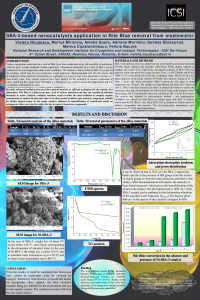
Various mesoporous molecular sites, such as SBA, have been synthesized using self-assembly of surfactants, with low and / or high molecular weight copolymers. Mesoporous molecular sieves such as SBA-3 can be synthesized at room temperature under acidic conditions. The method is similar to that of SBA-15, except for the template, which may be a low molecular weight quaternary alkylammonium salt. For this reason, the development of this material is interesting for applications in catalysis and redox deposition of metals on a nano-metric scale. Also, various catalysts have been applied for the oxidation of organic compounds in water, including the organic dyes. Nile Blue is a fluorescent dye, used in various bio-applications and it is considered a contaminant in water.
In this study, catalysts obtained by immobilisation of transitional metals on SBA-3 mesoporous silica were used to oxidize the Nile Blue from wastewater. The obtained silica support and catalysts were characterized by SEM, TG, UV-VIS, FTIR, BET surface area and pore size distribution measurements.
The oxidation was carried out in a batch reactor at room temperature and pressure. The de-colourization experiments were monitored by UV-VIS spectrophotometry. The oxidation reactions followed the first order kinetics. The catalysts could be recovered and reused.
The Nile Blue from wastewater can be oxidized by catalysts obtained by impregnation of transitional metals on SBA-3 suport, the oxidation products being less harmful for the environment and for the aquatic systems.
Keywords
dye
nanocatalyst
silica
wastewater
Manuscript
033360R.pdf
Poster
2020_V_Niculescu.pdf
Photodegradation of Ibuprofen Using Phthalocyanine–Grafted Titanium Dioxide Nanoparticles
Blue-Light-Mediated Selenealkoxilation and Selenocyclofuncionalization