Event submissions
Published
 10.3390/foods_2020-07621 (registering DOI)
 This submission belongs to the session 2. Food Packaging and New Packaging Materials of the event 1st International Electronic Conference on Food Science and Functional Foods
Published date
09 Nov, 2020
Citation
Sonia Khatun, Shaima Aktar, Zannatun Naeem, Md. Monjurul Hasan, Fawzia Adib Flowra, Md Abul Bashar, Md Tariqul Islam, Yahia Mahmud, Does vacuum packaging retain the quality of hilsa fish (Tenualosa ilisha) during long-term frozen storage?, in Proceedings of 1st International Electronic Conference on Food Science and Functional Foods, 10 November–25 November 2020, MDPI: Basel, Switzerland, doi: 10.3390/foods_2020-07621
Share
Email
Facebook
Twitter
LinkedIn
Does vacuum packaging retain the quality of hilsa fish (Tenualosa ilisha) during long-term frozen storage?
'%3e%3cpath%20d='M12.6647%2010.9104C12.4176%2010.325%2012.0589%209.7933%2011.6088%209.34485C11.16%208.89511%2010.6283%208.53653%2010.0432%208.28891C10.038%208.28629%2010.0327%208.28498%2010.0275%208.28236C10.8437%207.69282%2011.3743%206.73252%2011.3743%205.64907C11.3743%203.85423%209.92005%202.40002%208.12522%202.40002C6.33038%202.40002%204.87618%203.85423%204.87618%205.64907C4.87618%206.73252%205.40677%207.69282%206.22296%208.28367C6.21772%208.28629%206.21248%208.2876%206.20724%208.29022C5.62031%208.53783%205.09365%208.89287%204.64167%209.34616C4.19192%209.79496%203.83334%2010.3266%203.58573%2010.9117C3.34247%2011.4846%203.21128%2012.0987%203.19925%2012.721C3.1989%2012.735%203.20135%2012.7489%203.20646%2012.7619C3.21157%2012.7749%203.21924%2012.7868%203.22901%2012.7968C3.23877%2012.8068%203.25045%2012.8148%203.26334%2012.8202C3.27623%2012.8256%203.29007%2012.8284%203.30406%2012.8284H4.09012C4.14776%2012.8284%204.19362%2012.7825%204.19493%2012.7262C4.22113%2011.7148%204.62726%2010.7676%205.34519%2010.0497C6.08802%209.30686%207.07452%208.89811%208.12522%208.89811C9.17592%208.89811%2010.1624%209.30686%2010.9052%2010.0497C11.6232%2010.7676%2012.0293%2011.7148%2012.0555%2012.7262C12.0568%2012.7839%2012.1027%2012.8284%2012.1603%2012.8284H12.9464C12.9604%2012.8284%2012.9742%2012.8256%2012.9871%2012.8202C13%2012.8148%2013.0117%2012.8068%2013.0214%2012.7968C13.0312%2012.7868%2013.0389%2012.7749%2013.044%2012.7619C13.0491%2012.7489%2013.0515%2012.735%2013.0512%2012.721C13.0381%2012.0947%2012.9084%2011.4856%2012.6647%2010.9104ZM8.12522%207.90243C7.52388%207.90243%206.95792%207.66793%206.53214%207.24215C6.10636%206.81636%205.87185%206.2504%205.87185%205.64907C5.87185%205.04773%206.10636%204.48177%206.53214%204.05599C6.95792%203.63021%207.52388%203.3957%208.12522%203.3957C8.72655%203.3957%209.29252%203.63021%209.7183%204.05599C10.1441%204.48177%2010.3786%205.04773%2010.3786%205.64907C10.3786%206.2504%2010.1441%206.81636%209.7183%207.24215C9.29252%207.66793%208.72655%207.90243%208.12522%207.90243Z'%20fill='%235D1EE1'/%3e%3c/g%3e%3c/svg%3e)
Sonia Khatun 1
Shaima Aktar 1
Zannatun Naeem 1

Md. Monjurul Hasan 2
Fawzia Adib Flowra 1

Md Abul Bashar 2

Md Tariqul Islam 1
Yahia Mahmud 3
1. Department of Fisheries, University of Rajshahi, Rajshahi, Bangladesh
2. Bangladesh Fisheries Research Institute, Riverine Station, Chandpur, Bangladesh
3. Bangladesh Fisheries Research Institute, Riverine Station, Chandpur-3602, Bangladesh
Abstract
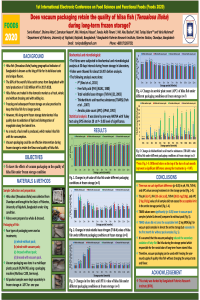
The long-term frozen storage deteriorates the quality of hilsa fish (Tenualosa ilisha), which is famous for its delicious taste and flavors. Vacuum packaging may retain the flavor and quality of hilsa fish. To this end, biochemical and microbiological analyses were used to assess the quality of hilsa fishes under whole & not sealed pack, whole & vacuum pack, dressed & not sealed pack, and dressed & vacuum pack at a monthly interval during nine months of storage at -18°C. There were no significant differences (p> 0.05) in the values of pH, free fatty acids (FFA), total volatile base nitrogen (TVB-N), and aerobic plate count (APC) among the treatments, and the values remained within the acceptable limit in the storage period. However, thiobarbituric acid reactive substances (TBARS) were significantly (p< 0.05) lower in samples under vacuum (whole & dressed) compared to unsealed pack. TBARS values did not cross the acceptable limit for vacuum pack samples in nearly the entire storage period but exceeded for unsealed pack samples within the first month. It is assumed that the vacuum packaging reduced the secondary oxidation of fatty fish like hilsa during the frozen storage, which can ensure a year-round supply of quality hilsa fish without altering the distinctive taste and flavor.
Keywords
hilsa fish
quality
vacuum packaging
rancid odor
Manuscript
sciforum_034371-done.pdf
Poster
FOODS2020_Poster_sciforum-034371_Md Tariqul Islam.pdf
Antioxidant properties of white sesame (Sesamum indicum L.) flour on human liver cells in vitro.
Critical Evaluation of Coffee Pulp as an Innovative Antioxidant Dietary Fiber Ingredient: Nutritional Value, Functional Properties, and Acute and Subchronic Toxicity