Event submissions
Published
 10.3390/foods_2020-07626 (registering DOI)
 This submission belongs to the session 3. Food Preservation: Basics and Methods of the event 1st International Electronic Conference on Food Science and Functional Foods
Published date
09 Nov, 2020
Citation
Joaquina Pinheiro, Diana I. Santos, Elsa M. Gonçalves, Marta Abreu, Margarida Moldão-Martins, Effect of heat treatment on smoothie quality by response surface methodology, in Proceedings of 1st International Electronic Conference on Food Science and Functional Foods, 10 November–25 November 2020, MDPI: Basel, Switzerland, doi: 10.3390/foods_2020-07626
Share
Email
Facebook
Twitter
LinkedIn
Effect of heat treatment on smoothie quality by response surface methodology

Joaquina Pinheiro 1
'%3e%3cpath%20d='M12.6647%2010.9104C12.4176%2010.325%2012.0589%209.7933%2011.6088%209.34485C11.16%208.89511%2010.6283%208.53653%2010.0432%208.28891C10.038%208.28629%2010.0327%208.28498%2010.0275%208.28236C10.8437%207.69282%2011.3743%206.73252%2011.3743%205.64907C11.3743%203.85423%209.92005%202.40002%208.12522%202.40002C6.33038%202.40002%204.87618%203.85423%204.87618%205.64907C4.87618%206.73252%205.40677%207.69282%206.22296%208.28367C6.21772%208.28629%206.21248%208.2876%206.20724%208.29022C5.62031%208.53783%205.09365%208.89287%204.64167%209.34616C4.19192%209.79496%203.83334%2010.3266%203.58573%2010.9117C3.34247%2011.4846%203.21128%2012.0987%203.19925%2012.721C3.1989%2012.735%203.20135%2012.7489%203.20646%2012.7619C3.21157%2012.7749%203.21924%2012.7868%203.22901%2012.7968C3.23877%2012.8068%203.25045%2012.8148%203.26334%2012.8202C3.27623%2012.8256%203.29007%2012.8284%203.30406%2012.8284H4.09012C4.14776%2012.8284%204.19362%2012.7825%204.19493%2012.7262C4.22113%2011.7148%204.62726%2010.7676%205.34519%2010.0497C6.08802%209.30686%207.07452%208.89811%208.12522%208.89811C9.17592%208.89811%2010.1624%209.30686%2010.9052%2010.0497C11.6232%2010.7676%2012.0293%2011.7148%2012.0555%2012.7262C12.0568%2012.7839%2012.1027%2012.8284%2012.1603%2012.8284H12.9464C12.9604%2012.8284%2012.9742%2012.8256%2012.9871%2012.8202C13%2012.8148%2013.0117%2012.8068%2013.0214%2012.7968C13.0312%2012.7868%2013.0389%2012.7749%2013.044%2012.7619C13.0491%2012.7489%2013.0515%2012.735%2013.0512%2012.721C13.0381%2012.0947%2012.9084%2011.4856%2012.6647%2010.9104ZM8.12522%207.90243C7.52388%207.90243%206.95792%207.66793%206.53214%207.24215C6.10636%206.81636%205.87185%206.2504%205.87185%205.64907C5.87185%205.04773%206.10636%204.48177%206.53214%204.05599C6.95792%203.63021%207.52388%203.3957%208.12522%203.3957C8.72655%203.3957%209.29252%203.63021%209.7183%204.05599C10.1441%204.48177%2010.3786%205.04773%2010.3786%205.64907C10.3786%206.2504%2010.1441%206.81636%209.7183%207.24215C9.29252%207.66793%208.72655%207.90243%208.12522%207.90243Z'%20fill='%235D1EE1'/%3e%3c/g%3e%3c/svg%3e)
Diana I. Santos 2

Elsa M. Gonçalves 3,4
Marta Abreu 3,5
Margarida Moldão-Martins 5
1. MARE - Marine and Environmental Sciences Centre, School of Tourism and Maritime Technology, Polytechnic of Leiria
2. LEAF, Linking Landscape, Environment, Agriculture and Food, Instituto Superior de Agronomia
3. UTI—Unidade de Tecnologia e Inovação, Instituto Nacional de Investigação Veterinária e Agrária
4. GeoBiotec—GeoBioTec Research Institute
5. LEAF, Linking Landscape, Environment, Agriculture and Food
Abstract
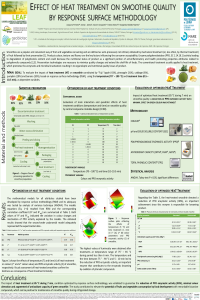
Smoothies are a popular and convenient way for bioactive compounds consumption from fruits and vegetables such as, total phenolics, carotenoids and flavonoids, being the preservation treatment an important action to guarantee the safety and extension of shelf-life. The main goal of this study was to evaluate the impact of heat treatment (HT) on smoothie prepared with “Fuji “apple (41%), pineapple (31%), cabbage (8%), pumpkin (10% ) and banana (10%), by response surface methodology (RSM), where the temperature (70 – 100 ºC) and treatment time (0.5 – 10.5 min), were the dependent variables.
After optimization of HT conditions, a validation assay was performed to guarantee the minimal changes on colour and reduction of 90 % of polyphenoloxidase enzyme (PPO). Antioxidant activity (FRAP, DPPH, ABTS), total phenolics content (TPC), pH and solids soluble content, were also analysed. Predicted models of colour parameters (L*, a*, ºh) and PPO enzymatic activity, were found to be significant (P < 0.05) with regression coefficients (R2) of 0.84, 0.86, 0.92 and 0.97, respectively. From the RSM-generated model, the HT conditions that ensure a minimal green loss of smoothie and inactivation of PPO enzyme were 85 ºC during 7 min. In the validation study, these conditions were tested and proved to be sufficient to achieve the main goals. In heat treated smoothie, an increase of TPC (10%) and antioxidant capacity (ABTS: 50%, DPPH: 17%, FRAP: 13%) was attained.
This study demonstrated that RSM was efficient to select the optimal conditions of HT, and improved the important attributes that influence product quality and consumer´s health (TPC and antioxidant capacity).
Keywords
fruits
vegetable
heat treatment
total phenolic content
RSM
antioxidant capacity
Manuscript
sciforum-037123 final.pdf
Poster
sciforum-037123-poster.pdf
Interactions between L. monocytogenes and P. fluorescens in dual-species biofilms under simulated dairy processing conditions
Microbiological and physicochemical assessment of artisanally produced “Alheira” fermented sausages in Northern Portugal