Event submissions
Published
 10.3390/foods_2020-07627 (registering DOI)
 This submission belongs to the session 5. Food Safety and Sustainable Development of the event 1st International Electronic Conference on Food Science and Functional Foods
Published date
09 Nov, 2020
Citation
Sara Coelho-Fernandes, Odete Zefanias, Gisela Santos-Rodrigues, Ana Sofia Faria, Ângela Fernandes, Lillian Barros, Vasco Cadavez, Ursula Gonzales-Barron, Microbiological and physicochemical assessment of artisanally produced “Alheira” fermented sausages in Northern Portugal, in Proceedings of 1st International Electronic Conference on Food Science and Functional Foods, 10 November–25 November 2020, MDPI: Basel, Switzerland, doi: 10.3390/foods_2020-07627
Share
Email
Facebook
Twitter
LinkedIn
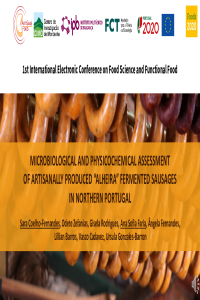
Microbiological and physicochemical assessment of artisanally produced “Alheira” fermented sausages in Northern Portugal
'%3e%3cpath%20d='M12.6647%2010.9104C12.4176%2010.325%2012.0589%209.7933%2011.6088%209.34485C11.16%208.89511%2010.6283%208.53653%2010.0432%208.28891C10.038%208.28629%2010.0327%208.28498%2010.0275%208.28236C10.8437%207.69282%2011.3743%206.73252%2011.3743%205.64907C11.3743%203.85423%209.92005%202.40002%208.12522%202.40002C6.33038%202.40002%204.87618%203.85423%204.87618%205.64907C4.87618%206.73252%205.40677%207.69282%206.22296%208.28367C6.21772%208.28629%206.21248%208.2876%206.20724%208.29022C5.62031%208.53783%205.09365%208.89287%204.64167%209.34616C4.19192%209.79496%203.83334%2010.3266%203.58573%2010.9117C3.34247%2011.4846%203.21128%2012.0987%203.19925%2012.721C3.1989%2012.735%203.20135%2012.7489%203.20646%2012.7619C3.21157%2012.7749%203.21924%2012.7868%203.22901%2012.7968C3.23877%2012.8068%203.25045%2012.8148%203.26334%2012.8202C3.27623%2012.8256%203.29007%2012.8284%203.30406%2012.8284H4.09012C4.14776%2012.8284%204.19362%2012.7825%204.19493%2012.7262C4.22113%2011.7148%204.62726%2010.7676%205.34519%2010.0497C6.08802%209.30686%207.07452%208.89811%208.12522%208.89811C9.17592%208.89811%2010.1624%209.30686%2010.9052%2010.0497C11.6232%2010.7676%2012.0293%2011.7148%2012.0555%2012.7262C12.0568%2012.7839%2012.1027%2012.8284%2012.1603%2012.8284H12.9464C12.9604%2012.8284%2012.9742%2012.8256%2012.9871%2012.8202C13%2012.8148%2013.0117%2012.8068%2013.0214%2012.7968C13.0312%2012.7868%2013.0389%2012.7749%2013.044%2012.7619C13.0491%2012.7489%2013.0515%2012.735%2013.0512%2012.721C13.0381%2012.0947%2012.9084%2011.4856%2012.6647%2010.9104ZM8.12522%207.90243C7.52388%207.90243%206.95792%207.66793%206.53214%207.24215C6.10636%206.81636%205.87185%206.2504%205.87185%205.64907C5.87185%205.04773%206.10636%204.48177%206.53214%204.05599C6.95792%203.63021%207.52388%203.3957%208.12522%203.3957C8.72655%203.3957%209.29252%203.63021%209.7183%204.05599C10.1441%204.48177%2010.3786%205.04773%2010.3786%205.64907C10.3786%206.2504%2010.1441%206.81636%209.7183%207.24215C9.29252%207.66793%208.72655%207.90243%208.12522%207.90243Z'%20fill='%235D1EE1'/%3e%3c/g%3e%3c/svg%3e)
Sara Coelho-Fernandes 1
Odete Zefanias 1
Gisela Santos-Rodrigues 1

Ana Sofia Faria 1

Ângela Fernandes 1

Lillian Barros 1
Vasco Cadavez 1

Ursula Gonzales-Barron 1
1. Centro de Investigação de Montanha (CIMO), Instituto Politécnico de Bragança, Campus de Santa Apolónia, 5300-253 Bragança, Portugal
Abstract
Alheira is a traditional non-ready-to-eat sausage produced mainly in Northern Portugal. Made of poultry, pork or game meat, bread and seasonings, it is a very sought-after meat product in Portuguese cuisine due to its organoleptic properties. The objective of this study was to evaluate the associations between some relevant physicochemical and microbiological attributes of alheiras produced by different regional producers. Finished products from 8 regional factories amounting to 40 samples were analysed. Counts of mesophiles, lactic acid bacteria (LAB on MRS and M17 agar), Staphylococcus aureus, Clostridium spp. and Salmonella spp., as well as pH, water activity (aW), moisture, ashes and protein content were determined. Principal Component Analysis (PCA) of these variables was conducted to construct quality maps. Three meaningful components were extracted, accounting for 63% of data variability. PCA1 (26% of data) was positively associated with LAB, mesophiles and S. aureus, characterising therefore longer fermentation. PCA2 (22%) correlated negatively with moisture, aW and positively with Clostridium, and thus has been linked to greater dehydration of these sausages. PCA3 (15%) correlated positively with pH and protein content, implying the use of more meat in the formulation. Projection of samples in the three-dimensional space allowed the differentiation of three clusters of factories: one made up of 4 factories that represent microbiologically safe alheiras of lower pH and higher LAB. Another quality cluster of 3 factories describes meat-rich alheiras of higher pH and ash content. A third cluster of one factory was identified representing drier alheiras with higher incidence of pathogenic bacteria. This preliminary work has identified three quality factors (axes) underpinning the variability in artisanal alheiras: duration of fermentation, extent of dehydration and proportion of meat in formulation; and has also highlighted the need to implement better microbiological control and process standardisation during the production of artisanal alheiras.
Keywords
Regional sausage
Clostridium
Staphylococcus
Salmonella
LAB
pH
proximate composition
principal component analysis.
Manuscript
sciforum_034497-done.pdf
Poster
ppt alheiras FINAL 28_10_2020.pdf
Effect of heat treatment on smoothie quality by response surface methodology
Comparative study on the inhibition of acetylcholinesterase activity by Hyptis spp. methanolic extracts