Event submissions
Published

This submission belongs to the session J. Posters of the event The 1st International Electronic Conference on Catalysis Sciences
Published date
09 Nov, 2020
Citation
Andrea Madabeni, Marco Dalla Tiezza, Omage Bright Folorunsho, Pablo Andrei Nogara, Marco Bortoli, Joao Batista Rocha, Laura Orian, Methylmercury – Chalcogenolates Ligand Exchange: Insight from DFT into A Very Fast Reaction, in Proceedings of The 1st International Electronic Conference on Catalysis Sciences, 10 November–30 November 2020, MDPI: Basel, Switzerland, doi: 10.3390/ECCS2020-07635
Share
Email
Facebook
Twitter
LinkedIn
Methylmercury – Chalcogenolates Ligand Exchange: Insight from DFT into A Very Fast Reaction
'%3e%3cpath%20d='M12.6647%2010.9104C12.4176%2010.325%2012.0589%209.7933%2011.6088%209.34485C11.16%208.89511%2010.6283%208.53653%2010.0432%208.28891C10.038%208.28629%2010.0327%208.28498%2010.0275%208.28236C10.8437%207.69282%2011.3743%206.73252%2011.3743%205.64907C11.3743%203.85423%209.92005%202.40002%208.12522%202.40002C6.33038%202.40002%204.87618%203.85423%204.87618%205.64907C4.87618%206.73252%205.40677%207.69282%206.22296%208.28367C6.21772%208.28629%206.21248%208.2876%206.20724%208.29022C5.62031%208.53783%205.09365%208.89287%204.64167%209.34616C4.19192%209.79496%203.83334%2010.3266%203.58573%2010.9117C3.34247%2011.4846%203.21128%2012.0987%203.19925%2012.721C3.1989%2012.735%203.20135%2012.7489%203.20646%2012.7619C3.21157%2012.7749%203.21924%2012.7868%203.22901%2012.7968C3.23877%2012.8068%203.25045%2012.8148%203.26334%2012.8202C3.27623%2012.8256%203.29007%2012.8284%203.30406%2012.8284H4.09012C4.14776%2012.8284%204.19362%2012.7825%204.19493%2012.7262C4.22113%2011.7148%204.62726%2010.7676%205.34519%2010.0497C6.08802%209.30686%207.07452%208.89811%208.12522%208.89811C9.17592%208.89811%2010.1624%209.30686%2010.9052%2010.0497C11.6232%2010.7676%2012.0293%2011.7148%2012.0555%2012.7262C12.0568%2012.7839%2012.1027%2012.8284%2012.1603%2012.8284H12.9464C12.9604%2012.8284%2012.9742%2012.8256%2012.9871%2012.8202C13%2012.8148%2013.0117%2012.8068%2013.0214%2012.7968C13.0312%2012.7868%2013.0389%2012.7749%2013.044%2012.7619C13.0491%2012.7489%2013.0515%2012.735%2013.0512%2012.721C13.0381%2012.0947%2012.9084%2011.4856%2012.6647%2010.9104ZM8.12522%207.90243C7.52388%207.90243%206.95792%207.66793%206.53214%207.24215C6.10636%206.81636%205.87185%206.2504%205.87185%205.64907C5.87185%205.04773%206.10636%204.48177%206.53214%204.05599C6.95792%203.63021%207.52388%203.3957%208.12522%203.3957C8.72655%203.3957%209.29252%203.63021%209.7183%204.05599C10.1441%204.48177%2010.3786%205.04773%2010.3786%205.64907C10.3786%206.2504%2010.1441%206.81636%209.7183%207.24215C9.29252%207.66793%208.72655%207.90243%208.12522%207.90243Z'%20fill='%235D1EE1'/%3e%3c/g%3e%3c/svg%3e)
Andrea Madabeni 1
Marco Dalla Tiezza 1

Omage Bright Folorunsho 2

Pablo Andrei Nogara 3
Marco Bortoli 1
Joao Batista Rocha 2

Laura Orian 1
1. Dipartimento di Scienze Chimiche Università degli Studi di Padova Via Marzolo 1 35131 Padova, Italy
2. Departamento de Bioquímica e Biologia Molecular, Universidade Federal de Santa Maria, Santa Maria RS Brazil
3. Dipartimento di Scienze Chimiche Università degli Studi di Padova Via Marzolo 1 35131 Padova, Italy
Departamento de Bioquímica e Biologia Molecular, Universidade Federal de Santa Maria, Santa Maria RS Brazil
Abstract
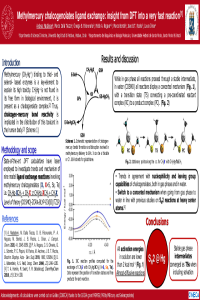
Methylmercury (CH3Hg+) binding to thiol- and selenol- based enzymes is a key-element to explain its high toxicity. CH3Hg+ is not found in its free form in biological environment, but is present as a chalcogenolate complex. Thus, chalcogen-mercury bond reactivity is implicated in the distribution of this toxicant in the human body. Particularly, Hg – S and Hg – Se bond formation and disruption is responsible for glutathione depletion and CH3Hg+ delivery to target enzymes. We have investigated systematically, in silico, trends and mechanisms of nine ligand-exchange model reactions between a methylchalcogenolate and a methylmercury methylchalcogenolate complex in order to understand the role of the chalcogen (S, Se, Te) and of the environment (gas phase vs solvent).1 We discuss trends in activation and reaction energies, highlighting a change in mechanism (from a single-well to a unimodal/double-well potential energy surface) when moving from gas to condensed phase, in analogy with SN2 reactions. Further similarities with SN2 reactions are quantified by means of activation strain analysis. Reactions involving S and Se display very similar energetics and (low) activation energies. Therefore, the reasons behind the biochemically challenging detoxification of CH3Hg+ inhibited (seleno)proteins clearly emerge also from our minimal model, which paves the route to future mechanistic investigations.
- A. Madabeni, M. Dalla Tiezza, O. B. Folorunsho, P. A. Nogara, M. Bortoli, J. B. Rocha, L. Orian, J. Comput. Chem. 2020, 41, 2045-2059
Keywords
selenium
sulfur
methylmercury
dft
Poster
poster_eccs_madabeni.pdf
GpX-like Catalysis: Real Opportunity or A Chimera?
BioICEP. Bio Innovation of A Circular Economy for Plastics