Event submissions
Published
 10.3390/foods_2020-07645 (registering DOI)
 This submission belongs to the session 9. Innovative Food Additives and Ingredients of the event 1st International Electronic Conference on Food Science and Functional Foods
Published date
09 Nov, 2020
Citation
Maria Emilia Lorenzo, Patricia Elizabeth Gómez, Eugenia Sabatino, Adrián Federico Segovia, Lara Carolina Figueroa, María Verónica Baroni, Phenolic profile and antioxidant activity of ethanolic leaf extract of Larrea cuneifolia Cav, in Proceedings of 1st International Electronic Conference on Food Science and Functional Foods, 10 November–25 November 2020, MDPI: Basel, Switzerland, doi: 10.3390/foods_2020-07645
Share
Email
Facebook
Twitter
LinkedIn
Phenolic profile and antioxidant activity of ethanolic leaf extract of Larrea cuneifolia Cav
'%3e%3cpath%20d='M12.6647%2010.9104C12.4176%2010.325%2012.0589%209.7933%2011.6088%209.34485C11.16%208.89511%2010.6283%208.53653%2010.0432%208.28891C10.038%208.28629%2010.0327%208.28498%2010.0275%208.28236C10.8437%207.69282%2011.3743%206.73252%2011.3743%205.64907C11.3743%203.85423%209.92005%202.40002%208.12522%202.40002C6.33038%202.40002%204.87618%203.85423%204.87618%205.64907C4.87618%206.73252%205.40677%207.69282%206.22296%208.28367C6.21772%208.28629%206.21248%208.2876%206.20724%208.29022C5.62031%208.53783%205.09365%208.89287%204.64167%209.34616C4.19192%209.79496%203.83334%2010.3266%203.58573%2010.9117C3.34247%2011.4846%203.21128%2012.0987%203.19925%2012.721C3.1989%2012.735%203.20135%2012.7489%203.20646%2012.7619C3.21157%2012.7749%203.21924%2012.7868%203.22901%2012.7968C3.23877%2012.8068%203.25045%2012.8148%203.26334%2012.8202C3.27623%2012.8256%203.29007%2012.8284%203.30406%2012.8284H4.09012C4.14776%2012.8284%204.19362%2012.7825%204.19493%2012.7262C4.22113%2011.7148%204.62726%2010.7676%205.34519%2010.0497C6.08802%209.30686%207.07452%208.89811%208.12522%208.89811C9.17592%208.89811%2010.1624%209.30686%2010.9052%2010.0497C11.6232%2010.7676%2012.0293%2011.7148%2012.0555%2012.7262C12.0568%2012.7839%2012.1027%2012.8284%2012.1603%2012.8284H12.9464C12.9604%2012.8284%2012.9742%2012.8256%2012.9871%2012.8202C13%2012.8148%2013.0117%2012.8068%2013.0214%2012.7968C13.0312%2012.7868%2013.0389%2012.7749%2013.044%2012.7619C13.0491%2012.7489%2013.0515%2012.735%2013.0512%2012.721C13.0381%2012.0947%2012.9084%2011.4856%2012.6647%2010.9104ZM8.12522%207.90243C7.52388%207.90243%206.95792%207.66793%206.53214%207.24215C6.10636%206.81636%205.87185%206.2504%205.87185%205.64907C5.87185%205.04773%206.10636%204.48177%206.53214%204.05599C6.95792%203.63021%207.52388%203.3957%208.12522%203.3957C8.72655%203.3957%209.29252%203.63021%209.7183%204.05599C10.1441%204.48177%2010.3786%205.04773%2010.3786%205.64907C10.3786%206.2504%2010.1441%206.81636%209.7183%207.24215C9.29252%207.66793%208.72655%207.90243%208.12522%207.90243Z'%20fill='%235D1EE1'/%3e%3c/g%3e%3c/svg%3e)
Maria Emilia Lorenzo 1,2
Patricia Elizabeth Gómez 1,2
Eugenia Sabatino 3
Adrián Federico Segovia 1
Lara Carolina Figueroa 1
María Verónica Baroni 3,4,5
1. Universidad Nacional de Catamarca, Facultad de Ciencias Agrarias.
2. CITCA/CONICET-UNCA, Catamarca, Argentina.
3. CONICET, ICYTAC, Córdoba, Argentina
4. Universidad Nacional de Córdoba, Facultad de Ciencias Químicas.
5. ISIDSA, SECyT, Córdoba, Argentina
Abstract
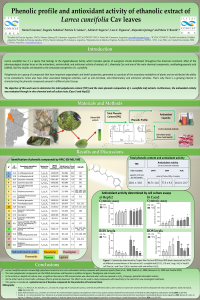
Genus of the Zygophyllaceae family includes evergreen shrub species. Background highlights the antioxidant and anti-tumor activity of Larrea divaricata and nordhydroguayaretic acid (NDGA) due to their potential as a dietary supplement and food preservative, but little is known about Larrea cuneifolia. The aim of this work was to determine the antioxidant activity of extracts of L. cuneifolia and to identify its main phenolic compounds. Extracts were prepared with 50% ethanol from leaves collected in the Central Valley of Catamarca (Argentina). Total polyphenols content (TP) was determined by Folin-Ciocalteu and the phenolic identification and HPLC-PDA-ESI-MS/MS. In vitro antioxidant capacity was measured using the FRAP and DPPH chemical assays and on HepG2 and Caco2a cell lines to which oxidative stress was induced. ROS formation was determined through the dichlorofluresce in probe (DCFH) and cell viability was corroborated by Trypan Blue Test. The phenolic compounds identified were mainly derivatives of NDGA and glycosylated as well as methylated flavanols of quercetin, kaempferol, isorhamnetin, and gossipetin. TP content and antioxidant activity exceeded the values reported for L. divaricata. In HepG2, a ROS reduction was observed when the extract concentration increased without affecting cell viability. In Caco2, the effect on stress was less marked and viability increased at higher concentration. L. cuneifolia is a species rich in phenolic compounds, with antioxidant properties and is a potential source of bioactive compounds for the production of functional foods.
Keywords
antioxidant activity
polyphenols
cell lines
Larrea
Manuscript
sciforum_037127_original_Foods_2020_Word_LorenzoME_revision_Euge-done.pdf
Poster
Presentation_Lorenzo ME.pdf
Evaluation of starch hydrolysis for glycemic index prediction of rice varieties
Red algae as source of nutrients with antioxidant and antimicrobial potential