Event submissions
Published
 10.3390/foods_2020-07648 (registering DOI)
 This submission belongs to the session 8. Nutraceuticals and Functional Foods of the event 1st International Electronic Conference on Food Science and Functional Foods
Published date
09 Nov, 2020
Citation
Paula Garcia-Oliveira, Anxo Carreira-Casais, Cristina Caleja, Eliana Pereira, Ricardo C. Calhelha, Marina Sokovic, Jesús Simal-Gandara, Isabel C. F. R. Ferreira, Miguel A. Prieto, Lillian Barros, Macroalgae as an alternative source of nutrients and compounds with bioactive potential, in Proceedings of 1st International Electronic Conference on Food Science and Functional Foods, 10 November–25 November 2020, MDPI: Basel, Switzerland, doi: 10.3390/foods_2020-07648
Share
Email
Facebook
Twitter
LinkedIn
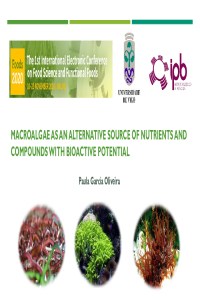
Macroalgae as an alternative source of nutrients and compounds with bioactive potential
'%3e%3cpath%20d='M12.6647%2010.9104C12.4176%2010.325%2012.0589%209.7933%2011.6088%209.34485C11.16%208.89511%2010.6283%208.53653%2010.0432%208.28891C10.038%208.28629%2010.0327%208.28498%2010.0275%208.28236C10.8437%207.69282%2011.3743%206.73252%2011.3743%205.64907C11.3743%203.85423%209.92005%202.40002%208.12522%202.40002C6.33038%202.40002%204.87618%203.85423%204.87618%205.64907C4.87618%206.73252%205.40677%207.69282%206.22296%208.28367C6.21772%208.28629%206.21248%208.2876%206.20724%208.29022C5.62031%208.53783%205.09365%208.89287%204.64167%209.34616C4.19192%209.79496%203.83334%2010.3266%203.58573%2010.9117C3.34247%2011.4846%203.21128%2012.0987%203.19925%2012.721C3.1989%2012.735%203.20135%2012.7489%203.20646%2012.7619C3.21157%2012.7749%203.21924%2012.7868%203.22901%2012.7968C3.23877%2012.8068%203.25045%2012.8148%203.26334%2012.8202C3.27623%2012.8256%203.29007%2012.8284%203.30406%2012.8284H4.09012C4.14776%2012.8284%204.19362%2012.7825%204.19493%2012.7262C4.22113%2011.7148%204.62726%2010.7676%205.34519%2010.0497C6.08802%209.30686%207.07452%208.89811%208.12522%208.89811C9.17592%208.89811%2010.1624%209.30686%2010.9052%2010.0497C11.6232%2010.7676%2012.0293%2011.7148%2012.0555%2012.7262C12.0568%2012.7839%2012.1027%2012.8284%2012.1603%2012.8284H12.9464C12.9604%2012.8284%2012.9742%2012.8256%2012.9871%2012.8202C13%2012.8148%2013.0117%2012.8068%2013.0214%2012.7968C13.0312%2012.7868%2013.0389%2012.7749%2013.044%2012.7619C13.0491%2012.7489%2013.0515%2012.735%2013.0512%2012.721C13.0381%2012.0947%2012.9084%2011.4856%2012.6647%2010.9104ZM8.12522%207.90243C7.52388%207.90243%206.95792%207.66793%206.53214%207.24215C6.10636%206.81636%205.87185%206.2504%205.87185%205.64907C5.87185%205.04773%206.10636%204.48177%206.53214%204.05599C6.95792%203.63021%207.52388%203.3957%208.12522%203.3957C8.72655%203.3957%209.29252%203.63021%209.7183%204.05599C10.1441%204.48177%2010.3786%205.04773%2010.3786%205.64907C10.3786%206.2504%2010.1441%206.81636%209.7183%207.24215C9.29252%207.66793%208.72655%207.90243%208.12522%207.90243Z'%20fill='%235D1EE1'/%3e%3c/g%3e%3c/svg%3e)
Paula Garcia-Oliveira 1,2
Anxo Carreira-Casais 1,2

Cristina Caleja 2

Eliana Pereira 2

Ricardo C. Calhelha 2
Marina Sokovic 3

Jesús Simal-Gandara 1

Isabel C. F. R. Ferreira 2

Miguel A. Prieto 1

Lillian Barros 2
1. Nutrition and Bromatology Group, Faculty of Food Science and Technology, University of Vigo, Ourense Campus, E32004 Ourense, Spain
2. Centro de Investigação de Montanha (CIMO), Instituto Politécnico de Bragança, Campus de Santa Apolónia, 5300-253 Bragança, Portugal
3. 3Institute for Biological Research "Siniša Stanković"- National Institute of Republic of Serbia, University of Belgrade
Abstract
The consumption of macroalgae has increased in occidental countries, favoured by the excellent nutritional properties of their food products and the bioactive properties attributed to them. The present work aims to analyse the nutritional values, the composition in fatty acids, organic acids and carotenoids of several macroalgae species: Codium tomentosum; Himanthalia elongata; Laminaria ochroleuca.; Saccharina latissima; Undaria pinnatifida; Porphyra sp. and Palmaria palmata. Furthermore, the antioxidant and antimicrobial properties were assessed. Regarding the composition of the macroalgae, the levels of proteins (which ranged between 6 and 30 g/100 g of dry weight (dw) for S. latissima and Porphyra sp., respectively) and the low levels of lipids (below 1 g/100 g dw for all the species) stand out. In the case of carotenoids, lycopene and Chlorophyll a were detected in all samples, with the highest values observed in C. tomentosum (11.2 and 56.3 mg/100g dw, respectively), while P. palmata showed the lowest content (0.32 mg and 1.5 mg/100g dw, respectively). Regarding antioxidant activity, OxHLIA assay was employed. EC50 values varied between 1.7 and 650 μg/mL for L. ochroleuca and P. palmata. H. elongata presented the greatest antibacterial potential (minimal bactericidal concentrations between 0.5-2 mg/mL) while L. ochroleuca showed the best antifungal effects (2 – 4 mg/mL). These species have good nutritional values and present interesting bioactivities. Thus, the incorporation of this macroalgae into the daily diet could provide nutritional and health benefits to the consumers. In addition, they could be used as a source of compounds for the nutraceutical, cosmetic of pharmaceutical industries.
Keywords
Macroalgae
nutritional value
chemical characterization
bioactive potential.
Manuscript
sciforum_037120_original_Foods_2020_Paula-done.pdf
Poster
Foods-Paula.pdf
Valorization of kiwi sub-products for recovering bioactive compounds: circular economy model
Decontamination of pig carcasses with organic acids