Event submissions
Published
 10.3390/foods_2020-07678 (registering DOI)
 This submission belongs to the session 5. Food Safety and Sustainable Development of the event 1st International Electronic Conference on Food Science and Functional Foods
Published date
09 Nov, 2020
Citation
Cláudia Ferreira, Rui Oliveira, Protective antifungal activity of Plantago major extract against the phytopathogenic fungi Phytophthora cinnamomi, Diplodia corticola and Colletotrichum species, in Proceedings of 1st International Electronic Conference on Food Science and Functional Foods, 10 November–25 November 2020, MDPI: Basel, Switzerland, doi: 10.3390/foods_2020-07678
Share
Email
Facebook
Twitter
LinkedIn
Protective antifungal activity of Plantago major extract against the phytopathogenic fungi Phytophthora cinnamomi, Diplodia corticola and Colletotrichum species
'%3e%3cpath%20d='M12.6647%2010.9104C12.4176%2010.325%2012.0589%209.7933%2011.6088%209.34485C11.16%208.89511%2010.6283%208.53653%2010.0432%208.28891C10.038%208.28629%2010.0327%208.28498%2010.0275%208.28236C10.8437%207.69282%2011.3743%206.73252%2011.3743%205.64907C11.3743%203.85423%209.92005%202.40002%208.12522%202.40002C6.33038%202.40002%204.87618%203.85423%204.87618%205.64907C4.87618%206.73252%205.40677%207.69282%206.22296%208.28367C6.21772%208.28629%206.21248%208.2876%206.20724%208.29022C5.62031%208.53783%205.09365%208.89287%204.64167%209.34616C4.19192%209.79496%203.83334%2010.3266%203.58573%2010.9117C3.34247%2011.4846%203.21128%2012.0987%203.19925%2012.721C3.1989%2012.735%203.20135%2012.7489%203.20646%2012.7619C3.21157%2012.7749%203.21924%2012.7868%203.22901%2012.7968C3.23877%2012.8068%203.25045%2012.8148%203.26334%2012.8202C3.27623%2012.8256%203.29007%2012.8284%203.30406%2012.8284H4.09012C4.14776%2012.8284%204.19362%2012.7825%204.19493%2012.7262C4.22113%2011.7148%204.62726%2010.7676%205.34519%2010.0497C6.08802%209.30686%207.07452%208.89811%208.12522%208.89811C9.17592%208.89811%2010.1624%209.30686%2010.9052%2010.0497C11.6232%2010.7676%2012.0293%2011.7148%2012.0555%2012.7262C12.0568%2012.7839%2012.1027%2012.8284%2012.1603%2012.8284H12.9464C12.9604%2012.8284%2012.9742%2012.8256%2012.9871%2012.8202C13%2012.8148%2013.0117%2012.8068%2013.0214%2012.7968C13.0312%2012.7868%2013.0389%2012.7749%2013.044%2012.7619C13.0491%2012.7489%2013.0515%2012.735%2013.0512%2012.721C13.0381%2012.0947%2012.9084%2011.4856%2012.6647%2010.9104ZM8.12522%207.90243C7.52388%207.90243%206.95792%207.66793%206.53214%207.24215C6.10636%206.81636%205.87185%206.2504%205.87185%205.64907C5.87185%205.04773%206.10636%204.48177%206.53214%204.05599C6.95792%203.63021%207.52388%203.3957%208.12522%203.3957C8.72655%203.3957%209.29252%203.63021%209.7183%204.05599C10.1441%204.48177%2010.3786%205.04773%2010.3786%205.64907C10.3786%206.2504%2010.1441%206.81636%209.7183%207.24215C9.29252%207.66793%208.72655%207.90243%208.12522%207.90243Z'%20fill='%235D1EE1'/%3e%3c/g%3e%3c/svg%3e)
Cláudia Ferreira 1
Rui Oliveira 1,2,3
1. a Centre of Molecular and Environmental Biology (CBMA), Department of Biology, University of Minho, Campus de Gualtar, 4710-057 Braga, Portugal
2. b Centre for the Research and Technology of Agro-Environmental and Biological Sciences (CITAB), Department of Biology, University of Minho, Campus de Gualtar, 4710-057 Braga, Portugal
3. c Centre of Biological Engineering (CEB), Department of Biology, University of Minho, Campus de Gualtar 4710-057 Braga, Portugal
Abstract
Synthetic fungicides for crops protection raise environmental and human concerns due to accumulation in edible vegetables, showing significant toxicity to humans, and in soil, groundwater and rivers, affecting ecological balance. In addition, they are prone to the development of resistant strains because of the single target-based mechanism of action. Plant extracts provide attractive alternatives, as they constitute a rich source of biodegradable secondary metabolites, such as phenols, flavonoids and saponins, which have multiple modes of antifungal action and lower probability of development of resistant fungi. This work has the objective of identifying plant extracts with antifungal activity aiming to contribute to food safety and sustainable agricultural practices. We selected a saponin-containing plant, Plantago major and extracted secondary metabolites with 50% (v/v) ethanol, dried by evaporation, and dissolved in water. For antifungal activity, the phytopathogenic fungi Colletotrichum acutatum, Colletotrichum gloeosporioides, Colletotrichum godetiae, Colletotrichum nymphaeae, Diplodia corticola and Phytophthora cinnamomi were selected because they affect fruits and vegetables, such as strawberry, almond, apple, avocado, blueberry and chestnut trees. The aqueous extract was incorporated into PDA medium at different concentrations and mycelial discs were placed in the center of each Petri dish. Growth was measured as radial mycelial growth at 3, 6, and 9 days incubation at 25 ºC in the dark. Maximum growth inhibition (32.2%) was obtained against P. cinnamomi with 2000 µg/mL extract followed by C. gloeosporioides (25.7%) on the sixth day and by C. godetiae and C. nymphaeae (21.1%) on the ninth day. Results show that P. major presents antifungal activity in all phytopathogenic fungi tested and the extract can be used to protect important crops, by inhibiting the development of fungal infections and promoting food security and a sustainable agriculture.
Keywords
Antifungal phytochemicals
Natural antifungals
Sustainable crop production
Sustainable agriculture
Plantago major
Manuscript
sciforum-036925 - done.pdf
Poster
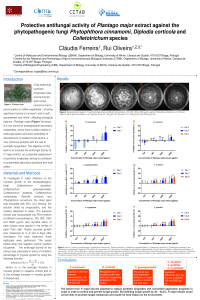
Poster_ ClaudiaFerreira_RuiOliveira FOODS.pdf
Development of a vegan Spanish sausage-type using coproducts from the pepper “Sol del Pilar“
How can the combination of pasta and wine affect the digestibility of polyphenols? A simulated digestion study to assess the meal antioxidant properties.