Event submissions
Published
 10.3390/foods_2020-07683 (registering DOI)
 This submission belongs to the session 9. Innovative Food Additives and Ingredients of the event 1st International Electronic Conference on Food Science and Functional Foods
Published date
09 Nov, 2020
Citation
Mariana Lingua, Virginia Salomón, Jesica Blajman, Roxana Páez, Luis María Maldonado, María Verónica Baroni, Effect of spray drying on the microencapsulation of the blueberry natural antioxidants, in Proceedings of 1st International Electronic Conference on Food Science and Functional Foods, 10 November–25 November 2020, MDPI: Basel, Switzerland, doi: 10.3390/foods_2020-07683
Share
Email
Facebook
Twitter
LinkedIn
Effect of spray drying on the microencapsulation of the blueberry natural antioxidants
'%3e%3cpath%20d='M12.6647%2010.9104C12.4176%2010.325%2012.0589%209.7933%2011.6088%209.34485C11.16%208.89511%2010.6283%208.53653%2010.0432%208.28891C10.038%208.28629%2010.0327%208.28498%2010.0275%208.28236C10.8437%207.69282%2011.3743%206.73252%2011.3743%205.64907C11.3743%203.85423%209.92005%202.40002%208.12522%202.40002C6.33038%202.40002%204.87618%203.85423%204.87618%205.64907C4.87618%206.73252%205.40677%207.69282%206.22296%208.28367C6.21772%208.28629%206.21248%208.2876%206.20724%208.29022C5.62031%208.53783%205.09365%208.89287%204.64167%209.34616C4.19192%209.79496%203.83334%2010.3266%203.58573%2010.9117C3.34247%2011.4846%203.21128%2012.0987%203.19925%2012.721C3.1989%2012.735%203.20135%2012.7489%203.20646%2012.7619C3.21157%2012.7749%203.21924%2012.7868%203.22901%2012.7968C3.23877%2012.8068%203.25045%2012.8148%203.26334%2012.8202C3.27623%2012.8256%203.29007%2012.8284%203.30406%2012.8284H4.09012C4.14776%2012.8284%204.19362%2012.7825%204.19493%2012.7262C4.22113%2011.7148%204.62726%2010.7676%205.34519%2010.0497C6.08802%209.30686%207.07452%208.89811%208.12522%208.89811C9.17592%208.89811%2010.1624%209.30686%2010.9052%2010.0497C11.6232%2010.7676%2012.0293%2011.7148%2012.0555%2012.7262C12.0568%2012.7839%2012.1027%2012.8284%2012.1603%2012.8284H12.9464C12.9604%2012.8284%2012.9742%2012.8256%2012.9871%2012.8202C13%2012.8148%2013.0117%2012.8068%2013.0214%2012.7968C13.0312%2012.7868%2013.0389%2012.7749%2013.044%2012.7619C13.0491%2012.7489%2013.0515%2012.735%2013.0512%2012.721C13.0381%2012.0947%2012.9084%2011.4856%2012.6647%2010.9104ZM8.12522%207.90243C7.52388%207.90243%206.95792%207.66793%206.53214%207.24215C6.10636%206.81636%205.87185%206.2504%205.87185%205.64907C5.87185%205.04773%206.10636%204.48177%206.53214%204.05599C6.95792%203.63021%207.52388%203.3957%208.12522%203.3957C8.72655%203.3957%209.29252%203.63021%209.7183%204.05599C10.1441%204.48177%2010.3786%205.04773%2010.3786%205.64907C10.3786%206.2504%2010.1441%206.81636%209.7183%207.24215C9.29252%207.66793%208.72655%207.90243%208.12522%207.90243Z'%20fill='%235D1EE1'/%3e%3c/g%3e%3c/svg%3e)
Mariana Lingua 1
Virginia Salomón 2
Jesica Blajman 3
Roxana Páez 4
Luis María Maldonado 2
María Verónica Baroni 1,5
1. Instituto de Ciencia y Tecnología de Alimentos Córdoba (ICYTAC-CONICET)- Córdoba, Argentina
2. Instituto Nacional de Tecnología Agropecuaria INTA-EEA Famaillá- Tucumán, Argentina
3. Instituto de Investigación de la Cadena Láctea (IDICAL-CONICET)- Rafaela, Santa Fe, Argentina
4. Instituto Nacional de Tecnología Agropecuaria INTA-EEA Rafaela, Santa Fe, Argentina
5. Departamento de Química Orgánica, Facultad de Ciencias Químicas, Universidad Nacional de Córdoba, Córdoba, Argentina
Abstract
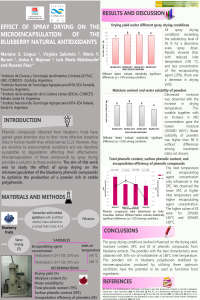
Phenolic compounds obtained from blueberries have gained great attention due to their more effective bioactive roles in human health than whole berries. However, they are sensitive to environmental conditions and are therefore susceptible to degradation affecting their effectiveness. Microencapsulation of these compounds by spray drying provides a solution to these problems. This work aimed to study the effect of spray drying on the microencapsulation of the blueberry phenolic compounds to optimize the production of a powder rich in stable polyphenols. The phenolic compounds from blueberries were obtained using orbital agitation (220 rpm) during 5h at 25°C of blueberries, previously destemmed and washed, with acidified ethanol (52.6% v/v; pH 2.0 with citric acid) at a mass solvent to fruits ratio 4.2. This phenolic extract was spray dried under different conditions of inlet air temperatures (140 and 160°C) and encapsulating agent concentrations (20 and 30% w/v), using maltodextrin (14.7 dextrose equivalent). The drying yield, moisture content, water-solubility, total and surface phenolic content (by Folin-Ciocalteu), and encapsulation efficiency of total phenolic were investigated. The results obtained showed that the different conditions evaluated influenced on the drying yield, moisture content, surface phenolic content, and encapsulation efficiency of total phenolic. In this sense, the powders with the best characteristics were obtained with 30% w/v of maltodextrin at 160°C inlet temperature. These powders rich in blueberry polyphenols stabilized by microencapsulation, are easier to handle for application, so they could be used as functional food ingredients.
Keywords
blueberry
polyphenols
spray drying
microencapsulation
Manuscript
sciforum_036900_original_Foods_2020_Manuscript_Blueberry_FINAL - done.pdf
Poster
Póster ARANDANOS 2020 FINAL.pdf
Microwave-assisted Extraction of Hibiscus sabdariffa Antioxidants: Method Developmet and Validation
Anxiolytic-like effects of Lupinus angustifolious protein hydrolysates in Alzheimer model mice.