Event submissions
Published
 10.3390/foods_2020-07685 (registering DOI)
 This submission belongs to the session 8. Nutraceuticals and Functional Foods of the event 1st International Electronic Conference on Food Science and Functional Foods
Published date
09 Nov, 2020
Citation
Guillermo Santos-Sánchez, Eduardo Ponce-España, Ivan Cruz-Chamorro, Juan Carlos López-García, Ana Isabel Álvarez-López, Justo Pedroche, María Carmen Millán-Linares, Francisco Millán, Patricia Judith Lardone, Ignacio Bejarano, Juan Miguel Guerrero, Antonio Carrillo-Vico, Anxiolytic-like effects of Lupinus angustifolious protein hydrolysates in Alzheimer model mice., in Proceedings of 1st International Electronic Conference on Food Science and Functional Foods, 10 November–25 November 2020, MDPI: Basel, Switzerland, doi: 10.3390/foods_2020-07685
Share
Email
Facebook
Twitter
LinkedIn
Anxiolytic-like effects of Lupinus angustifolious protein hydrolysates in Alzheimer model mice.

Guillermo Santos-Sánchez 1,2
'%3e%3cpath%20d='M12.6647%2010.9104C12.4176%2010.325%2012.0589%209.7933%2011.6088%209.34485C11.16%208.89511%2010.6283%208.53653%2010.0432%208.28891C10.038%208.28629%2010.0327%208.28498%2010.0275%208.28236C10.8437%207.69282%2011.3743%206.73252%2011.3743%205.64907C11.3743%203.85423%209.92005%202.40002%208.12522%202.40002C6.33038%202.40002%204.87618%203.85423%204.87618%205.64907C4.87618%206.73252%205.40677%207.69282%206.22296%208.28367C6.21772%208.28629%206.21248%208.2876%206.20724%208.29022C5.62031%208.53783%205.09365%208.89287%204.64167%209.34616C4.19192%209.79496%203.83334%2010.3266%203.58573%2010.9117C3.34247%2011.4846%203.21128%2012.0987%203.19925%2012.721C3.1989%2012.735%203.20135%2012.7489%203.20646%2012.7619C3.21157%2012.7749%203.21924%2012.7868%203.22901%2012.7968C3.23877%2012.8068%203.25045%2012.8148%203.26334%2012.8202C3.27623%2012.8256%203.29007%2012.8284%203.30406%2012.8284H4.09012C4.14776%2012.8284%204.19362%2012.7825%204.19493%2012.7262C4.22113%2011.7148%204.62726%2010.7676%205.34519%2010.0497C6.08802%209.30686%207.07452%208.89811%208.12522%208.89811C9.17592%208.89811%2010.1624%209.30686%2010.9052%2010.0497C11.6232%2010.7676%2012.0293%2011.7148%2012.0555%2012.7262C12.0568%2012.7839%2012.1027%2012.8284%2012.1603%2012.8284H12.9464C12.9604%2012.8284%2012.9742%2012.8256%2012.9871%2012.8202C13%2012.8148%2013.0117%2012.8068%2013.0214%2012.7968C13.0312%2012.7868%2013.0389%2012.7749%2013.044%2012.7619C13.0491%2012.7489%2013.0515%2012.735%2013.0512%2012.721C13.0381%2012.0947%2012.9084%2011.4856%2012.6647%2010.9104ZM8.12522%207.90243C7.52388%207.90243%206.95792%207.66793%206.53214%207.24215C6.10636%206.81636%205.87185%206.2504%205.87185%205.64907C5.87185%205.04773%206.10636%204.48177%206.53214%204.05599C6.95792%203.63021%207.52388%203.3957%208.12522%203.3957C8.72655%203.3957%209.29252%203.63021%209.7183%204.05599C10.1441%204.48177%2010.3786%205.04773%2010.3786%205.64907C10.3786%206.2504%2010.1441%206.81636%209.7183%207.24215C9.29252%207.66793%208.72655%207.90243%208.12522%207.90243Z'%20fill='%235D1EE1'/%3e%3c/g%3e%3c/svg%3e)
Eduardo Ponce-España 1,2

Ivan Cruz-Chamorro 1,2
Juan Carlos López-García 3
Ana Isabel Álvarez-López 1
Justo Pedroche 4

María Carmen Millán-Linares 4
Francisco Millán 4

Patricia Judith Lardone 1,2
Ignacio Bejarano 1,2
Juan Miguel Guerrero 1,2

Antonio Carrillo-Vico 1,2
1. Instituto de Biomedicina de Sevilla (IBiS)
2. Departamento de Bioquímica Médica y Biología Molecular e Inmunología, Universidad de Sevilla
3. Departamento de Psicología Experimental, Universidad de Sevilla
4. Instituto de la Grasa, CSIC
Abstract
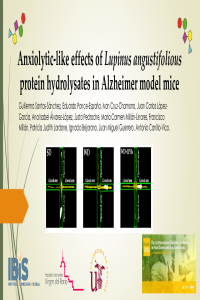
Alzheimer’s disease (AD), which is characterized by a devastating and progressive loss of memory, is the principal neurodegenerative disease in the elderly population worldwide. As a consequence, AD patients present neuropsychiatric symptoms such as anxiety, causing sleeping difficulty, irritability, agitation, or aggressiveness. Previous studies have demonstrated that a high-fat diet, in addition to exacerbating AD, aggravates anxiety. The relationship between diet and AD has generated a search for nutritional treatments that ameliorate the symptoms and consequences of AD. Hence, it has been demonstrated that peptides from sea cucumber, white egg, and soy can help to improve memory activity and anxiety. We have previously demonstrated that Lupinus angustifolius protein hydrolysates (LPHs) have anti-inflammatory and antioxidant effects, key risk factors for AD and anxiety. Thus, this study aimed to evaluate the potential effects of LPHs on spatial memory and anxiety of a preclinical model of Alzheimer's. ApoE-/- mice fed with a western diet were intragastrically treated with LPHs (or vehicle) for 14 weeks. Spatial memory and anxiety were then assessed through Morris water and elevated plus maze, respectively. The results did not show significant differences in spatial memory between groups. However, a significantly increase (p<0.05) in time in open arms (Ctrl: 29.75s vs. LPHs: 54s), center time (Ctrl: 46.75s vs. LPHs: 77.25s), number of crossing (Ctrl: 2.5 vs LPHs: 5 times), and a reduction of anxiety behavior were observed in LPHs-treated mice in comparison to the control group. To summarize, this is the first study showing that a LPHs treatment for 14 weeks causes anxiolytic effects, pointing out LPHs as an effective component of future nutritional therapies.
Keywords
Alzheimer's
Lupine
Peptide
Anxiety
ApoE -/-
Manuscript
sciforum-036888-final.pdf
Poster
presentation_foods.pdf
Effect of spray drying on the microencapsulation of the blueberry natural antioxidants
Nutritional and physicochemical characterization of vegetable fibres in order to obtain gelled products.