Event submissions
Published
 10.3390/foods_2020-07687 (registering DOI)
 This submission belongs to the session 1. Novel Technologies in Food Technology of the event 1st International Electronic Conference on Food Science and Functional Foods
Published date
09 Nov, 2020
Citation
Marko Obranović, Joanna Bryś, Maja Repajić, Sandra Balbino, Dubravka Škevin, Andrzej Bryś, Petra Tonković, Ana Marija Medved, Verica Dragović- Uzelac, Klara Kraljić, Fatty acid and sterol profile of nutmeg (Myristica fragrans) and star anise (Illicium verum) extracted by three different methods, in Proceedings of 1st International Electronic Conference on Food Science and Functional Foods, 10 November–25 November 2020, MDPI: Basel, Switzerland, doi: 10.3390/foods_2020-07687
Share
Email
Facebook
Twitter
LinkedIn
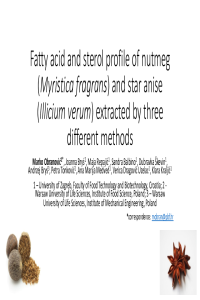
Fatty acid and sterol profile of nutmeg (Myristica fragrans) and star anise (Illicium verum) extracted by three different methods
'%3e%3cpath%20d='M12.6647%2010.9104C12.4176%2010.325%2012.0589%209.7933%2011.6088%209.34485C11.16%208.89511%2010.6283%208.53653%2010.0432%208.28891C10.038%208.28629%2010.0327%208.28498%2010.0275%208.28236C10.8437%207.69282%2011.3743%206.73252%2011.3743%205.64907C11.3743%203.85423%209.92005%202.40002%208.12522%202.40002C6.33038%202.40002%204.87618%203.85423%204.87618%205.64907C4.87618%206.73252%205.40677%207.69282%206.22296%208.28367C6.21772%208.28629%206.21248%208.2876%206.20724%208.29022C5.62031%208.53783%205.09365%208.89287%204.64167%209.34616C4.19192%209.79496%203.83334%2010.3266%203.58573%2010.9117C3.34247%2011.4846%203.21128%2012.0987%203.19925%2012.721C3.1989%2012.735%203.20135%2012.7489%203.20646%2012.7619C3.21157%2012.7749%203.21924%2012.7868%203.22901%2012.7968C3.23877%2012.8068%203.25045%2012.8148%203.26334%2012.8202C3.27623%2012.8256%203.29007%2012.8284%203.30406%2012.8284H4.09012C4.14776%2012.8284%204.19362%2012.7825%204.19493%2012.7262C4.22113%2011.7148%204.62726%2010.7676%205.34519%2010.0497C6.08802%209.30686%207.07452%208.89811%208.12522%208.89811C9.17592%208.89811%2010.1624%209.30686%2010.9052%2010.0497C11.6232%2010.7676%2012.0293%2011.7148%2012.0555%2012.7262C12.0568%2012.7839%2012.1027%2012.8284%2012.1603%2012.8284H12.9464C12.9604%2012.8284%2012.9742%2012.8256%2012.9871%2012.8202C13%2012.8148%2013.0117%2012.8068%2013.0214%2012.7968C13.0312%2012.7868%2013.0389%2012.7749%2013.044%2012.7619C13.0491%2012.7489%2013.0515%2012.735%2013.0512%2012.721C13.0381%2012.0947%2012.9084%2011.4856%2012.6647%2010.9104ZM8.12522%207.90243C7.52388%207.90243%206.95792%207.66793%206.53214%207.24215C6.10636%206.81636%205.87185%206.2504%205.87185%205.64907C5.87185%205.04773%206.10636%204.48177%206.53214%204.05599C6.95792%203.63021%207.52388%203.3957%208.12522%203.3957C8.72655%203.3957%209.29252%203.63021%209.7183%204.05599C10.1441%204.48177%2010.3786%205.04773%2010.3786%205.64907C10.3786%206.2504%2010.1441%206.81636%209.7183%207.24215C9.29252%207.66793%208.72655%207.90243%208.12522%207.90243Z'%20fill='%235D1EE1'/%3e%3c/g%3e%3c/svg%3e)
Marko Obranović 1

Joanna Bryś 2

Maja Repajić 1

Sandra Balbino 1
Dubravka Škevin 1

Andrzej Bryś 3
Petra Tonković 1
Ana Marija Medved 1

Verica Dragović- Uzelac 1
Klara Kraljić 1
1. University of Zagreb, Faculty of Food Technology and Biotechnology, Croatia
2. Warsaw University of Life Sciences, Institute of Food Science, Poland
3. Warsaw University of Life Sciences, Institute of Mechanical Engineering, Poland
Abstract
Nutmeg (Myristica fragrans) and star anise (Illicium verum) are world popular spices originally from South East part of Asia. Apart as food condiment they have been used extensively in traditional medicine and lately as a subject of research in the field of pharmacology and medical sciences. Most of the research were done on the subject of essential oils, especially for the star anise, while the data on seed oil properties is much scarcer.
The main problems in oil extraction of nutmeg is hardness of the nut while for star anise seed is relatively low oil yield (around 10 %). This presents significant problem for screw press production and demands different methods of extraction for better oil yield and quality.
Aim of this research was to compare three different methods of oil extraction with n-hexane - cold extraction, the Soxhlet extraction and Accelerated Solvent Extraction (ASE) at 25 and 100 °C and to compare the processes on the basis of invested time, oil yield, fatty acid and sterol profile of the oils. The determination of fatty acid composition was carried out by GC-FID analysis of fatty acid methyl esters while sterols composition was determined with GC-MS. The highest yield of oil was obtained using the Soxhlet method while the best results combining time and yield were obtained with the ASE method at 100°C. The main fatty acid in star anise seed oil was lauric (average 61,85%) with significant differences between extraction methods (p<0,01) while myristic (average 63,20%) was the most abundant in all samples of nutmeg oil. The main sterol in most of the samples was β-sitosterol.
Keywords
nutmeg
star anise
ASE
fatty acids
sterols
oil
Manuscript
sciforum_036864_original_M_Obranovic_Sciforum_2020 -done.pdf
Poster
Foods_ 2020_M.Obranovic.pdf
Nutritional and physicochemical characterization of vegetable fibres in order to obtain gelled products.
PARTICIPATION OF VINEYARD SOIL YEASTS IN THE SPONTANEOUS MUST FERMENTATION