Event submissions
Published

This submission belongs to the session B. General: Posters of the event 6th International Electronic Conference on Medicinal Chemistry
Published date
09 Nov, 2020
Citation
Sofia Shtykalova, Anna Egorova, Alexander Selyutin, Marianna Maretina, Sergei Selkov, Vladislav Baranov, Anton Kiselev, Suicidal gene therapy of leiomyoma via delivery of herpes thymidine kinase gene by means of αvβ3 integrin-targeted peptide-based carriers and magnetic nanoparticles, in Proceedings of 6th International Electronic Conference on Medicinal Chemistry, 1 November–30 November 2020, MDPI: Basel, Switzerland, doi: 10.3390/ECMC2020-07696
Share
Email
Facebook
Twitter
LinkedIn
Suicidal gene therapy of leiomyoma via delivery of herpes thymidine kinase gene by means of αvβ3 integrin-targeted peptide-based carriers and magnetic nanoparticles
'%3e%3cpath%20d='M12.6647%2010.9104C12.4176%2010.325%2012.0589%209.7933%2011.6088%209.34485C11.16%208.89511%2010.6283%208.53653%2010.0432%208.28891C10.038%208.28629%2010.0327%208.28498%2010.0275%208.28236C10.8437%207.69282%2011.3743%206.73252%2011.3743%205.64907C11.3743%203.85423%209.92005%202.40002%208.12522%202.40002C6.33038%202.40002%204.87618%203.85423%204.87618%205.64907C4.87618%206.73252%205.40677%207.69282%206.22296%208.28367C6.21772%208.28629%206.21248%208.2876%206.20724%208.29022C5.62031%208.53783%205.09365%208.89287%204.64167%209.34616C4.19192%209.79496%203.83334%2010.3266%203.58573%2010.9117C3.34247%2011.4846%203.21128%2012.0987%203.19925%2012.721C3.1989%2012.735%203.20135%2012.7489%203.20646%2012.7619C3.21157%2012.7749%203.21924%2012.7868%203.22901%2012.7968C3.23877%2012.8068%203.25045%2012.8148%203.26334%2012.8202C3.27623%2012.8256%203.29007%2012.8284%203.30406%2012.8284H4.09012C4.14776%2012.8284%204.19362%2012.7825%204.19493%2012.7262C4.22113%2011.7148%204.62726%2010.7676%205.34519%2010.0497C6.08802%209.30686%207.07452%208.89811%208.12522%208.89811C9.17592%208.89811%2010.1624%209.30686%2010.9052%2010.0497C11.6232%2010.7676%2012.0293%2011.7148%2012.0555%2012.7262C12.0568%2012.7839%2012.1027%2012.8284%2012.1603%2012.8284H12.9464C12.9604%2012.8284%2012.9742%2012.8256%2012.9871%2012.8202C13%2012.8148%2013.0117%2012.8068%2013.0214%2012.7968C13.0312%2012.7868%2013.0389%2012.7749%2013.044%2012.7619C13.0491%2012.7489%2013.0515%2012.735%2013.0512%2012.721C13.0381%2012.0947%2012.9084%2011.4856%2012.6647%2010.9104ZM8.12522%207.90243C7.52388%207.90243%206.95792%207.66793%206.53214%207.24215C6.10636%206.81636%205.87185%206.2504%205.87185%205.64907C5.87185%205.04773%206.10636%204.48177%206.53214%204.05599C6.95792%203.63021%207.52388%203.3957%208.12522%203.3957C8.72655%203.3957%209.29252%203.63021%209.7183%204.05599C10.1441%204.48177%2010.3786%205.04773%2010.3786%205.64907C10.3786%206.2504%2010.1441%206.81636%209.7183%207.24215C9.29252%207.66793%208.72655%207.90243%208.12522%207.90243Z'%20fill='%235D1EE1'/%3e%3c/g%3e%3c/svg%3e)
Sofia Shtykalova 1
Anna Egorova 1
Alexander Selyutin 1
Marianna Maretina 1
Sergei Selkov 1
Vladislav Baranov 1

Anton Kiselev 1
1. D.O. Ott Research Institute of Obstetrics, Gynecology and Reproductology
Abstract
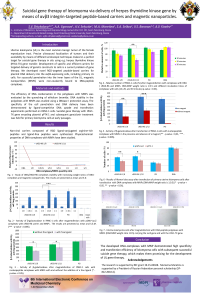
Uterine leiomyoma (UL) is the most common benign tumor of female reproductive tract. Localization of tumors makes the disease a perfect target for suicidal gene therapy using herpes thymidine kinase (HSV1-TK) gene transfer. We developed novel αvβ3-integrin-targeted peptide-based carrier for plasmid DNA delivery. For successful penetration into the inner layers of the UL, magnetic nanoparticles (MNP) were non-covalently bound to DNA-peptide complexes.
Non-viral carrier composed of RGD ligand-conjugated arginine-rich peptides was synthesized and complexes with pDNA and MNP were formed. Physicochemical properties of DNA-complexes were tested. The specificity of DNA delivery was demonstrated by ligand competitive transfection experiments in αvβ3-overexpressed PANC-1 cells. Suicidal gene therapy with HSV1-TK gene delivery and subsequent ganciclovir treatment was held for UL cells obtained after myomectomy. αvβ3-integrins surface expression was detected in 73% of leiomyoma cells.
Non-covalent conjugation of MNP does not lead to the destruction of DNA-peptide complexes and does not affect the protection of DNA from nuclease degradation. Addition of c(RGDfK) ligand during transfection of PANC-1 cells blocked ligand-conjugated complexes transport significantly. Cellular proliferation AlamarBlue and TrypanBlue tests showed a decline of proliferative activity in 27% leiomyoma cells transfected with HSV1-TK gene in comparison with lacZ gene-transfected cells. Addition of MNP to DNA-peptide complexes significantly reduces the incubation time required for efficient transfection.
The developed DNA-complexes with MNP demonstrated high specificity and transfection efficiency of leiomyoma cells with subsequent successful suicide gene therapy, which makes them promising for the development of UL gene therapy.
The work is supported by RSF grant 19-15-00108.
Keywords
gene therapy
herpes thymidine kinase
integrin
leiomyoma
magnetic nanoparticle
non-viral delivery
peptide-based carrier
Poster
Poster_MNPs.pdf
Towards quantitative analysis of the non-covalent interactions in a newly synthesized phenanthroline-based nickel(II) complex: A combined experimental and computational study
Identification of novel compounds from Neocarya macrophylla against toxins from Naja nigricollis using computational approach