Event submissions
Published
 10.3390/foods_2020-07717 (registering DOI)
 This submission belongs to the session 8. Nutraceuticals and Functional Foods of the event 1st International Electronic Conference on Food Science and Functional Foods
Published date
10 Nov, 2020
Citation
Rimjhim Agarwal, Hung Hong, Alice Hayward, Stephen Harper, Neena Mitter, Tim O' Hare, Carotenoid profiling of orange-coloured capsicums in search of high zeaxanthin varieties, in Proceedings of 1st International Electronic Conference on Food Science and Functional Foods, 10 November–25 November 2020, MDPI: Basel, Switzerland, doi: 10.3390/foods_2020-07717
Share
Email
Facebook
Twitter
LinkedIn
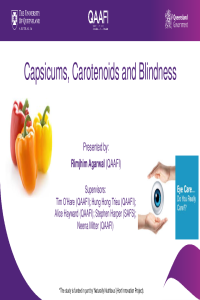
Carotenoid profiling of orange-coloured capsicums in search of high zeaxanthin varieties

Rimjhim Agarwal 1
'%3e%3cpath%20d='M12.6647%2010.9104C12.4176%2010.325%2012.0589%209.7933%2011.6088%209.34485C11.16%208.89511%2010.6283%208.53653%2010.0432%208.28891C10.038%208.28629%2010.0327%208.28498%2010.0275%208.28236C10.8437%207.69282%2011.3743%206.73252%2011.3743%205.64907C11.3743%203.85423%209.92005%202.40002%208.12522%202.40002C6.33038%202.40002%204.87618%203.85423%204.87618%205.64907C4.87618%206.73252%205.40677%207.69282%206.22296%208.28367C6.21772%208.28629%206.21248%208.2876%206.20724%208.29022C5.62031%208.53783%205.09365%208.89287%204.64167%209.34616C4.19192%209.79496%203.83334%2010.3266%203.58573%2010.9117C3.34247%2011.4846%203.21128%2012.0987%203.19925%2012.721C3.1989%2012.735%203.20135%2012.7489%203.20646%2012.7619C3.21157%2012.7749%203.21924%2012.7868%203.22901%2012.7968C3.23877%2012.8068%203.25045%2012.8148%203.26334%2012.8202C3.27623%2012.8256%203.29007%2012.8284%203.30406%2012.8284H4.09012C4.14776%2012.8284%204.19362%2012.7825%204.19493%2012.7262C4.22113%2011.7148%204.62726%2010.7676%205.34519%2010.0497C6.08802%209.30686%207.07452%208.89811%208.12522%208.89811C9.17592%208.89811%2010.1624%209.30686%2010.9052%2010.0497C11.6232%2010.7676%2012.0293%2011.7148%2012.0555%2012.7262C12.0568%2012.7839%2012.1027%2012.8284%2012.1603%2012.8284H12.9464C12.9604%2012.8284%2012.9742%2012.8256%2012.9871%2012.8202C13%2012.8148%2013.0117%2012.8068%2013.0214%2012.7968C13.0312%2012.7868%2013.0389%2012.7749%2013.044%2012.7619C13.0491%2012.7489%2013.0515%2012.735%2013.0512%2012.721C13.0381%2012.0947%2012.9084%2011.4856%2012.6647%2010.9104ZM8.12522%207.90243C7.52388%207.90243%206.95792%207.66793%206.53214%207.24215C6.10636%206.81636%205.87185%206.2504%205.87185%205.64907C5.87185%205.04773%206.10636%204.48177%206.53214%204.05599C6.95792%203.63021%207.52388%203.3957%208.12522%203.3957C8.72655%203.3957%209.29252%203.63021%209.7183%204.05599C10.1441%204.48177%2010.3786%205.04773%2010.3786%205.64907C10.3786%206.2504%2010.1441%206.81636%209.7183%207.24215C9.29252%207.66793%208.72655%207.90243%208.12522%207.90243Z'%20fill='%235D1EE1'/%3e%3c/g%3e%3c/svg%3e)
Hung Hong 2

Alice Hayward 3
Stephen Harper 4
Neena Mitter 3
Tim O' Hare 2
1. Centre for Nutrition and Food Science, Queensland Alliance for Agriculture and Food Innovation
2. Centre for Nutrition and Food Sciences, Queensland Alliance for Agriculture and Food Innovation, The University of Queensland, Brisbane, QLD, Australia.
3. Centre for Horticultural Sciences, Queensland Alliance for Agriculture and Food Innovation, The University of Queensland, Brisbane, QLD, Australia.
4. School of Agriculture and Food Science, The University of Queensland, Brisbane, QLD, Australia.
Abstract
Age related Macular Degeneration (AMD) is the leading cause of blindness in developed countries, such as Australia. Lutein and zeaxanthin are the only two carotenoids found in the macular region of the eye. Past studies have shown that intake of 10 mg and 2 mg per day of lutein and zeaxanthin, respectively, can reduce the risk of AMD. The supply of these carotenoids can only be met through dietary sources or supplements, as these compounds cannot be synthesised by humans. Although lutein is relatively abundant in dietary sources, such as green leafy vegetables, zeaxanthin is much less common, although orange capsicums have been identified as an excellent source. In this study, eight orange and three red capsicum varieties were analysed for their carotenoid profiles by UHPLC-DAD-ESI-MS. It was observed that the principal carotenoid for seven of the orange varieties was zeaxanthin (50-75%), and capsanthin (46-70%) for the three red varieties. One orange variety, which had a darker orange hue, had capsanthin (33%) and violaxanthin (39%) as its principal carotenoids. Zeaxanthin concentration in the 7 orange varieties, with zeaxanthin as the principal carotenoid, varied from a maximum of 25.27±9.4 mg/100g FW to 2.6±0.5 mg/100g FW. Depending on variety, different amounts of tissue would be required to be consumed to attain 2 mg per person per day of zeaxanthin, ranging from 8 g for the highest zeaxanthin-concentration to 100 g for the lowest zeaxanthin-containing variety. This study emphasises the large differences in zeaxanthin concentration that can occur, even between capsicums of similar appearance.
Keywords
Carotenoids
Macular degeneration
Eye health
Orange Capsicums
Zeaxanthin
Manuscript
sciforum_036183_original_Sciforum_net_abstract_approved_sciforum_036183_Revised-done.pdf
Poster
Rimjhim_agarwal.pdf
Comparative evaluation of the antimicrobial actions of Greek honeys produced in the island of Lemnos and that of manuka against clinically important bacteria
Application of 13C NMR and Untargeted Multivariate Analysis for Classification of Virgin Coconut Oil