Event submissions
Published
 10.3390/foods_2020-07720 (registering DOI)
 This submission belongs to the session 4. Food Microbiology and Biotechnology of the event 1st International Electronic Conference on Food Science and Functional Foods
Published date
10 Nov, 2020
Citation
Alexandre Lamas, Laura Sanjulian, Cristina Fente, Alberto Cepeda, Patricia Regal, Milk microbiota: a source of antimicrobial-producing bacteria with potential application in food science, in Proceedings of 1st International Electronic Conference on Food Science and Functional Foods, 10 November–25 November 2020, MDPI: Basel, Switzerland, doi: 10.3390/foods_2020-07720
Share
Email
Facebook
Twitter
LinkedIn
Milk microbiota: a source of antimicrobial-producing bacteria with potential application in food science

Alexandre Lamas 1
'%3e%3cpath%20d='M12.6647%2010.9104C12.4176%2010.325%2012.0589%209.7933%2011.6088%209.34485C11.16%208.89511%2010.6283%208.53653%2010.0432%208.28891C10.038%208.28629%2010.0327%208.28498%2010.0275%208.28236C10.8437%207.69282%2011.3743%206.73252%2011.3743%205.64907C11.3743%203.85423%209.92005%202.40002%208.12522%202.40002C6.33038%202.40002%204.87618%203.85423%204.87618%205.64907C4.87618%206.73252%205.40677%207.69282%206.22296%208.28367C6.21772%208.28629%206.21248%208.2876%206.20724%208.29022C5.62031%208.53783%205.09365%208.89287%204.64167%209.34616C4.19192%209.79496%203.83334%2010.3266%203.58573%2010.9117C3.34247%2011.4846%203.21128%2012.0987%203.19925%2012.721C3.1989%2012.735%203.20135%2012.7489%203.20646%2012.7619C3.21157%2012.7749%203.21924%2012.7868%203.22901%2012.7968C3.23877%2012.8068%203.25045%2012.8148%203.26334%2012.8202C3.27623%2012.8256%203.29007%2012.8284%203.30406%2012.8284H4.09012C4.14776%2012.8284%204.19362%2012.7825%204.19493%2012.7262C4.22113%2011.7148%204.62726%2010.7676%205.34519%2010.0497C6.08802%209.30686%207.07452%208.89811%208.12522%208.89811C9.17592%208.89811%2010.1624%209.30686%2010.9052%2010.0497C11.6232%2010.7676%2012.0293%2011.7148%2012.0555%2012.7262C12.0568%2012.7839%2012.1027%2012.8284%2012.1603%2012.8284H12.9464C12.9604%2012.8284%2012.9742%2012.8256%2012.9871%2012.8202C13%2012.8148%2013.0117%2012.8068%2013.0214%2012.7968C13.0312%2012.7868%2013.0389%2012.7749%2013.044%2012.7619C13.0491%2012.7489%2013.0515%2012.735%2013.0512%2012.721C13.0381%2012.0947%2012.9084%2011.4856%2012.6647%2010.9104ZM8.12522%207.90243C7.52388%207.90243%206.95792%207.66793%206.53214%207.24215C6.10636%206.81636%205.87185%206.2504%205.87185%205.64907C5.87185%205.04773%206.10636%204.48177%206.53214%204.05599C6.95792%203.63021%207.52388%203.3957%208.12522%203.3957C8.72655%203.3957%209.29252%203.63021%209.7183%204.05599C10.1441%204.48177%2010.3786%205.04773%2010.3786%205.64907C10.3786%206.2504%2010.1441%206.81636%209.7183%207.24215C9.29252%207.66793%208.72655%207.90243%208.12522%207.90243Z'%20fill='%235D1EE1'/%3e%3c/g%3e%3c/svg%3e)
Laura Sanjulian 2

Cristina Fente 2

Alberto Cepeda 2

Patricia Regal 2
1. University of Santiago de Compostela
2. Laboratorio de Higiene, Inspección y Control de Alimentos, Universidad de Santiago de Compostela
Abstract
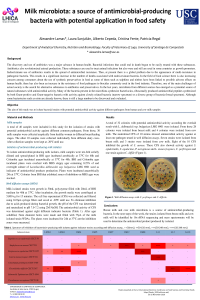
Antimicrobial and biocide resistance is a major public health problem today. Therefore, one of the main scientific challenges nowadays is the search for alternatives to these substances. One of these potential alternatives are the bacteriocins. Microbiota is a potential source of bacteriocin-producing bacteria that needs to be studied. In this study, a total of 40 samples of human milk and 10 samples of cow milk were collected from healthy individuals and stored at -20ºC until use. To isolate antimicrobial-producing milk isolates, milk samples were ten-fold serially diluted and spread-plated in BHI agar and incubated aerobically at 37ºC for 48h. BHI incubated plates were overlaid with MRS sloppy agar containing 0.25% of and overnight culture of Lactobacillus delbrueckii ssp. bulgaricus LMG 6901 used as indicator of antimicrobial products production. Plates were incubated anaerobically 24h at 37ºC. Colonies from BHI that exhibited zones of inhibition on MRS agar were stocked. Well diffusion assays were carried out with the cell-free supernatant (CFS) from these colonies neutralized to pH 7.2 and inhibition zones were recorded. The activity against eight common bacterial pathogens was evaluated. A total of 32 colonies with potential antimicrobial activity were isolated. The neutralized CFS of 10 strains showed antimicrobial activity against at least one pathogen tested in well diffusion assays. Eight of the 10 CFS inhibited the growth of Staphylococcus aureus. These CFS also showed activity against Staphylococcus epidermidis, Streptococcus agalactiae, Pseudomonas aeruginosa and L. monocytogenes. The next steps of the research will be 16s rRNA sequencing to identify the species of isolates and mass spectrometry to determine the antimicrobial product produced by isolated. Finally, this study demonstrated that milk microbiota is a potential source of new producing bacteriocin bacteria that can be used in the formulation of new food products.
Keywords
milk
microbiota
antimicrobial potential
food safety
bacteriocin
Manuscript
sciforum_036101-done.pdf
Poster
Lamas_Foods.pdf
Application of 13C NMR and Untargeted Multivariate Analysis for Classification of Virgin Coconut Oil
Profile of Volatile Organic Compounds (VOCs) from Cold-Processed and Heat-Treated Virgin Coconut Oil (VCO) Samples