Event submissions
Published

This submission belongs to the session C. Crystal Engineering of the event The 2nd International Online Conference on Crystals
Published date
10 Nov, 2020
Citation
Paul Danny Anandan, Chris Rielly, Brahim Benyahia, Optimal trajectory tracking control of batch crystallization process based on reinforcement learning, in Proceedings of The 2nd International Online Conference on Crystals, 10 November–20 November 2020, MDPI: Basel, Switzerland, doi: 10.3390/IOCC_2020-07731
Share
Email
Facebook
Twitter
LinkedIn
Optimal trajectory tracking control of batch crystallization process based on reinforcement learning
'%3e%3cpath%20d='M12.6647%2010.9104C12.4176%2010.325%2012.0589%209.7933%2011.6088%209.34485C11.16%208.89511%2010.6283%208.53653%2010.0432%208.28891C10.038%208.28629%2010.0327%208.28498%2010.0275%208.28236C10.8437%207.69282%2011.3743%206.73252%2011.3743%205.64907C11.3743%203.85423%209.92005%202.40002%208.12522%202.40002C6.33038%202.40002%204.87618%203.85423%204.87618%205.64907C4.87618%206.73252%205.40677%207.69282%206.22296%208.28367C6.21772%208.28629%206.21248%208.2876%206.20724%208.29022C5.62031%208.53783%205.09365%208.89287%204.64167%209.34616C4.19192%209.79496%203.83334%2010.3266%203.58573%2010.9117C3.34247%2011.4846%203.21128%2012.0987%203.19925%2012.721C3.1989%2012.735%203.20135%2012.7489%203.20646%2012.7619C3.21157%2012.7749%203.21924%2012.7868%203.22901%2012.7968C3.23877%2012.8068%203.25045%2012.8148%203.26334%2012.8202C3.27623%2012.8256%203.29007%2012.8284%203.30406%2012.8284H4.09012C4.14776%2012.8284%204.19362%2012.7825%204.19493%2012.7262C4.22113%2011.7148%204.62726%2010.7676%205.34519%2010.0497C6.08802%209.30686%207.07452%208.89811%208.12522%208.89811C9.17592%208.89811%2010.1624%209.30686%2010.9052%2010.0497C11.6232%2010.7676%2012.0293%2011.7148%2012.0555%2012.7262C12.0568%2012.7839%2012.1027%2012.8284%2012.1603%2012.8284H12.9464C12.9604%2012.8284%2012.9742%2012.8256%2012.9871%2012.8202C13%2012.8148%2013.0117%2012.8068%2013.0214%2012.7968C13.0312%2012.7868%2013.0389%2012.7749%2013.044%2012.7619C13.0491%2012.7489%2013.0515%2012.735%2013.0512%2012.721C13.0381%2012.0947%2012.9084%2011.4856%2012.6647%2010.9104ZM8.12522%207.90243C7.52388%207.90243%206.95792%207.66793%206.53214%207.24215C6.10636%206.81636%205.87185%206.2504%205.87185%205.64907C5.87185%205.04773%206.10636%204.48177%206.53214%204.05599C6.95792%203.63021%207.52388%203.3957%208.12522%203.3957C8.72655%203.3957%209.29252%203.63021%209.7183%204.05599C10.1441%204.48177%2010.3786%205.04773%2010.3786%205.64907C10.3786%206.2504%2010.1441%206.81636%209.7183%207.24215C9.29252%207.66793%208.72655%207.90243%208.12522%207.90243Z'%20fill='%235D1EE1'/%3e%3c/g%3e%3c/svg%3e)
Paul Danny Anandan 1
Chris Rielly 1

Brahim Benyahia 1
1. Loughborough University
Abstract
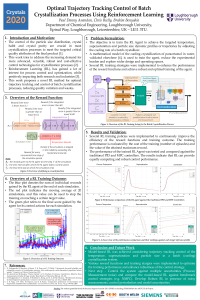
The control of the particle size distribution, crystal habit, and crystal purity is crucial in most crystallization processes to meet the targeted critical quality attributes of the final product. Over the last two decades, several model-free strategies, such as supersaturation control and direct nucleation control, and model-based techniques, such as model predictive control, have been developed and implemented in a wide range of scientific and industrial sectors, particularly the pharmaceutical industry. Despite the significant progress, there is still an increasing demand for more advanced, versatile, robust, and cost-effective optimization and control technologies for both batch and continuous crystallization processes to ensure, through real-time trajectory tracking control, high product quality and reduce batch-to-batch variation and wastes. A novel optimal trajectory tracking control strategies of a batch cooling crystallization processes based on reinforcement learning is presented. The cooling crystallization of paracetamol in water was used as a case study. A model-based technique is implemented, using a dynamic mathematical model validated elsewhere, to reduce the experimental burden and explore wider design and operating spaces. The main objective is to achieve a large crystal size and reduce the deviation from a targeted final yield and coefficient of variation. Several training strategies and reward functions were tested to help achieve robust optimal training of the agent. The agents, with the best training features, were validated against different particle size, temperature, and supersaturation trajectories, then compared to benchmark control techniques, such as supersaturation control and model predictive control.
Keywords
Reinforcement learning
Trajectory tracking control
Batch crystallization
Supersaturation control
Crystal size distribution
Poster
Paul Danny Anandan Poster.pdf
MAPPING OF NOVEL BINARY COPPER OXIDES WITH DENSITY FUNCTIONAL THEORY MODELLING
Physico-Chemical Characterization of New Rare-Earth Doped Calcium Phosphates