Event submissions
Published
 10.3390/foods_2020-07732 (registering DOI)
 This submission belongs to the session 4. Food Microbiology and Biotechnology of the event 1st International Electronic Conference on Food Science and Functional Foods
Published date
10 Nov, 2020
Citation
Patricia Gil, Alberto Martínez, Joaquín Bautista, Rocío Velázquez, Manuel Ramírez, Luis Miguel Hernández, Co-inocula essays of yeasts with “killer” phenotype and sensitive strains of Saccharomyces cerevisiae with defects in mannoprotein synthesis., in Proceedings of 1st International Electronic Conference on Food Science and Functional Foods, 10 November–25 November 2020, MDPI: Basel, Switzerland, doi: 10.3390/foods_2020-07732
Share
Email
Facebook
Twitter
LinkedIn
Co-inocula essays of yeasts with “killer” phenotype and sensitive strains of Saccharomyces cerevisiae with defects in mannoprotein synthesis.
'%3e%3cpath%20d='M12.6647%2010.9104C12.4176%2010.325%2012.0589%209.7933%2011.6088%209.34485C11.16%208.89511%2010.6283%208.53653%2010.0432%208.28891C10.038%208.28629%2010.0327%208.28498%2010.0275%208.28236C10.8437%207.69282%2011.3743%206.73252%2011.3743%205.64907C11.3743%203.85423%209.92005%202.40002%208.12522%202.40002C6.33038%202.40002%204.87618%203.85423%204.87618%205.64907C4.87618%206.73252%205.40677%207.69282%206.22296%208.28367C6.21772%208.28629%206.21248%208.2876%206.20724%208.29022C5.62031%208.53783%205.09365%208.89287%204.64167%209.34616C4.19192%209.79496%203.83334%2010.3266%203.58573%2010.9117C3.34247%2011.4846%203.21128%2012.0987%203.19925%2012.721C3.1989%2012.735%203.20135%2012.7489%203.20646%2012.7619C3.21157%2012.7749%203.21924%2012.7868%203.22901%2012.7968C3.23877%2012.8068%203.25045%2012.8148%203.26334%2012.8202C3.27623%2012.8256%203.29007%2012.8284%203.30406%2012.8284H4.09012C4.14776%2012.8284%204.19362%2012.7825%204.19493%2012.7262C4.22113%2011.7148%204.62726%2010.7676%205.34519%2010.0497C6.08802%209.30686%207.07452%208.89811%208.12522%208.89811C9.17592%208.89811%2010.1624%209.30686%2010.9052%2010.0497C11.6232%2010.7676%2012.0293%2011.7148%2012.0555%2012.7262C12.0568%2012.7839%2012.1027%2012.8284%2012.1603%2012.8284H12.9464C12.9604%2012.8284%2012.9742%2012.8256%2012.9871%2012.8202C13%2012.8148%2013.0117%2012.8068%2013.0214%2012.7968C13.0312%2012.7868%2013.0389%2012.7749%2013.044%2012.7619C13.0491%2012.7489%2013.0515%2012.735%2013.0512%2012.721C13.0381%2012.0947%2012.9084%2011.4856%2012.6647%2010.9104ZM8.12522%207.90243C7.52388%207.90243%206.95792%207.66793%206.53214%207.24215C6.10636%206.81636%205.87185%206.2504%205.87185%205.64907C5.87185%205.04773%206.10636%204.48177%206.53214%204.05599C6.95792%203.63021%207.52388%203.3957%208.12522%203.3957C8.72655%203.3957%209.29252%203.63021%209.7183%204.05599C10.1441%204.48177%2010.3786%205.04773%2010.3786%205.64907C10.3786%206.2504%2010.1441%206.81636%209.7183%207.24215C9.29252%207.66793%208.72655%207.90243%208.12522%207.90243Z'%20fill='%235D1EE1'/%3e%3c/g%3e%3c/svg%3e)
Patricia Gil 1
Alberto Martínez 1

Joaquín Bautista 1
Rocío Velázquez 2
Manuel Ramírez 1
Luis Miguel Hernández 1
1. University of Extremadura
2. Università degli Studi di Padova
Abstract
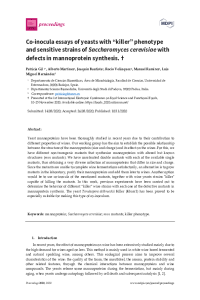
In order to study the relationship between mannoprotein structures and their effect on wine properties, in a preview study, some mutants of S.cerevisiae with altered and known N-oligosaccharide structure were constructed. In this research, we have made preliminary studies to find the optimal conditions to use mixed cultures of killer yeasts, with high fermentative efficiency and sensitive mutant strains.
Mutant yeasts were spread in YEPD-methylene blue plates and killer yeasts drop on top. The assays were done at two pHs (3,5 and 4) and two temperatures (13 and 25oC).
Single mutants used: mnn1, mnn2, mnn3, mnn5, mnn6, mnn9 y mnn10. Double mutants used: mnn1mnn2, mnn1mnn6, mnn1mnn9, mnn1mnn10, mnn2mnn6, mnn2mnn10, y mnn6mnn10.
As killer strains, we used yeasts that produce different killer toxins: K1, K2, K28 Klus, Kbarr1, and Kbarr2. The differences between these toxins are the mechanism of action (unknown in some cases), the degree of toxicity, and optimal temperature and pH of action.
The results suggest that the susceptibility of a strain to a toxin is usually greater the more damaged its cell wall is. It is particularly clear in the case of K1 and K2 toxins. Strains with a more exposed surface charge (mnn1 mutation) are more sensitive than those without it (mnn6). Concerning temperatures, no significant differences were observed, although, in some cases, the effects of the toxin were slightly more intense at 25ºC (Klus and Kbarr1).
Acknowledgments: Projects GR18117 y IB16132 (Consejería de Economía, Ciencia y Agenda Digital, Junta de Extremadura), project AGL2017-87635-R (Ministerio de Economía, Industria y Competitividad, Agencia Estatal de Investigación, Gobierno de España) and Fondo Europeo de Desarrollo Regional (FEDER).
Keywords
mannoprotein
Saccharomyces cerevisiae
mnn mutants
killer phenotype.
Manuscript
sciforum_034875 - done.pdf
Poster
Co-inocula essays_v.final-final.pdf
Profiling of the oil of the Egyptian cultivar of sesame ‘Giza 32’ using LC-MS-based untargeted metabolomics
Genetic analysis of mutant strains of Saccharomyces cerevisiae with defects in mannoproteins synthesis