Event submissions
Published
 10.3390/foods_2020-07747 (registering DOI)
 This submission belongs to the session 2. Food Packaging and New Packaging Materials of the event 1st International Electronic Conference on Food Science and Functional Foods
Published date
10 Nov, 2020
Citation
Sofia Agriopoulou, Vasiliki Skiada, Eygenia Stamatelopoulou, Panagiotis Tsarouhas, Theodoros Varzakas, Emerging nanomaterials applications for food packaging and preservation. Safety issues and risk assessment., in Proceedings of 1st International Electronic Conference on Food Science and Functional Foods, 10 November–25 November 2020, MDPI: Basel, Switzerland, doi: 10.3390/foods_2020-07747
Share
Email
Facebook
Twitter
LinkedIn
Emerging nanomaterials applications for food packaging and preservation. Safety issues and risk assessment.

Sofia Agriopoulou 1
'%3e%3cpath%20d='M12.6647%2010.9104C12.4176%2010.325%2012.0589%209.7933%2011.6088%209.34485C11.16%208.89511%2010.6283%208.53653%2010.0432%208.28891C10.038%208.28629%2010.0327%208.28498%2010.0275%208.28236C10.8437%207.69282%2011.3743%206.73252%2011.3743%205.64907C11.3743%203.85423%209.92005%202.40002%208.12522%202.40002C6.33038%202.40002%204.87618%203.85423%204.87618%205.64907C4.87618%206.73252%205.40677%207.69282%206.22296%208.28367C6.21772%208.28629%206.21248%208.2876%206.20724%208.29022C5.62031%208.53783%205.09365%208.89287%204.64167%209.34616C4.19192%209.79496%203.83334%2010.3266%203.58573%2010.9117C3.34247%2011.4846%203.21128%2012.0987%203.19925%2012.721C3.1989%2012.735%203.20135%2012.7489%203.20646%2012.7619C3.21157%2012.7749%203.21924%2012.7868%203.22901%2012.7968C3.23877%2012.8068%203.25045%2012.8148%203.26334%2012.8202C3.27623%2012.8256%203.29007%2012.8284%203.30406%2012.8284H4.09012C4.14776%2012.8284%204.19362%2012.7825%204.19493%2012.7262C4.22113%2011.7148%204.62726%2010.7676%205.34519%2010.0497C6.08802%209.30686%207.07452%208.89811%208.12522%208.89811C9.17592%208.89811%2010.1624%209.30686%2010.9052%2010.0497C11.6232%2010.7676%2012.0293%2011.7148%2012.0555%2012.7262C12.0568%2012.7839%2012.1027%2012.8284%2012.1603%2012.8284H12.9464C12.9604%2012.8284%2012.9742%2012.8256%2012.9871%2012.8202C13%2012.8148%2013.0117%2012.8068%2013.0214%2012.7968C13.0312%2012.7868%2013.0389%2012.7749%2013.044%2012.7619C13.0491%2012.7489%2013.0515%2012.735%2013.0512%2012.721C13.0381%2012.0947%2012.9084%2011.4856%2012.6647%2010.9104ZM8.12522%207.90243C7.52388%207.90243%206.95792%207.66793%206.53214%207.24215C6.10636%206.81636%205.87185%206.2504%205.87185%205.64907C5.87185%205.04773%206.10636%204.48177%206.53214%204.05599C6.95792%203.63021%207.52388%203.3957%208.12522%203.3957C8.72655%203.3957%209.29252%203.63021%209.7183%204.05599C10.1441%204.48177%2010.3786%205.04773%2010.3786%205.64907C10.3786%206.2504%2010.1441%206.81636%209.7183%207.24215C9.29252%207.66793%208.72655%207.90243%208.12522%207.90243Z'%20fill='%235D1EE1'/%3e%3c/g%3e%3c/svg%3e)
Vasiliki Skiada 1
Eygenia Stamatelopoulou 1

Panagiotis Tsarouhas 2

Theodoros Varzakas 1
1. Department of Food Science and Technology, University of the Peloponnese, Antikalamos, 24100 Kalamata, Greece
2. Department of Supply Chain Management (Logistics), International Hellenic University, Kanellopoulou 2,
60100 Katerini, Greece
Abstract
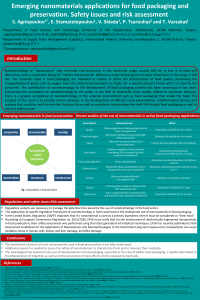
The contribution of nanomaterials to the development of food packaging systems has been enormous in last years. Nanomaterial, defined as material having one or more dimensions in the range 1–100 nm. Materials at the nano scale cannot be seen with the naked eye, nor even with a conventional light microscope. Nano-sized materials change their optical, magnetic, electrical, and other properties and for this reason are widely used in food packaging. A variety of nanomaterials find many applications, in food preservation extending the shelf life of foods and increasing preservation time. Nanoparticles (NPs), nanocomposites (NCs), nanoclays (NCs), nanoemulsions (NEs), nanosensors (NSs), and nanostructures (NSTs) (including nanoliposomes, nanospheres, nanocapsules, nanofibers, and nanotubes) are some of the important nanomaterials that have been used in food packaging and preservation. Nanomaterials can offer solutions in food packaging and preservation, through active and smart packaging, edible coatings and the development of a wide range of capable nanosystems. Therefore, nanomaterials can be considered as important tools and efficient options for controlling, limiting and improving safety parameters and food quality that is highly desirable in food technology. Innovative nanomaterials even achieve real-time food quality monitoring, providing an efficient option in food preservation applications. The use of these materials in food preservation is an emerging trend that raises significant inconveniences, as some of them, through ingestion, inhalation and exposure end up in the human body. Food preservation in all cases should be related to materials that are completely safe and compatible with food systems. The toxicological risk posed by the use of nanomaterials in food packaging and in particular in the case of edible nano-packaging, is significantly linked to the migration phenomenon as well as the occurrence of toxic effects on the exposed human body.
Keywords
nanomaterials
food packaging and preservation
active and smart packaging
edible coatings
food quality
toxicological risk
Manuscript
sciforum_034686_original_Emerging_nanomaterials-done.pdf
Poster
Poster_Emerging nanomaterials applications.pdf
Application of chia seed coproduct in dry-cured sausages: effect upon its physicochemical properties
Examining the possibility of improving the properties of sunflower oil in order to obtain a better medium for the process of frying food