Event submissions
Published
 10.3390/foods_2020-07751 (registering DOI)
 This submission belongs to the session 9. Innovative Food Additives and Ingredients of the event 1st International Electronic Conference on Food Science and Functional Foods
Published date
10 Nov, 2020
Citation
Stefania Toscano, Valeria Rizzo, Giuseppe Muratore, Daniela Romano, Edible wild flowers: an innovative but ancient food, in Proceedings of 1st International Electronic Conference on Food Science and Functional Foods, 10 November–25 November 2020, MDPI: Basel, Switzerland, doi: 10.3390/foods_2020-07751
Share
Email
Facebook
Twitter
LinkedIn
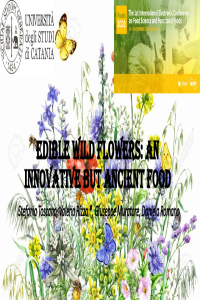
Edible wild flowers: an innovative but ancient food

Stefania Toscano 1

Valeria Rizzo 2
'%3e%3cpath%20d='M12.6647%2010.9104C12.4176%2010.325%2012.0589%209.7933%2011.6088%209.34485C11.16%208.89511%2010.6283%208.53653%2010.0432%208.28891C10.038%208.28629%2010.0327%208.28498%2010.0275%208.28236C10.8437%207.69282%2011.3743%206.73252%2011.3743%205.64907C11.3743%203.85423%209.92005%202.40002%208.12522%202.40002C6.33038%202.40002%204.87618%203.85423%204.87618%205.64907C4.87618%206.73252%205.40677%207.69282%206.22296%208.28367C6.21772%208.28629%206.21248%208.2876%206.20724%208.29022C5.62031%208.53783%205.09365%208.89287%204.64167%209.34616C4.19192%209.79496%203.83334%2010.3266%203.58573%2010.9117C3.34247%2011.4846%203.21128%2012.0987%203.19925%2012.721C3.1989%2012.735%203.20135%2012.7489%203.20646%2012.7619C3.21157%2012.7749%203.21924%2012.7868%203.22901%2012.7968C3.23877%2012.8068%203.25045%2012.8148%203.26334%2012.8202C3.27623%2012.8256%203.29007%2012.8284%203.30406%2012.8284H4.09012C4.14776%2012.8284%204.19362%2012.7825%204.19493%2012.7262C4.22113%2011.7148%204.62726%2010.7676%205.34519%2010.0497C6.08802%209.30686%207.07452%208.89811%208.12522%208.89811C9.17592%208.89811%2010.1624%209.30686%2010.9052%2010.0497C11.6232%2010.7676%2012.0293%2011.7148%2012.0555%2012.7262C12.0568%2012.7839%2012.1027%2012.8284%2012.1603%2012.8284H12.9464C12.9604%2012.8284%2012.9742%2012.8256%2012.9871%2012.8202C13%2012.8148%2013.0117%2012.8068%2013.0214%2012.7968C13.0312%2012.7868%2013.0389%2012.7749%2013.044%2012.7619C13.0491%2012.7489%2013.0515%2012.735%2013.0512%2012.721C13.0381%2012.0947%2012.9084%2011.4856%2012.6647%2010.9104ZM8.12522%207.90243C7.52388%207.90243%206.95792%207.66793%206.53214%207.24215C6.10636%206.81636%205.87185%206.2504%205.87185%205.64907C5.87185%205.04773%206.10636%204.48177%206.53214%204.05599C6.95792%203.63021%207.52388%203.3957%208.12522%203.3957C8.72655%203.3957%209.29252%203.63021%209.7183%204.05599C10.1441%204.48177%2010.3786%205.04773%2010.3786%205.64907C10.3786%206.2504%2010.1441%206.81636%209.7183%207.24215C9.29252%207.66793%208.72655%207.90243%208.12522%207.90243Z'%20fill='%235D1EE1'/%3e%3c/g%3e%3c/svg%3e)
Giuseppe Muratore 1

Daniela Romano 1
1. Università di Catania
2. Università di Catania Dipartimento di Agricoltura, Alimentazione e Ambiente (Di3A)
Via Santa Sofia 100 – 95123 Catania
Abstract
Edible flowers are often more mentioned in connection with biologically active substances and their presence is today frequent in supermarket. The main factor that determines the purchase of edible flowers by consumers is their appearance, so particular attention must be paid to the shelf life. The potential number of suitable species is very high (over 1,000) and some species are also present in the spontaneous flora of Mediterranean environment.
Flowers must be protected from desiccation and their quality preserved, so the aims of this study were to evaluate the shelf life of the spontaneous edible flowers Glebionis segetum, Malva sylvestris, Papaver rhoeas and Tropaeolum majus and detect the presence of major polyphenols. The flowers have been packaged with polypropylene (PP) bags and then stored in a refrigerator at +4±1°C. Samples were tested in the dark and in the presence of light for 12 days.
Gas composition, weight loss and colour have been registered once the packages have been opened; the flower petals were frozen for antioxidant activity, total phenols and enzymatic analyses. Catalase (CAT), Glutathione peroxidase (GPX) and Superoxide dismutase (SOD) were performed.
As expected the light has always a negative influence, the weight loss was limited and the gas composition did not change too much during shelf life, with different variation in the studied edible flowers.
Image analysis was performed to describe color changes and the highest variation in color parameters (Red Green Blue) was found in control samples. The extracts from Glebionis segetum showed the highest antioxidant activity and polyphenol content. Also enzymatic results pointed out the PP as best packaging film if considered in the dark. Glebionis segetum was the most resistant but it had also the highest weight loss, Papaver rhoeas was characterized by extreme fragility, Malva sylvestris was not able to tolerate low temperatures and Tropaeolum majus changed its color progressively with the time.
Keywords
visual quality
shelf life
lightening
color
Manuscript
sciforum_034513-done.pdf
Poster
edible flowers_rev.pdf
Avocado-derived biomass: chemical composition and antioxidant potential
Functionalisation of pectin by ultra high pressure homogenisation