Event submissions
Published
 10.3390/foods_2020-07753 (registering DOI)
 This submission belongs to the session 5. Food Safety and Sustainable Development of the event 1st International Electronic Conference on Food Science and Functional Foods
Published date
10 Nov, 2020
Citation
Gisela Rodrigues, Sara Coelho-Fernandes, José M. Lorenzo, Ursula Gonzales-Barron, Vasco Cadavez, MICROBIAL DETERIORATION OF LAMB MEAT OF PORTUGUESE ORIGIN AS AFFECTED BY ITS INTRINSIC PROPERTIES, in Proceedings of 1st International Electronic Conference on Food Science and Functional Foods, 10 November–25 November 2020, MDPI: Basel, Switzerland, doi: 10.3390/foods_2020-07753
Share
Email
Facebook
Twitter
LinkedIn
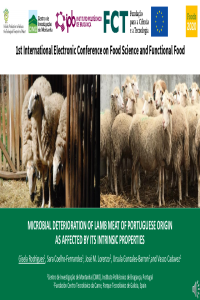
MICROBIAL DETERIORATION OF LAMB MEAT OF PORTUGUESE ORIGIN AS AFFECTED BY ITS INTRINSIC PROPERTIES
'%3e%3cpath%20d='M12.6647%2010.9104C12.4176%2010.325%2012.0589%209.7933%2011.6088%209.34485C11.16%208.89511%2010.6283%208.53653%2010.0432%208.28891C10.038%208.28629%2010.0327%208.28498%2010.0275%208.28236C10.8437%207.69282%2011.3743%206.73252%2011.3743%205.64907C11.3743%203.85423%209.92005%202.40002%208.12522%202.40002C6.33038%202.40002%204.87618%203.85423%204.87618%205.64907C4.87618%206.73252%205.40677%207.69282%206.22296%208.28367C6.21772%208.28629%206.21248%208.2876%206.20724%208.29022C5.62031%208.53783%205.09365%208.89287%204.64167%209.34616C4.19192%209.79496%203.83334%2010.3266%203.58573%2010.9117C3.34247%2011.4846%203.21128%2012.0987%203.19925%2012.721C3.1989%2012.735%203.20135%2012.7489%203.20646%2012.7619C3.21157%2012.7749%203.21924%2012.7868%203.22901%2012.7968C3.23877%2012.8068%203.25045%2012.8148%203.26334%2012.8202C3.27623%2012.8256%203.29007%2012.8284%203.30406%2012.8284H4.09012C4.14776%2012.8284%204.19362%2012.7825%204.19493%2012.7262C4.22113%2011.7148%204.62726%2010.7676%205.34519%2010.0497C6.08802%209.30686%207.07452%208.89811%208.12522%208.89811C9.17592%208.89811%2010.1624%209.30686%2010.9052%2010.0497C11.6232%2010.7676%2012.0293%2011.7148%2012.0555%2012.7262C12.0568%2012.7839%2012.1027%2012.8284%2012.1603%2012.8284H12.9464C12.9604%2012.8284%2012.9742%2012.8256%2012.9871%2012.8202C13%2012.8148%2013.0117%2012.8068%2013.0214%2012.7968C13.0312%2012.7868%2013.0389%2012.7749%2013.044%2012.7619C13.0491%2012.7489%2013.0515%2012.735%2013.0512%2012.721C13.0381%2012.0947%2012.9084%2011.4856%2012.6647%2010.9104ZM8.12522%207.90243C7.52388%207.90243%206.95792%207.66793%206.53214%207.24215C6.10636%206.81636%205.87185%206.2504%205.87185%205.64907C5.87185%205.04773%206.10636%204.48177%206.53214%204.05599C6.95792%203.63021%207.52388%203.3957%208.12522%203.3957C8.72655%203.3957%209.29252%203.63021%209.7183%204.05599C10.1441%204.48177%2010.3786%205.04773%2010.3786%205.64907C10.3786%206.2504%2010.1441%206.81636%209.7183%207.24215C9.29252%207.66793%208.72655%207.90243%208.12522%207.90243Z'%20fill='%235D1EE1'/%3e%3c/g%3e%3c/svg%3e)
Gisela Rodrigues 1
Sara Coelho-Fernandes 1

José M. Lorenzo 2

Ursula Gonzales-Barron 1
Vasco Cadavez 1
1. Centro de Investigação de Montanha (CIMO), Instituto Politécnico de Bragança, 5300-253 Bragança, Portugal
2. Fundación Centro Tecnolóxico da Carne, Parque Tecnolóxico de Galicia, 3200 San Cibrao das Viñas, Spain
Abstract
The main autochthonous Portuguese sheep breeds exploited for meat production are Churra-Galega-Bragançana (CGB) and Bordaleira-de-Entre-Douro-e-Minho (BEDM), whose quality must be optimised in order to ensure adequate income levels for sheep producers. The study aimed to elucidate how intrinsic properties affected the evolution of spoilage microorganisms in refrigerated vacuum-packed (VP) lamb meat from BEDM and CGB breeds. Thirty CGB and 30 BEDM lambs were four months old when slaughtered. Physicochemical analyses (i.e., pH, water activity and proximate composition) were performed on meat on day 1 after slaughter, while microbial counts (mesophiles, psychrotrophic, lactic acid bacteria and Pseudomonas spp.) were essayed on VP meat on days 3, 9 and 15. Mixed-effects models were adjusted to each of the microbial groups to assess the effect of breed, time of maturation and each of the intrinsic properties of meat, in separate. Breed had a significant effect on all microbial groups (p<.0001): meat from BEDM breed presented higher (p<.0001) populations of mesophiles, lactic acid bacteria, Pseudomonas spp. and psychrotrophic bacteria, since its higher ultimate pH (means: 5.77 for BEDM vs. 5.58 for CGB) accelerated spoilage rate (p<.0001). While water activity and protein content were not found to modulate microbial deterioration (p>0.05), the growth of spoilage bacteria was found to be exacerbated by higher moisture (p<.0001) and higher ashes content (p<0.001). By contrast, a higher fat content retarded (p<.0001) the growth of spoilage bacteria in VP lamb meat. In order to extend the shelf-life of Portuguese-origin lamb meat, animal handling must be enhanced to minimise pre-slaughter stress, and a carcass classification system should be adopted towards the selection of fatter animals and chilled carcasses of optimal ultimate pH.
Keywords
Sheep
local breeds
proximate composition
pH
lactic acid bacteria
Pseudomonas
psychrotrophic bacteria
shelf-life
Manuscript
sciforum-034496.pdf
Poster
ppt_Lamb_PDF.pdf
Functionalisation of pectin by ultra high pressure homogenisation
Multiple SERS detection of phenol derivatives in tap water