Event submissions
Published

This submission belongs to the session J. Posters of the event The 1st International Electronic Conference on Catalysis Sciences
Published date
10 Nov, 2020
Citation
El-Mahdi Ourhzif, Mostafa Khouili, Mohamed Akssira, Yves Troin, Synthesis and Biological Evaluation of New Naphthoquinones Derivatives by Catalytic Oxidation, in Proceedings of The 1st International Electronic Conference on Catalysis Sciences, 10 November–30 November 2020, MDPI: Basel, Switzerland, doi: 10.3390/ECCS2020-07754
Share
Email
Facebook
Twitter
LinkedIn
Synthesis and Biological Evaluation of New Naphthoquinones Derivatives by Catalytic Oxidation
'%3e%3cpath%20d='M12.6647%2010.9104C12.4176%2010.325%2012.0589%209.7933%2011.6088%209.34485C11.16%208.89511%2010.6283%208.53653%2010.0432%208.28891C10.038%208.28629%2010.0327%208.28498%2010.0275%208.28236C10.8437%207.69282%2011.3743%206.73252%2011.3743%205.64907C11.3743%203.85423%209.92005%202.40002%208.12522%202.40002C6.33038%202.40002%204.87618%203.85423%204.87618%205.64907C4.87618%206.73252%205.40677%207.69282%206.22296%208.28367C6.21772%208.28629%206.21248%208.2876%206.20724%208.29022C5.62031%208.53783%205.09365%208.89287%204.64167%209.34616C4.19192%209.79496%203.83334%2010.3266%203.58573%2010.9117C3.34247%2011.4846%203.21128%2012.0987%203.19925%2012.721C3.1989%2012.735%203.20135%2012.7489%203.20646%2012.7619C3.21157%2012.7749%203.21924%2012.7868%203.22901%2012.7968C3.23877%2012.8068%203.25045%2012.8148%203.26334%2012.8202C3.27623%2012.8256%203.29007%2012.8284%203.30406%2012.8284H4.09012C4.14776%2012.8284%204.19362%2012.7825%204.19493%2012.7262C4.22113%2011.7148%204.62726%2010.7676%205.34519%2010.0497C6.08802%209.30686%207.07452%208.89811%208.12522%208.89811C9.17592%208.89811%2010.1624%209.30686%2010.9052%2010.0497C11.6232%2010.7676%2012.0293%2011.7148%2012.0555%2012.7262C12.0568%2012.7839%2012.1027%2012.8284%2012.1603%2012.8284H12.9464C12.9604%2012.8284%2012.9742%2012.8256%2012.9871%2012.8202C13%2012.8148%2013.0117%2012.8068%2013.0214%2012.7968C13.0312%2012.7868%2013.0389%2012.7749%2013.044%2012.7619C13.0491%2012.7489%2013.0515%2012.735%2013.0512%2012.721C13.0381%2012.0947%2012.9084%2011.4856%2012.6647%2010.9104ZM8.12522%207.90243C7.52388%207.90243%206.95792%207.66793%206.53214%207.24215C6.10636%206.81636%205.87185%206.2504%205.87185%205.64907C5.87185%205.04773%206.10636%204.48177%206.53214%204.05599C6.95792%203.63021%207.52388%203.3957%208.12522%203.3957C8.72655%203.3957%209.29252%203.63021%209.7183%204.05599C10.1441%204.48177%2010.3786%205.04773%2010.3786%205.64907C10.3786%206.2504%2010.1441%206.81636%209.7183%207.24215C9.29252%207.66793%208.72655%207.90243%208.12522%207.90243Z'%20fill='%235D1EE1'/%3e%3c/g%3e%3c/svg%3e)
El-Mahdi Ourhzif 1
Mostafa Khouili 2
Mohamed Akssira 3
Yves Troin 4
1. Université Clermont Auvergne, CNRS, SIGMA Clermont , ICCF, F-63000 Clermont–Ferrand, France .Université Hassan II Casablanca, FST, Laboratoire de Chimie Physique et Chimie Bio organique BP 146,28800 Mohammedia, Maroc. Université Sultan Moulay Slimane, FST
2. Université Sultan Moulay Slimane, FST, Laboratoire de Chimie Organique et Analytique, BP 523 Beni-Mellal, Maroc
3. Université Hassan II Casablanca, FST, Laboratoire de Chimie Physique et Chimie Bio organique BP 146,28800 Mohammedia, Maroc
4. Université Clermont Auvergne, CNRS, SIGMA Clermont , ICCF, F-63000 Clermont–Ferrand, France
Abstract
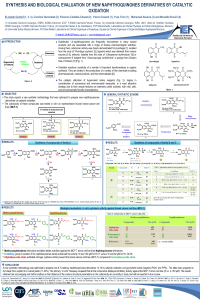
The catalytic utilization of hypervalent iodine reagents, largely in consideration of economical and environmental viewpoints, is a most attractive strategy due to their unique features as extremely useful oxidants, with mild, safe, and environmentally friendly characteristics. Oxidation reactions constitute of a number of important transformations in organic synthesis. They are widely in the productions of a variety pharmaceuticals and natural products, and their intermediates.[1] As oxidants, hypervalent iodine reagents have recently received much attention due to their low toxicity, mild reactivity, ready availability, high stability, easy handling, etc.[2] For examples, phenyliodine(III) diacetate (PIDA) and phenyliodine(III) bis (trifluoroacetate) (PIFA)-induced oxidations of phenols and related reactions have been applied to many total syntheses of biologically important natural products and their pivotal intermediates.[3] This study reports a new synthetic methodology that was optimized to prepare new naphthoquinones derivatives via catalytic oxidation.
[1] Hoelderich , W. F., Kollmer, F. Pure Appl. Chem.2000, 72, 1273.
[2] (a) Zhdankin, V. V. ; Stang, P. J. Chem. Rev. 2002, 102, 2523. (b) Tohma, H. ; Kita, Y. Adv. Synth. Catal. 2004, 346, 111. (c) Moriarty, R. M. J. Org. Chem, 2005, 70, 2893. (d) Wirth, T. Angew. Chem. Int. Ed. 2005, 44, 3656. (e) Ochiai, M. Chem. Rec. 2007, 7, 12.
[3] a) Pouységu, L.; Deffieux, D.; Quideau, S. Hypervalent iodine-mediated phenol dearomatization in natural product synthesis. Tetrahedron. 2010, 66, 2235-2261.Available. b) Moriarty, R.; Prakash, O. Oxidation of phenolic compounds with organohypervalent iodine reagents in Organic Reactions. Wiley New York, 2001, 57, 327-415. C) Ladziata, U.; Zhdankin, V.V. Hypervalent iodine(V) reagents in organic synthesis. ARKIVOC, 2006, (ix), 26-58.
Keywords
Naphthoquinones
naphthols
phenyliodine(III) diacetate (PIDA)
phenyliodine(III) bis(trifluoroacetate) (PIFA)
catalytic oxydation
Manuscript
034233.pdf
Poster
Poster. E. OURHZIF. ESSC 2020.pdf
BioICEP. Bio Innovation of A Circular Economy for Plastics
Synthesis of New Selenides-1,2,3-triazoles With Potential Activity Against Trypanossoma cruzi