Event submissions
Published
 10.3390/foods_2020-07756 (registering DOI)
 This submission belongs to the session 4. Food Microbiology and Biotechnology of the event 1st International Electronic Conference on Food Science and Functional Foods
Published date
10 Nov, 2020
Citation
Alberto Martínez Brígido, Rocío Velázquez, Emiliano Zamora, Maria L. Álvarez, Patricia Gil, Camille Garzo, Luis Miguel Hernández, Manuel Ramírez, BASE WINE AND TRADITIONAL SPARKLING WINE MAKING USING TORULASPORA DELBRUECKII KILLER YEASTS, in Proceedings of 1st International Electronic Conference on Food Science and Functional Foods, 10 November–25 November 2020, MDPI: Basel, Switzerland, doi: 10.3390/foods_2020-07756
Share
Email
Facebook
Twitter
LinkedIn
BASE WINE AND TRADITIONAL SPARKLING WINE MAKING USING TORULASPORA DELBRUECKII KILLER YEASTS

Alberto Martínez Brígido 1
'%3e%3cpath%20d='M12.6647%2010.9104C12.4176%2010.325%2012.0589%209.7933%2011.6088%209.34485C11.16%208.89511%2010.6283%208.53653%2010.0432%208.28891C10.038%208.28629%2010.0327%208.28498%2010.0275%208.28236C10.8437%207.69282%2011.3743%206.73252%2011.3743%205.64907C11.3743%203.85423%209.92005%202.40002%208.12522%202.40002C6.33038%202.40002%204.87618%203.85423%204.87618%205.64907C4.87618%206.73252%205.40677%207.69282%206.22296%208.28367C6.21772%208.28629%206.21248%208.2876%206.20724%208.29022C5.62031%208.53783%205.09365%208.89287%204.64167%209.34616C4.19192%209.79496%203.83334%2010.3266%203.58573%2010.9117C3.34247%2011.4846%203.21128%2012.0987%203.19925%2012.721C3.1989%2012.735%203.20135%2012.7489%203.20646%2012.7619C3.21157%2012.7749%203.21924%2012.7868%203.22901%2012.7968C3.23877%2012.8068%203.25045%2012.8148%203.26334%2012.8202C3.27623%2012.8256%203.29007%2012.8284%203.30406%2012.8284H4.09012C4.14776%2012.8284%204.19362%2012.7825%204.19493%2012.7262C4.22113%2011.7148%204.62726%2010.7676%205.34519%2010.0497C6.08802%209.30686%207.07452%208.89811%208.12522%208.89811C9.17592%208.89811%2010.1624%209.30686%2010.9052%2010.0497C11.6232%2010.7676%2012.0293%2011.7148%2012.0555%2012.7262C12.0568%2012.7839%2012.1027%2012.8284%2012.1603%2012.8284H12.9464C12.9604%2012.8284%2012.9742%2012.8256%2012.9871%2012.8202C13%2012.8148%2013.0117%2012.8068%2013.0214%2012.7968C13.0312%2012.7868%2013.0389%2012.7749%2013.044%2012.7619C13.0491%2012.7489%2013.0515%2012.735%2013.0512%2012.721C13.0381%2012.0947%2012.9084%2011.4856%2012.6647%2010.9104ZM8.12522%207.90243C7.52388%207.90243%206.95792%207.66793%206.53214%207.24215C6.10636%206.81636%205.87185%206.2504%205.87185%205.64907C5.87185%205.04773%206.10636%204.48177%206.53214%204.05599C6.95792%203.63021%207.52388%203.3957%208.12522%203.3957C8.72655%203.3957%209.29252%203.63021%209.7183%204.05599C10.1441%204.48177%2010.3786%205.04773%2010.3786%205.64907C10.3786%206.2504%2010.1441%206.81636%209.7183%207.24215C9.29252%207.66793%208.72655%207.90243%208.12522%207.90243Z'%20fill='%235D1EE1'/%3e%3c/g%3e%3c/svg%3e)
Rocío Velázquez 1
Emiliano Zamora 2
Maria L. Álvarez 2
Patricia Gil 1
Camille Garzo 3
Luis Miguel Hernández 1
Manuel Ramírez 1
1. Departamento de Ciencias Biomédicas (Área de Microbiología), Facultad de Ciencias, Universidad de Extremadura, 06006 Badajoz, Spain
2. Estación Enológica, Junta de Extremadura, 06200 Almendralejo, Spain
3. IUT Génie Biologique, Université de Bourgogne BP 17867 21078 DIJON CEDEX, France
Abstract
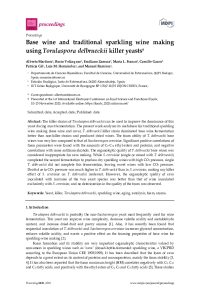
The killer strains of Torulaspora delbrueckii can be used to improve the dominance of this yeast during must fermentation. The present work analyzes its usefulness for traditional sparkling wine making (base wine and cava). T. delbrueckii killer strain dominated base wine fermentation better than non-killer strains and produced dried wines. The foam ability of T. delbrueckii base wines was very low compared to that of Saccharomyces cerevisiae. Significant positive correlations of foam parameters were found with the amounts of C4-C16 ethyl esters and proteins, and negative correlations with some antifoam alcohols. The organoleptic quality of T. delbrueckii base wines was considered inappropriate for cava making. While S. cerevisiae (alone or mixed with T. delbrueckii) completed the second fermentation to produce dry sparkling wines with high CO2 pressure, T. delbrueckii alone did not complete this fermentation, leaving sweet wines with low CO2 pressure. Death due to CO2 pressure was much higher in T. delbrueckii than in S. cerevisiae, making any killer effect of S. cerevisiae on T. delbrueckii irrelevant. However, the organoleptic quality of cava inoculated with mixtures of the two yeast species was better than that of wine inoculated exclusively with S. cerevisiae, and no deterioration in the quality of the foam was observed.
Keywords
Yeast
killer
Torulaspora delbrueckii
sparkling wine
aging
autolysis
foam
aroma.
Manuscript
sciforum_034950.pdf
Poster
sciforum-Base wine and traditional sparkling wine making using Torulaspora delbrueckii killer yeasts.pdf
Multiple SERS detection of phenol derivatives in tap water
Applying nanotechnology to okara for developing soy protein gel-based foods