Event submissions
EventsThe 1st International Electronic Conference on Forests — Forests for a Better Future: Sustainability, Innovation, Interdisciplinarity
Published

This submission belongs to the session S8. Posters of the event The 1st International Electronic Conference on Forests — Forests for a Better Future: Sustainability, Innovation, Interdisciplinarity
Published date
10 Nov, 2020
Citation
Janine Schweier, Stephan Zimmermann, Timothy Thrippleton, Stefan Holm, Golo Stadelmann, Daniel Kurz, Fritz Frutig, Nutrient Sustainability in Swiss wood extraction, in Proceedings of The 1st International Electronic Conference on Forests — Forests for a Better Future: Sustainability, Innovation, Interdisciplinarity, 15 November–30 November 2020, MDPI: Basel, Switzerland, doi: 10.3390/IECF2020-07764
Share
Email
Facebook
Twitter
LinkedIn
Nutrient Sustainability in Swiss wood extraction

Janine Schweier 1
'%3e%3cpath%20d='M12.6647%2010.9104C12.4176%2010.325%2012.0589%209.7933%2011.6088%209.34485C11.16%208.89511%2010.6283%208.53653%2010.0432%208.28891C10.038%208.28629%2010.0327%208.28498%2010.0275%208.28236C10.8437%207.69282%2011.3743%206.73252%2011.3743%205.64907C11.3743%203.85423%209.92005%202.40002%208.12522%202.40002C6.33038%202.40002%204.87618%203.85423%204.87618%205.64907C4.87618%206.73252%205.40677%207.69282%206.22296%208.28367C6.21772%208.28629%206.21248%208.2876%206.20724%208.29022C5.62031%208.53783%205.09365%208.89287%204.64167%209.34616C4.19192%209.79496%203.83334%2010.3266%203.58573%2010.9117C3.34247%2011.4846%203.21128%2012.0987%203.19925%2012.721C3.1989%2012.735%203.20135%2012.7489%203.20646%2012.7619C3.21157%2012.7749%203.21924%2012.7868%203.22901%2012.7968C3.23877%2012.8068%203.25045%2012.8148%203.26334%2012.8202C3.27623%2012.8256%203.29007%2012.8284%203.30406%2012.8284H4.09012C4.14776%2012.8284%204.19362%2012.7825%204.19493%2012.7262C4.22113%2011.7148%204.62726%2010.7676%205.34519%2010.0497C6.08802%209.30686%207.07452%208.89811%208.12522%208.89811C9.17592%208.89811%2010.1624%209.30686%2010.9052%2010.0497C11.6232%2010.7676%2012.0293%2011.7148%2012.0555%2012.7262C12.0568%2012.7839%2012.1027%2012.8284%2012.1603%2012.8284H12.9464C12.9604%2012.8284%2012.9742%2012.8256%2012.9871%2012.8202C13%2012.8148%2013.0117%2012.8068%2013.0214%2012.7968C13.0312%2012.7868%2013.0389%2012.7749%2013.044%2012.7619C13.0491%2012.7489%2013.0515%2012.735%2013.0512%2012.721C13.0381%2012.0947%2012.9084%2011.4856%2012.6647%2010.9104ZM8.12522%207.90243C7.52388%207.90243%206.95792%207.66793%206.53214%207.24215C6.10636%206.81636%205.87185%206.2504%205.87185%205.64907C5.87185%205.04773%206.10636%204.48177%206.53214%204.05599C6.95792%203.63021%207.52388%203.3957%208.12522%203.3957C8.72655%203.3957%209.29252%203.63021%209.7183%204.05599C10.1441%204.48177%2010.3786%205.04773%2010.3786%205.64907C10.3786%206.2504%2010.1441%206.81636%209.7183%207.24215C9.29252%207.66793%208.72655%207.90243%208.12522%207.90243Z'%20fill='%235D1EE1'/%3e%3c/g%3e%3c/svg%3e)
Stephan Zimmermann 1
Timothy Thrippleton 1
Stefan Holm 1
Golo Stadelmann 1
Daniel Kurz 2
Fritz Frutig 1
1. Swiss Federal Institute for Forest, Snow and Landscape Research (WSL)
2. EKG-Geo Science
Abstract
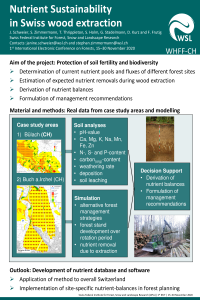
We here present the approach to be implemented in the frame of a Swiss research project that recently started (July 2020). The overall aim is to protect the forest soil fertility and biodiversity. When choosing an extraction method, the nutrient storage of a respective forest stand should be considered in order to prevent the exploitation of the site-specific nutrient pool. This topic is timely because full-tree harvesting for energetic purposes increased continuously in the last years. In addition, summer logging in foliage state is under discussion due to the climate change that increasingly reduces the winter harvesting periods. We aim to determine the current nutrient pools of different Swiss forest sites by conducting comprehensive soil analyses considering pH-value, exchangeable nutrient cations (Ca, Mg, K, Na, Mn, Fe, Zn), as well as contents of nitrogen, sulfur, phosphorus and carbon(org). Furthermore, nutrient fluxes like weathering rate, deposition and soil leaching are considered. Resulting site-specific data are combined with expected nutrient removals over one rotation period depending on tree species composition, forest stand development and extraction methods. In the frame of this project, two case studies will be implemented in beech woodland stands on sediments of the early and late Pleistocene serving as a data basis to calculate nutrient balances and to formulate management recommendations. In the long-term, we aim to apply this method to overall Switzerland and develop a software that allows an automatically calculation of site-specific nutrient-balances in order to support future forest management planning and decision-making processes.
Keywords
nutrient balance
soil fertility
weathering rate
deposition
soil leaching
full-tree harvesting
energy wood
nutrient removal
forest management planning
Manuscript
IEFC_2020_BuNaeNa_Projektvorstellung_Abstract.pdf
Poster
IEFC_2020_BuNaeNa_Projektvorstellung_Poster.pdf
Long-Term Wood Micro-Density Variation in Alpine Forests at Central Mexico and Their Spatial Links with Remotely Sensed Information
EFFECTS OF MICROWAVE DRYING ON MOISTURE CONTENT DEPENDING ON WOOD CHIP SIZE DISTRIBUTION