Event submissions
EventsThe 1st International Electronic Conference on Forests — Forests for a Better Future: Sustainability, Innovation, Interdisciplinarity
Published

This submission belongs to the session S8. Posters of the event The 1st International Electronic Conference on Forests — Forests for a Better Future: Sustainability, Innovation, Interdisciplinarity
Published date
10 Nov, 2020
Citation
Tamás Hofmann, Levente Albert, Balázs Bocz, Dániel Bocz, Eszter Visi-Rajczi, Coniferous cones as a forestry waste biomass - a source of antioxidants, in Proceedings of The 1st International Electronic Conference on Forests — Forests for a Better Future: Sustainability, Innovation, Interdisciplinarity, 15 November–30 November 2020, MDPI: Basel, Switzerland, doi: 10.3390/IECF2020-07766
Share
Email
Facebook
Twitter
LinkedIn
Coniferous cones as a forestry waste biomass - a source of antioxidants

Tamás Hofmann 1
'%3e%3cpath%20d='M12.6647%2010.9104C12.4176%2010.325%2012.0589%209.7933%2011.6088%209.34485C11.16%208.89511%2010.6283%208.53653%2010.0432%208.28891C10.038%208.28629%2010.0327%208.28498%2010.0275%208.28236C10.8437%207.69282%2011.3743%206.73252%2011.3743%205.64907C11.3743%203.85423%209.92005%202.40002%208.12522%202.40002C6.33038%202.40002%204.87618%203.85423%204.87618%205.64907C4.87618%206.73252%205.40677%207.69282%206.22296%208.28367C6.21772%208.28629%206.21248%208.2876%206.20724%208.29022C5.62031%208.53783%205.09365%208.89287%204.64167%209.34616C4.19192%209.79496%203.83334%2010.3266%203.58573%2010.9117C3.34247%2011.4846%203.21128%2012.0987%203.19925%2012.721C3.1989%2012.735%203.20135%2012.7489%203.20646%2012.7619C3.21157%2012.7749%203.21924%2012.7868%203.22901%2012.7968C3.23877%2012.8068%203.25045%2012.8148%203.26334%2012.8202C3.27623%2012.8256%203.29007%2012.8284%203.30406%2012.8284H4.09012C4.14776%2012.8284%204.19362%2012.7825%204.19493%2012.7262C4.22113%2011.7148%204.62726%2010.7676%205.34519%2010.0497C6.08802%209.30686%207.07452%208.89811%208.12522%208.89811C9.17592%208.89811%2010.1624%209.30686%2010.9052%2010.0497C11.6232%2010.7676%2012.0293%2011.7148%2012.0555%2012.7262C12.0568%2012.7839%2012.1027%2012.8284%2012.1603%2012.8284H12.9464C12.9604%2012.8284%2012.9742%2012.8256%2012.9871%2012.8202C13%2012.8148%2013.0117%2012.8068%2013.0214%2012.7968C13.0312%2012.7868%2013.0389%2012.7749%2013.044%2012.7619C13.0491%2012.7489%2013.0515%2012.735%2013.0512%2012.721C13.0381%2012.0947%2012.9084%2011.4856%2012.6647%2010.9104ZM8.12522%207.90243C7.52388%207.90243%206.95792%207.66793%206.53214%207.24215C6.10636%206.81636%205.87185%206.2504%205.87185%205.64907C5.87185%205.04773%206.10636%204.48177%206.53214%204.05599C6.95792%203.63021%207.52388%203.3957%208.12522%203.3957C8.72655%203.3957%209.29252%203.63021%209.7183%204.05599C10.1441%204.48177%2010.3786%205.04773%2010.3786%205.64907C10.3786%206.2504%2010.1441%206.81636%209.7183%207.24215C9.29252%207.66793%208.72655%207.90243%208.12522%207.90243Z'%20fill='%235D1EE1'/%3e%3c/g%3e%3c/svg%3e)
Levente Albert 1
Balázs Bocz 1
Dániel Bocz 1

Eszter Visi-Rajczi 1
1. Institute of Chemistry, University of Sopron, Sopron, Hungary
Abstract
The cones of conifers are a waste biomass, potentially be utilized for a variety of purposes, including the extraction of bioactive materials, particularly antioxidant polyphenols. In the present work we conducted a comparative analysis of the antioxidant content of selected taxa that are either common in Hungary or that have not yet been investigated in any great detail (Cedrus atlantica, Larix decidua, Picea abies, Pinus mugo, Pinus nigra, Pinus sylvestris, Pinus wallichiana, Tsuga Canadensis, Tsuga heterophylla, Chamaecyparis lawsoniana, Taxodium distichum, Thuja occidentalis, Metasequoia glyptostroboides, Thuja orientalis, Cryptomeria Japonica, Cunninghamia lanceolata). A comparison of different maturation stages (green, mature, and opened cones) was carried out for the assigned taxa. Folin-Ciocâlteu total phenol content, ferric reducing antioxidant power (FRAP) and 2,2-diphenyl-1-picrylhydrazyl (DPPH) assays were used to assess the antioxidant contents. Total antioxidant power was determined by a scoring system that combined the three assay results. For each taxon the overall best results were found for green cones, followed by mature, and opened cones. Taxa with the highest scores were Tsuga Canadensis, Metasequoia glyptostroboides, Chamaecyparis lawsoniana, Cryptomeria Japonica, Thuja orientalis and Picea abies. High-performance liquid chromatographic/tandem mass spectrometric profiling of the polyphenols was completed for selected samples. Results provide a basis for future bioactivity testing of these samples. The research was supported by the ÚNKP-20-5-12 New National Excellence Program of the Ministry for Innovation and Technology and by the János Bolyai Research Scholarship of the Hungarian Academy of Sciences.
Keywords
coniferous cones
antioxidants
polyphenols
LCMS
Manuscript
1proceeding Hofmann et al_-1.pdf
Poster
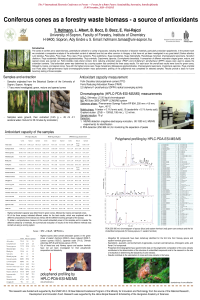
Poszter_IECF 2020_Hofmann et al..pdf
EFFECTS OF MICROWAVE DRYING ON MOISTURE CONTENT DEPENDING ON WOOD CHIP SIZE DISTRIBUTION
Constitutive chemical compounds in different tissues of seven pine species and their relationship with susceptibility to pine-wood nematode (Bursaphelenchus xylophilus).