Event submissions
EventsThe 1st International Electronic Conference on Forests — Forests for a Better Future: Sustainability, Innovation, Interdisciplinarity
Published

This submission belongs to the session S8. Posters of the event The 1st International Electronic Conference on Forests — Forests for a Better Future: Sustainability, Innovation, Interdisciplinarity
Published date
10 Nov, 2020
Citation
Margarita Alonso, María Menéndez, Raquel Díaz, Constitutive chemical compounds in different tissues of seven pine species and their relationship with susceptibility to pine-wood nematode (Bursaphelenchus xylophilus)., in Proceedings of The 1st International Electronic Conference on Forests — Forests for a Better Future: Sustainability, Innovation, Interdisciplinarity, 15 November–30 November 2020, MDPI: Basel, Switzerland, doi: 10.3390/IECF2020-07767
Share
Email
Facebook
Twitter
LinkedIn
Constitutive chemical compounds in different tissues of seven pine species and their relationship with susceptibility to pine-wood nematode (Bursaphelenchus xylophilus).
'%3e%3cpath%20d='M12.6647%2010.9104C12.4176%2010.325%2012.0589%209.7933%2011.6088%209.34485C11.16%208.89511%2010.6283%208.53653%2010.0432%208.28891C10.038%208.28629%2010.0327%208.28498%2010.0275%208.28236C10.8437%207.69282%2011.3743%206.73252%2011.3743%205.64907C11.3743%203.85423%209.92005%202.40002%208.12522%202.40002C6.33038%202.40002%204.87618%203.85423%204.87618%205.64907C4.87618%206.73252%205.40677%207.69282%206.22296%208.28367C6.21772%208.28629%206.21248%208.2876%206.20724%208.29022C5.62031%208.53783%205.09365%208.89287%204.64167%209.34616C4.19192%209.79496%203.83334%2010.3266%203.58573%2010.9117C3.34247%2011.4846%203.21128%2012.0987%203.19925%2012.721C3.1989%2012.735%203.20135%2012.7489%203.20646%2012.7619C3.21157%2012.7749%203.21924%2012.7868%203.22901%2012.7968C3.23877%2012.8068%203.25045%2012.8148%203.26334%2012.8202C3.27623%2012.8256%203.29007%2012.8284%203.30406%2012.8284H4.09012C4.14776%2012.8284%204.19362%2012.7825%204.19493%2012.7262C4.22113%2011.7148%204.62726%2010.7676%205.34519%2010.0497C6.08802%209.30686%207.07452%208.89811%208.12522%208.89811C9.17592%208.89811%2010.1624%209.30686%2010.9052%2010.0497C11.6232%2010.7676%2012.0293%2011.7148%2012.0555%2012.7262C12.0568%2012.7839%2012.1027%2012.8284%2012.1603%2012.8284H12.9464C12.9604%2012.8284%2012.9742%2012.8256%2012.9871%2012.8202C13%2012.8148%2013.0117%2012.8068%2013.0214%2012.7968C13.0312%2012.7868%2013.0389%2012.7749%2013.044%2012.7619C13.0491%2012.7489%2013.0515%2012.735%2013.0512%2012.721C13.0381%2012.0947%2012.9084%2011.4856%2012.6647%2010.9104ZM8.12522%207.90243C7.52388%207.90243%206.95792%207.66793%206.53214%207.24215C6.10636%206.81636%205.87185%206.2504%205.87185%205.64907C5.87185%205.04773%206.10636%204.48177%206.53214%204.05599C6.95792%203.63021%207.52388%203.3957%208.12522%203.3957C8.72655%203.3957%209.29252%203.63021%209.7183%204.05599C10.1441%204.48177%2010.3786%205.04773%2010.3786%205.64907C10.3786%206.2504%2010.1441%206.81636%209.7183%207.24215C9.29252%207.66793%208.72655%207.90243%208.12522%207.90243Z'%20fill='%235D1EE1'/%3e%3c/g%3e%3c/svg%3e)
Margarita Alonso 1
María Menéndez 1
Raquel Díaz 1
1. Centro de Investigación Forestal de Lourizán, Ctra. de Marín, km. 4, 36153 Pontevedra, Spain
Abstract
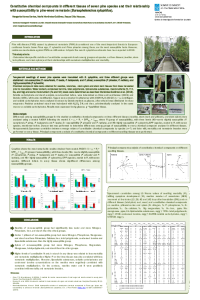
Pine-wilt-disease was detected in Galicia (NW of Spain) in 2010. Two-year-old seedlings of seven pine species were inoculated with B. xylophilus, and three different groups were stablished: non-susceptible (P. canariensis, P. taeda, P. halepensis, and P. pinea); susceptible (P. pinaster, P. radiata), and highly-susceptible (P. sylvestris). We aimed to determine interspecific variation of constitutive compounds levels groups and species, and their relationships with nematode multiplication and mortality.
Needles of non-susceptible group had significantly less water and more Nitrogen, Potassium, Iron, and starch than the others groups; Cortex + phloem of non-susceptible group had more Nitrogen, Phosphorus, Manganese, and Starch and less Potassium, Calcium, Iron, Total polyphenols, Condensed tannins and Liposoluble substances than the highly susceptible group; xylem of non-susceptible group had more N, P, Mg, Mn, Total polyphenols, and Starch than the other groups.
Higher levels of constitutive N and/or Starch in any tissue was related with less mortality and nematode multiplication; Higher P in the three tissues was also correlated with less nematode multiplication. Moreover, Liposoluble substances, Soluble carbohydrates and Condensed tannins concentrations in the needles were negatively correlated with nematode multiplication. On the contrary, needles water and K were positively correlated with mortality and nematode invasion.
Keywords
Pine wilt disease
constitutive defences
susceptibility levels
pine species
chemical compounds.
Manuscript
Constitutive chemical compounds in different tissues of seven pine species and their relationship with susceptibility to pin.pdf
Poster
SCIFORUM 2020_poster M. Alonso_MM.pdf
Coniferous cones as a forestry waste biomass - a source of antioxidants
A QGIS based workflow for optimized cable road layout planning