Event submissions
EventsThe 1st International Electronic Conference on Forests — Forests for a Better Future: Sustainability, Innovation, Interdisciplinarity
Published

This submission belongs to the session S8. Posters of the event The 1st International Electronic Conference on Forests — Forests for a Better Future: Sustainability, Innovation, Interdisciplinarity
Published date
10 Nov, 2020
Citation
Leonardo Enzo Taccari, Paloma Moncaleán, Maria Laura Vélez, Initiation of embryogenic suspensor masses in Austrocedrus chilensis, a vulnerable conifer, in Proceedings of The 1st International Electronic Conference on Forests — Forests for a Better Future: Sustainability, Innovation, Interdisciplinarity, 15 November–30 November 2020, MDPI: Basel, Switzerland, doi: 10.3390/IECF2020-07771
Share
Email
Facebook
Twitter
LinkedIn
Initiation of embryogenic suspensor masses in Austrocedrus chilensis, a vulnerable conifer
'%3e%3cpath%20d='M12.6647%2010.9104C12.4176%2010.325%2012.0589%209.7933%2011.6088%209.34485C11.16%208.89511%2010.6283%208.53653%2010.0432%208.28891C10.038%208.28629%2010.0327%208.28498%2010.0275%208.28236C10.8437%207.69282%2011.3743%206.73252%2011.3743%205.64907C11.3743%203.85423%209.92005%202.40002%208.12522%202.40002C6.33038%202.40002%204.87618%203.85423%204.87618%205.64907C4.87618%206.73252%205.40677%207.69282%206.22296%208.28367C6.21772%208.28629%206.21248%208.2876%206.20724%208.29022C5.62031%208.53783%205.09365%208.89287%204.64167%209.34616C4.19192%209.79496%203.83334%2010.3266%203.58573%2010.9117C3.34247%2011.4846%203.21128%2012.0987%203.19925%2012.721C3.1989%2012.735%203.20135%2012.7489%203.20646%2012.7619C3.21157%2012.7749%203.21924%2012.7868%203.22901%2012.7968C3.23877%2012.8068%203.25045%2012.8148%203.26334%2012.8202C3.27623%2012.8256%203.29007%2012.8284%203.30406%2012.8284H4.09012C4.14776%2012.8284%204.19362%2012.7825%204.19493%2012.7262C4.22113%2011.7148%204.62726%2010.7676%205.34519%2010.0497C6.08802%209.30686%207.07452%208.89811%208.12522%208.89811C9.17592%208.89811%2010.1624%209.30686%2010.9052%2010.0497C11.6232%2010.7676%2012.0293%2011.7148%2012.0555%2012.7262C12.0568%2012.7839%2012.1027%2012.8284%2012.1603%2012.8284H12.9464C12.9604%2012.8284%2012.9742%2012.8256%2012.9871%2012.8202C13%2012.8148%2013.0117%2012.8068%2013.0214%2012.7968C13.0312%2012.7868%2013.0389%2012.7749%2013.044%2012.7619C13.0491%2012.7489%2013.0515%2012.735%2013.0512%2012.721C13.0381%2012.0947%2012.9084%2011.4856%2012.6647%2010.9104ZM8.12522%207.90243C7.52388%207.90243%206.95792%207.66793%206.53214%207.24215C6.10636%206.81636%205.87185%206.2504%205.87185%205.64907C5.87185%205.04773%206.10636%204.48177%206.53214%204.05599C6.95792%203.63021%207.52388%203.3957%208.12522%203.3957C8.72655%203.3957%209.29252%203.63021%209.7183%204.05599C10.1441%204.48177%2010.3786%205.04773%2010.3786%205.64907C10.3786%206.2504%2010.1441%206.81636%209.7183%207.24215C9.29252%207.66793%208.72655%207.90243%208.12522%207.90243Z'%20fill='%235D1EE1'/%3e%3c/g%3e%3c/svg%3e)
Leonardo Enzo Taccari 1
Paloma Moncaleán 2
Maria Laura Vélez 3,4,5
1. Laboratorio de semillas‐Instituto de Biotecnología Esquel (INBIES), UNPSJB. Esquel, Chubut, Argentina.
2. Neiker-Tecnalia, Campus Agroalimentario de Arkaute Apdo. 46, 01080 Vitoria-Gasteiz, Spain
3. Centro de Investigación y Extensión Forestal Andino Patagónico (CIEFAP). Esquel, Chubut, Argentina
4. Consejo Nacional de Investigaciones Científicas y Técnicas (CONICET).
5. UNPSJB.
Abstract
Austrocedrus chilensis is a Cupressaceae native to Patagonia. Phytophthora austrocedri is a soil-borne pathogen that causes severe mortality of A. chilensis. Since factors associated with the spread of the disease are difficult to control, propagation and planting of tolerant individuals seems to be the best solution. At present, a micropropagation protocol for Austrocedrus has not been developed. The aim of this study was to contribute to the development of a somatic embryogenesis protocol. The effect of culture medium, collection date and seed family on embryogenic tissue initiation and proliferation in Austrocedrus was analyzed. Immature seeds were collected from selected 11 healthy trees from open pollinated natural stands. Sampling was done every 15 days from the end of December to mid-February 2020. Six media treatment were used: EDM, SH and DCR, supplemented with 3% sucrose, 4.5µM 2,4-dichlorophenoxyacetic acid, 2.2µM benzyladenine, 3g/l gellan gum and a mixture of aminoacids(aa) (EDMaa, SHaa, DCRaa); or the same media but instead of aa it was added 1g/l L-glutamine, 0.5g/l Myoinositol and 1g/l activated charcoal(AC) (EDMglu, SHglu, DCRglu). The best percentages of extrusion were observed from material collected in January 3 and January 22 in EDMaa (12.7%, 52%) and SHaa (7.8%, 67.7%), indicating seed collection time is critical for obtaining a high embryogenic mass initiation. The highest initiation percentages were obtained with seed families 4, 5 and 11 (12, 18.5 and 21.3%, respectively), indicating the initiation process was genotype dependent. As a result, 324 embryogenic callus were obtained. Proliferation was performed in EDMaa and SHaa media with 4.5g/l gellan gum. However, callus proliferated only when previously obtained in EDMglu or SHglu, denoting the importance of AC in the extrusion process. Embryogenic cells lines represented 0.6% of total number of callus. This work is the first report of success in obtaining embryogenic cell lines for A. chilensis.
Keywords
Patagonian cypress
somatic embryogenesis
plant disease resistance
Phytophthora diseases
Manuscript
extended abstract_Word_template_Initiation_SE.pdf
Poster
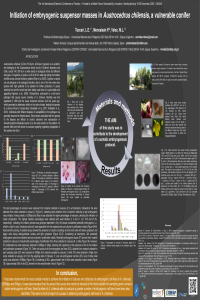
Poster Initiation of embryogenic suspensor masses in Austrocedrus chilensis para subir.pdf
Sustainable Practices in Furniture Design: Can Green Practices Influence Competitiveness?
Effects of the geographical scale in hybrid detection at extensive contact zones between Quercus faginea and Q. pyrenaica.