Event submissions
EventsThe 1st International Electronic Conference on Forests — Forests for a Better Future: Sustainability, Innovation, Interdisciplinarity
Published

This submission belongs to the session S8. Posters of the event The 1st International Electronic Conference on Forests — Forests for a Better Future: Sustainability, Innovation, Interdisciplinarity
Published date
10 Nov, 2020
Citation
Rubén Martín-Sánchez, Santiago Andrés-Sánchez, Teresa Malvar-Ferreras, María Montserrat Martínez-Ortega, Sonia Mediavilla, Effects of the geographical scale in hybrid detection at extensive contact zones between Quercus faginea and Q. pyrenaica., in Proceedings of The 1st International Electronic Conference on Forests — Forests for a Better Future: Sustainability, Innovation, Interdisciplinarity, 15 November–30 November 2020, MDPI: Basel, Switzerland, doi: 10.3390/IECF2020-07772
Share
Email
Facebook
Twitter
LinkedIn
Effects of the geographical scale in hybrid detection at extensive contact zones between Quercus faginea and Q. pyrenaica.
'%3e%3cpath%20d='M12.6647%2010.9104C12.4176%2010.325%2012.0589%209.7933%2011.6088%209.34485C11.16%208.89511%2010.6283%208.53653%2010.0432%208.28891C10.038%208.28629%2010.0327%208.28498%2010.0275%208.28236C10.8437%207.69282%2011.3743%206.73252%2011.3743%205.64907C11.3743%203.85423%209.92005%202.40002%208.12522%202.40002C6.33038%202.40002%204.87618%203.85423%204.87618%205.64907C4.87618%206.73252%205.40677%207.69282%206.22296%208.28367C6.21772%208.28629%206.21248%208.2876%206.20724%208.29022C5.62031%208.53783%205.09365%208.89287%204.64167%209.34616C4.19192%209.79496%203.83334%2010.3266%203.58573%2010.9117C3.34247%2011.4846%203.21128%2012.0987%203.19925%2012.721C3.1989%2012.735%203.20135%2012.7489%203.20646%2012.7619C3.21157%2012.7749%203.21924%2012.7868%203.22901%2012.7968C3.23877%2012.8068%203.25045%2012.8148%203.26334%2012.8202C3.27623%2012.8256%203.29007%2012.8284%203.30406%2012.8284H4.09012C4.14776%2012.8284%204.19362%2012.7825%204.19493%2012.7262C4.22113%2011.7148%204.62726%2010.7676%205.34519%2010.0497C6.08802%209.30686%207.07452%208.89811%208.12522%208.89811C9.17592%208.89811%2010.1624%209.30686%2010.9052%2010.0497C11.6232%2010.7676%2012.0293%2011.7148%2012.0555%2012.7262C12.0568%2012.7839%2012.1027%2012.8284%2012.1603%2012.8284H12.9464C12.9604%2012.8284%2012.9742%2012.8256%2012.9871%2012.8202C13%2012.8148%2013.0117%2012.8068%2013.0214%2012.7968C13.0312%2012.7868%2013.0389%2012.7749%2013.044%2012.7619C13.0491%2012.7489%2013.0515%2012.735%2013.0512%2012.721C13.0381%2012.0947%2012.9084%2011.4856%2012.6647%2010.9104ZM8.12522%207.90243C7.52388%207.90243%206.95792%207.66793%206.53214%207.24215C6.10636%206.81636%205.87185%206.2504%205.87185%205.64907C5.87185%205.04773%206.10636%204.48177%206.53214%204.05599C6.95792%203.63021%207.52388%203.3957%208.12522%203.3957C8.72655%203.3957%209.29252%203.63021%209.7183%204.05599C10.1441%204.48177%2010.3786%205.04773%2010.3786%205.64907C10.3786%206.2504%2010.1441%206.81636%209.7183%207.24215C9.29252%207.66793%208.72655%207.90243%208.12522%207.90243Z'%20fill='%235D1EE1'/%3e%3c/g%3e%3c/svg%3e)
Rubén Martín-Sánchez 1
Santiago Andrés-Sánchez 2,3
Teresa Malvar-Ferreras 3
María Montserrat Martínez-Ortega 2,3
Sonia Mediavilla 1
1. Área de Ecología, Facultad de Biología, Universidad de Salamanca, Campus Miguel de Unamuno s/n, 37007 Salamanca, Spain
2. Área de Botánica, Facultad de Biología, Universidad de Salamanca, Campus Miguel de Unamuno s/n, 37007 Salamanca, Spain.
3. Biobanco ADN Vegetal, banco Nacional de ADN, Salamanca, 37007, Spain.
Abstract
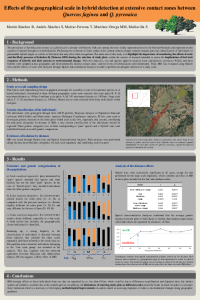
In the present climate change scenario, the question of to what extent horizontal gene flow among interbreeding species is of adaptive value represents an intriguing research topic. The aim of this study is to illustrate the importance of an accurate selection of the study scale for the correct identification of two oak species widely distributed in the Western Mediterranean (Q. faginea and Q. pyrenaica) and their hybrids. To this aim, we selected three plots each representing either an apparent monospecific assembly of one of the parentals or of hybrid individuals (through visual identification), distributed at three different geographic scales (fine/medium/large). We used AFLPs (Amplified Fragment Length Polymorphism) to investigate species limits and population structure through multivariate and Bayesian methods. In a first step, the three plots corresponding to each geographical scale level were analyzed separately, to be then treated as a unique data set in a second step. The obtained results revealed incongruence between both approaches and strong effects of scale. We then tested for spatial autocorrelation through Mantel tests and encountered that our data taken altogether show a pattern of isolation by distance. A subsequent Spatial Autocorrelation Analyses confirmed that the average genetic distance between pairs of individuals is smaller than random expectations when individuals are separated by distances <65 km. Although aware of the fact that our study represents just a preliminary approach, we demonstrate: (i) to our knowledge, for the first time, that introgressive homoploid hybridization is active and has historically modelled the evolution of the studied taxa; (ii) the necessity of including methodological improvements that may allow overcoming the limitations of assigning individuals to genetic categories when study-plots are selected for studies aimed to evaluate responses of oaks to environmental changes along geographic gradients.
Keywords
AFLPs
hybridization
population genetic structure
Quercus faginea
Quercus pyrenaica
spatial autocorrelation
Manuscript
Abstract_IECF_2020.pdf
Poster
Poster Effects of the geographical scale in hybrid detection at extensive contact zones between Quercus faginea and Q.pyrenaica.pdf
Initiation of embryogenic suspensor masses in Austrocedrus chilensis, a vulnerable conifer
The use of microsatelliets markers in molecular characteristisc of hybrids between Pulsatilla species