Event submissions
EventsThe 1st International Electronic Conference on Forests — Forests for a Better Future: Sustainability, Innovation, Interdisciplinarity
Published

This submission belongs to the session S8. Posters of the event The 1st International Electronic Conference on Forests — Forests for a Better Future: Sustainability, Innovation, Interdisciplinarity
Published date
10 Nov, 2020
Citation
Leo Bont, Laura Ramstein, Friedrich Frutig, Janine Schweier, Validation of catenary based methods for cable road layout planning, in Proceedings of The 1st International Electronic Conference on Forests — Forests for a Better Future: Sustainability, Innovation, Interdisciplinarity, 15 November–30 November 2020, MDPI: Basel, Switzerland, doi: 10.3390/IECF2020-07775
Share
Email
Facebook
Twitter
LinkedIn
Validation of catenary based methods for cable road layout planning
'%3e%3cpath%20d='M12.6647%2010.9104C12.4176%2010.325%2012.0589%209.7933%2011.6088%209.34485C11.16%208.89511%2010.6283%208.53653%2010.0432%208.28891C10.038%208.28629%2010.0327%208.28498%2010.0275%208.28236C10.8437%207.69282%2011.3743%206.73252%2011.3743%205.64907C11.3743%203.85423%209.92005%202.40002%208.12522%202.40002C6.33038%202.40002%204.87618%203.85423%204.87618%205.64907C4.87618%206.73252%205.40677%207.69282%206.22296%208.28367C6.21772%208.28629%206.21248%208.2876%206.20724%208.29022C5.62031%208.53783%205.09365%208.89287%204.64167%209.34616C4.19192%209.79496%203.83334%2010.3266%203.58573%2010.9117C3.34247%2011.4846%203.21128%2012.0987%203.19925%2012.721C3.1989%2012.735%203.20135%2012.7489%203.20646%2012.7619C3.21157%2012.7749%203.21924%2012.7868%203.22901%2012.7968C3.23877%2012.8068%203.25045%2012.8148%203.26334%2012.8202C3.27623%2012.8256%203.29007%2012.8284%203.30406%2012.8284H4.09012C4.14776%2012.8284%204.19362%2012.7825%204.19493%2012.7262C4.22113%2011.7148%204.62726%2010.7676%205.34519%2010.0497C6.08802%209.30686%207.07452%208.89811%208.12522%208.89811C9.17592%208.89811%2010.1624%209.30686%2010.9052%2010.0497C11.6232%2010.7676%2012.0293%2011.7148%2012.0555%2012.7262C12.0568%2012.7839%2012.1027%2012.8284%2012.1603%2012.8284H12.9464C12.9604%2012.8284%2012.9742%2012.8256%2012.9871%2012.8202C13%2012.8148%2013.0117%2012.8068%2013.0214%2012.7968C13.0312%2012.7868%2013.0389%2012.7749%2013.044%2012.7619C13.0491%2012.7489%2013.0515%2012.735%2013.0512%2012.721C13.0381%2012.0947%2012.9084%2011.4856%2012.6647%2010.9104ZM8.12522%207.90243C7.52388%207.90243%206.95792%207.66793%206.53214%207.24215C6.10636%206.81636%205.87185%206.2504%205.87185%205.64907C5.87185%205.04773%206.10636%204.48177%206.53214%204.05599C6.95792%203.63021%207.52388%203.3957%208.12522%203.3957C8.72655%203.3957%209.29252%203.63021%209.7183%204.05599C10.1441%204.48177%2010.3786%205.04773%2010.3786%205.64907C10.3786%206.2504%2010.1441%206.81636%209.7183%207.24215C9.29252%207.66793%208.72655%207.90243%208.12522%207.90243Z'%20fill='%235D1EE1'/%3e%3c/g%3e%3c/svg%3e)
Leo Bont 1
Laura Ramstein 1
Friedrich Frutig 1

Janine Schweier 1
1. WSL
Abstract
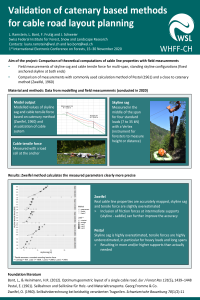
Cable-based technologies have been a backbone for harvesting on steep slopes. Computing the layout of a single cable road requires considering the standards of structural design, aiming to (1) guarantee structural safety, and (2) provide the required serviceability. Currently applied analysis methods, such as the Pestal method are unprecise. Alternatively, methods based on the catenary, such as Zweifel or Irvine are better suited to analyze and predict load path and occurring forces for skylines anchored fix on both ends. However, studies that validate those catenary analyses (concurrently load path and forces) are rare and were not carried out under realistic heavy load conditions. Therefore, the aim of the project was to validate the catenary analyses under realistic, heavy load conditions for cable roads with multiple spans. In two case studies in Switzerland the deflection in every span as well as the skyline tensile force at the anchor were measured for different load configurations and compared with theoretical computations of Zweifel and Pestal.
The approach of Zweifel maps the mechanical properties realistic. However, as proven by our measurements, he slightly overestimated the deflection and the skyline tensile forces because the friction on the supports was neglected (between skyline and saddle). The deflections calculated with the Pestal formulas were significantly larger than the measured values, in particular with heavy load and in large spans. Our measurement studies confirmed that the mechanical properties of a cable road can be described adequately with the algorithm by Zweifel. However, it should be further developed with inclusion of effects like the friction to improve the efficiency, safety and cost-performance ratio in cable road planning.
Keywords
cable line layout
catenary based methods
deflection
cable tensile force
forest management planning
Manuscript
IECF_2020_Durchhang_Projektvorstellung_Abstract_Revision.pdf
Poster
IECF_2020_Poster_Ramstein.pdf
Migration and multiplication of pathogenic Bursaphelenchus xylophilus isolates of diverse geographic origins
Comparison of microsatellites and SNP markers in genetic diversity level of two Scots pine stands