Event submissions
EventsThe 1st International Electronic Conference on Forests — Forests for a Better Future: Sustainability, Innovation, Interdisciplinarity
Published

This submission belongs to the session S8. Posters of the event The 1st International Electronic Conference on Forests — Forests for a Better Future: Sustainability, Innovation, Interdisciplinarity
Published date
10 Nov, 2020
Citation
Anna Tereba, Agata Konecka, Comparison of microsatellites and SNP markers in genetic diversity level of two Scots pine stands, in Proceedings of The 1st International Electronic Conference on Forests — Forests for a Better Future: Sustainability, Innovation, Interdisciplinarity, 15 November–30 November 2020, MDPI: Basel, Switzerland, doi: 10.3390/IECF2020-07776
Share
Email
Facebook
Twitter
LinkedIn
Comparison of microsatellites and SNP markers in genetic diversity level of two Scots pine stands
'%3e%3cpath%20d='M12.6647%2010.9104C12.4176%2010.325%2012.0589%209.7933%2011.6088%209.34485C11.16%208.89511%2010.6283%208.53653%2010.0432%208.28891C10.038%208.28629%2010.0327%208.28498%2010.0275%208.28236C10.8437%207.69282%2011.3743%206.73252%2011.3743%205.64907C11.3743%203.85423%209.92005%202.40002%208.12522%202.40002C6.33038%202.40002%204.87618%203.85423%204.87618%205.64907C4.87618%206.73252%205.40677%207.69282%206.22296%208.28367C6.21772%208.28629%206.21248%208.2876%206.20724%208.29022C5.62031%208.53783%205.09365%208.89287%204.64167%209.34616C4.19192%209.79496%203.83334%2010.3266%203.58573%2010.9117C3.34247%2011.4846%203.21128%2012.0987%203.19925%2012.721C3.1989%2012.735%203.20135%2012.7489%203.20646%2012.7619C3.21157%2012.7749%203.21924%2012.7868%203.22901%2012.7968C3.23877%2012.8068%203.25045%2012.8148%203.26334%2012.8202C3.27623%2012.8256%203.29007%2012.8284%203.30406%2012.8284H4.09012C4.14776%2012.8284%204.19362%2012.7825%204.19493%2012.7262C4.22113%2011.7148%204.62726%2010.7676%205.34519%2010.0497C6.08802%209.30686%207.07452%208.89811%208.12522%208.89811C9.17592%208.89811%2010.1624%209.30686%2010.9052%2010.0497C11.6232%2010.7676%2012.0293%2011.7148%2012.0555%2012.7262C12.0568%2012.7839%2012.1027%2012.8284%2012.1603%2012.8284H12.9464C12.9604%2012.8284%2012.9742%2012.8256%2012.9871%2012.8202C13%2012.8148%2013.0117%2012.8068%2013.0214%2012.7968C13.0312%2012.7868%2013.0389%2012.7749%2013.044%2012.7619C13.0491%2012.7489%2013.0515%2012.735%2013.0512%2012.721C13.0381%2012.0947%2012.9084%2011.4856%2012.6647%2010.9104ZM8.12522%207.90243C7.52388%207.90243%206.95792%207.66793%206.53214%207.24215C6.10636%206.81636%205.87185%206.2504%205.87185%205.64907C5.87185%205.04773%206.10636%204.48177%206.53214%204.05599C6.95792%203.63021%207.52388%203.3957%208.12522%203.3957C8.72655%203.3957%209.29252%203.63021%209.7183%204.05599C10.1441%204.48177%2010.3786%205.04773%2010.3786%205.64907C10.3786%206.2504%2010.1441%206.81636%209.7183%207.24215C9.29252%207.66793%208.72655%207.90243%208.12522%207.90243Z'%20fill='%235D1EE1'/%3e%3c/g%3e%3c/svg%3e)
Anna Tereba 1
Agata Konecka 2
1. Department of Forest Ecology, Forest Research Institute, 3 Braci Leśnej St., 05-090 Sękocin Stary
2. Faculty of Forestry, Agriculture University, Nowoursynowska st. 159, 02-776 Warsaw
Abstract
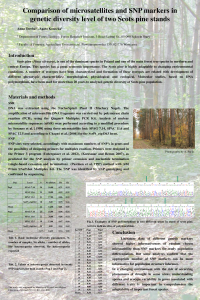
Scots pine (Pinus silvestris), is one of the dominant species in Poland and one of the main forest tree species in northern and central Europe. This species is of great economic importance. The Scots pine is highly adaptable to changing environmental conditions. A number of ecotypes have been characterized and formation of these ecotypes are related with development of different phenotypic characteristics: morphological, physiological and ecological. Molecular studies, based on DNA polymorphism, have been used for more than 20 years to analyzed genetic diversity of Scots pine population. The most popular are microsatellite markers due to the fact of wide availability and high polymorphism. However, the use of these markers is also associated with certain limitations: due to complex mutation models or high incidence of homoplasia. These features are prompting scientists to look for alternative types of markers such as for example SNP. In our study we conducted a comparison of the basic parameters of genetic variability of two Scots pine stands (25 and 24 trees in each) for 20 SNP markers and 4 microsatellite markers. For the 20 SNP loci the observed heterozygosity (Ho) was equal 0,34 for both stands and the expected heterozygosity (He) for the first stand was equal 0,34 and for the second 0,37. No statistical significant genetic distance was observed between them. For the microsatellite markers observed heterozygosity (Ho) was 0,81 and 0,74 and the expected heterozygosity (He) was equal 0,85 and 0,85 respectively for stands and similarly no statistical significant genetic distance was observed.
Literature data of different genetic markers showed higher informativeness of random chosen microsatellite than SNP markers for study population differentiation. But some analyzes confirm that the appropriate number of SNP markers can be more informative for population structure inference.
Keywords
SNP markers
microsatellites
Pinus silvestris
genetic diversity
Manuscript
A.Tereba abstract.pdf
Poster
A.Tereba, poster.pdf
Validation of catenary based methods for cable road layout planning
INFLUENCE OF SELECTED MATERIAL AND PROCESS PARAMETERS ON THE DURABILITY OF BRIQUETTES FROM SHREDDED LOGGING RESIDUES