Event submissions
EventsThe 1st International Electronic Conference on Forests — Forests for a Better Future: Sustainability, Innovation, Interdisciplinarity
Published

This submission belongs to the session S8. Posters of the event The 1st International Electronic Conference on Forests — Forests for a Better Future: Sustainability, Innovation, Interdisciplinarity
Published date
10 Nov, 2020
Citation
Meena Choudhary, Ashok Gehlot, Sarita Arya, Inder Dev Arya, Effect of genotypes on micropropagation of Terminalia arjuna – an important medicinal tree, in Proceedings of The 1st International Electronic Conference on Forests — Forests for a Better Future: Sustainability, Innovation, Interdisciplinarity, 15 November–30 November 2020, MDPI: Basel, Switzerland, doi: 10.3390/IECF2020-07778
Share
Email
Facebook
Twitter
LinkedIn
Effect of genotypes on micropropagation of Terminalia arjuna – an important medicinal tree
'%3e%3cpath%20d='M12.6647%2010.9104C12.4176%2010.325%2012.0589%209.7933%2011.6088%209.34485C11.16%208.89511%2010.6283%208.53653%2010.0432%208.28891C10.038%208.28629%2010.0327%208.28498%2010.0275%208.28236C10.8437%207.69282%2011.3743%206.73252%2011.3743%205.64907C11.3743%203.85423%209.92005%202.40002%208.12522%202.40002C6.33038%202.40002%204.87618%203.85423%204.87618%205.64907C4.87618%206.73252%205.40677%207.69282%206.22296%208.28367C6.21772%208.28629%206.21248%208.2876%206.20724%208.29022C5.62031%208.53783%205.09365%208.89287%204.64167%209.34616C4.19192%209.79496%203.83334%2010.3266%203.58573%2010.9117C3.34247%2011.4846%203.21128%2012.0987%203.19925%2012.721C3.1989%2012.735%203.20135%2012.7489%203.20646%2012.7619C3.21157%2012.7749%203.21924%2012.7868%203.22901%2012.7968C3.23877%2012.8068%203.25045%2012.8148%203.26334%2012.8202C3.27623%2012.8256%203.29007%2012.8284%203.30406%2012.8284H4.09012C4.14776%2012.8284%204.19362%2012.7825%204.19493%2012.7262C4.22113%2011.7148%204.62726%2010.7676%205.34519%2010.0497C6.08802%209.30686%207.07452%208.89811%208.12522%208.89811C9.17592%208.89811%2010.1624%209.30686%2010.9052%2010.0497C11.6232%2010.7676%2012.0293%2011.7148%2012.0555%2012.7262C12.0568%2012.7839%2012.1027%2012.8284%2012.1603%2012.8284H12.9464C12.9604%2012.8284%2012.9742%2012.8256%2012.9871%2012.8202C13%2012.8148%2013.0117%2012.8068%2013.0214%2012.7968C13.0312%2012.7868%2013.0389%2012.7749%2013.044%2012.7619C13.0491%2012.7489%2013.0515%2012.735%2013.0512%2012.721C13.0381%2012.0947%2012.9084%2011.4856%2012.6647%2010.9104ZM8.12522%207.90243C7.52388%207.90243%206.95792%207.66793%206.53214%207.24215C6.10636%206.81636%205.87185%206.2504%205.87185%205.64907C5.87185%205.04773%206.10636%204.48177%206.53214%204.05599C6.95792%203.63021%207.52388%203.3957%208.12522%203.3957C8.72655%203.3957%209.29252%203.63021%209.7183%204.05599C10.1441%204.48177%2010.3786%205.04773%2010.3786%205.64907C10.3786%206.2504%2010.1441%206.81636%209.7183%207.24215C9.29252%207.66793%208.72655%207.90243%208.12522%207.90243Z'%20fill='%235D1EE1'/%3e%3c/g%3e%3c/svg%3e)
Meena Choudhary 1
Ashok Gehlot 1
Sarita Arya 1
Inder Dev Arya 1
1. Genetics and Tree Improvement Division, Arid Forest Research Institute, Jodhpur-342005, Rajasthan, India
Abstract
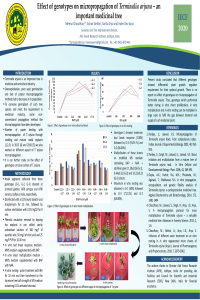
Terminalia arjuna is an important tree of medicinal and sericulture industry, commonly known as Arjun. It’s bark rich in secondary metabolites makes this plant highly valuable in medicine industry to treat cardiovascular disease. It is also used as feeder plant for tasar silkworm (Antheraea mylitta). Over exploitation due to high demand in medicine, low seed germination, limitations of conventional method of propagation push this plant towards being endangered. To conserve germplasm of such tree species and meet the requirement in medicinal industry, some non-conventional propagation method like micropropagation have been developed. The present work highlighted the effect of genotypes on tissue culture of T. arjuna. For this objective, nodal explants were collected from three genotypes (G-1, G-2 and G-3) of T. arjuna situated at Jodhpur, Rajasthan, India. In vitro shoot proliferation was achieved on modified MS medium enriched with BAP + additives. Genotype -1 showed maximum bud break response (100%) followed by G-3 (93.33 %) and G-2 (86.66%). Further multiplication of these shoots on modified MS medium containing BAP + NAA + additives gave 11.38±0.26 (G-1), 9.44±0.21 (G-2) and 10.22±0.32 (G-3) shoots. In vitro rooting was done by pulse treatment with IBA for 10 min prior to transfer on hormone free half strength MS medium containing 0.1% activated charcoal. Maximum in vitro rooting was obtained in G-1 (80%) followed by G-3 (71.11%) and G-2 (68.88%). In present study it was observed that optimum growth in all three genotypes require different dose of Plant Growth Regulator. Thus, by identifying and multiplying the best performing genotypes the gap between demand and supply of such medicinal plant can be fulfilled.
Keywords
tissue culture
modified MS medium
Plant Growth Regulator
Manuscript
forest conference 2020.pdf
Poster
TERMINALIA PPOSTER.pdf
INFLUENCE OF SELECTED MATERIAL AND PROCESS PARAMETERS ON THE DURABILITY OF BRIQUETTES FROM SHREDDED LOGGING RESIDUES
Assessment of leaf litter decomposition in a pine and beech mixed forest: case study in northern Spain