Event submissions
Published

This submission belongs to the session F. Round Table on Viral Infections of the event 6th International Electronic Conference on Medicinal Chemistry
Published date
10 Nov, 2020
Citation
Alpana Bastikar, Virupaksha Bastikar, Santosh Chhajed, PramodKumar Gupta, Targeting SARS-CoV2 Main Protease using HTVS and simulation analysis: A drug repurposing approach against COVID-19, in Proceedings of 6th International Electronic Conference on Medicinal Chemistry, 1 November–30 November 2020, MDPI: Basel, Switzerland, doi: 10.3390/ECMC2020-07803
Share
Email
Facebook
Twitter
LinkedIn
Targeting SARS-CoV2 Main Protease using HTVS and simulation analysis: A drug repurposing approach against COVID-19
'%3e%3cpath%20d='M12.6647%2010.9104C12.4176%2010.325%2012.0589%209.7933%2011.6088%209.34485C11.16%208.89511%2010.6283%208.53653%2010.0432%208.28891C10.038%208.28629%2010.0327%208.28498%2010.0275%208.28236C10.8437%207.69282%2011.3743%206.73252%2011.3743%205.64907C11.3743%203.85423%209.92005%202.40002%208.12522%202.40002C6.33038%202.40002%204.87618%203.85423%204.87618%205.64907C4.87618%206.73252%205.40677%207.69282%206.22296%208.28367C6.21772%208.28629%206.21248%208.2876%206.20724%208.29022C5.62031%208.53783%205.09365%208.89287%204.64167%209.34616C4.19192%209.79496%203.83334%2010.3266%203.58573%2010.9117C3.34247%2011.4846%203.21128%2012.0987%203.19925%2012.721C3.1989%2012.735%203.20135%2012.7489%203.20646%2012.7619C3.21157%2012.7749%203.21924%2012.7868%203.22901%2012.7968C3.23877%2012.8068%203.25045%2012.8148%203.26334%2012.8202C3.27623%2012.8256%203.29007%2012.8284%203.30406%2012.8284H4.09012C4.14776%2012.8284%204.19362%2012.7825%204.19493%2012.7262C4.22113%2011.7148%204.62726%2010.7676%205.34519%2010.0497C6.08802%209.30686%207.07452%208.89811%208.12522%208.89811C9.17592%208.89811%2010.1624%209.30686%2010.9052%2010.0497C11.6232%2010.7676%2012.0293%2011.7148%2012.0555%2012.7262C12.0568%2012.7839%2012.1027%2012.8284%2012.1603%2012.8284H12.9464C12.9604%2012.8284%2012.9742%2012.8256%2012.9871%2012.8202C13%2012.8148%2013.0117%2012.8068%2013.0214%2012.7968C13.0312%2012.7868%2013.0389%2012.7749%2013.044%2012.7619C13.0491%2012.7489%2013.0515%2012.735%2013.0512%2012.721C13.0381%2012.0947%2012.9084%2011.4856%2012.6647%2010.9104ZM8.12522%207.90243C7.52388%207.90243%206.95792%207.66793%206.53214%207.24215C6.10636%206.81636%205.87185%206.2504%205.87185%205.64907C5.87185%205.04773%206.10636%204.48177%206.53214%204.05599C6.95792%203.63021%207.52388%203.3957%208.12522%203.3957C8.72655%203.3957%209.29252%203.63021%209.7183%204.05599C10.1441%204.48177%2010.3786%205.04773%2010.3786%205.64907C10.3786%206.2504%2010.1441%206.81636%209.7183%207.24215C9.29252%207.66793%208.72655%207.90243%208.12522%207.90243Z'%20fill='%235D1EE1'/%3e%3c/g%3e%3c/svg%3e)
Alpana Bastikar 1
Virupaksha Bastikar 2
Santosh Chhajed 3

PramodKumar Gupta 4
1. NSRT
2. Amity University, Maharashtra
3. MET College of Pharmacy
4. D Y Patil University, Navi Mumbai
Abstract
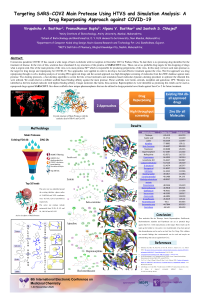
Coronavirus pandemic COVID-19 has caused a wide range of harm worldwide with its inception in December 2019 in Wuhan, China. To date, there is no promising drug identified for the treatment of the disease. In view of this, scientists have elucidated X-ray structures of the proteins in the SARS-CoV 2 virus. These can act as probable drug targets for the design of drugs ,what is an urgent need. One of the main proteins of the virus is its main protease Mpro, which is responsible for producing polyproteins of the virus. In this study, we have used the main protease as the target for drug design and repurposing for COVID-19. Two approaches were applied in order to develop a fast and effective treatment against the virus. The first approach was drug repurposing through in silico docking analysis of existing FDA-approved drugs and the second approach was high throughput screening of molecules from the ZINC database against the main protease. Two docking protocols - a fast docking algorithm to screen the hits or lead molecules and simulation-based molecular dynamics docking procedure to optimize the obtained hits were utilized. We could observe a definite scaffold-based binding affinity against the main protease. These scaffolds were lutein, steroids, morphine and quinolone, CPT. Thiotepa was identified as the best-docked molecule with the highest binding affinity. Unique molecules like lutein, beta carotene, Buprenorphine, etc were identified as promising hits, which can be used as repurposed drugs against SARS-CoV 2. Also, these scaffolds show unique pharmacophores that can be utilized to design potential novel leads against SARS-CoV 2 for future treatment.
Keywords
docking
drug repurposing
HTVS
main protease
SARS-CoV 2
simulation
Poster
covid poster.pdf
Novel 11-substituted ellipticines as potent anticancer agents with divergent activity against cancer cells
Isoquinolinequinone N-oxides as anticancer agents effective against drug resistant cell lines